

 99% Purity – Third-Party Tested
 Free U.S. Shipping on Orders $100+
 Proudly Made in the USA
 Fast & Reliable Shipping
 Secure Checkout Guaranteed
Description
What is Teriparatide (PTH 1-34)?
Teriparatide is a synthetic 34-amino-acid peptide that corresponds to the biologically active N-terminal fragment of human parathyroid hormone (PTH). The full-length endogenous hormone contains 84 amino acids; the 1-34 region represents the portion responsible for receptor activation and downstream signaling through the parathyroid hormone receptor type 1 (PTH1R), a class B G protein-coupled receptor. Teriparatide was originally isolated and characterized as the minimal PTH fragment capable of recapitulating the anabolic signaling profile of the full-length hormone in isolated receptor preparation and animal studies.
In research settings, teriparatide has been extensively employed as a pharmacological tool and reference agonist for investigating PTH1R receptor pharmacology, bone remodeling pathway dynamics, and cAMP-dependent intracellular signaling cascades. It has been investigated in preclinical models and isolated cell systems for its role in osteoblast biology, mesenchymal stem cell lineage commitment, RANKL/OPG axis modulation, and calcium homeostasis regulation.
A pharmaceutical formulation of teriparatide is approved by the Food and Drug Administration for specific clinical indications under medical supervision. However, the research-grade teriparatide supplied here is a distinct laboratory preparation produced under research-use-only (RUO) conditions. It is not approved by the FDA for use in this research-grade, non-pharmaceutical form. It is intended strictly for laboratory and research purposes. It is not a dietary supplement, not a pharmaceutical product, and is not supplied for any human application.
Chemical Properties
| Property | Detail |
| Product Type | Synthetic Linear Polypeptide (34 amino acids) |
| Product Name | Teriparatide (PTH 1-34) |
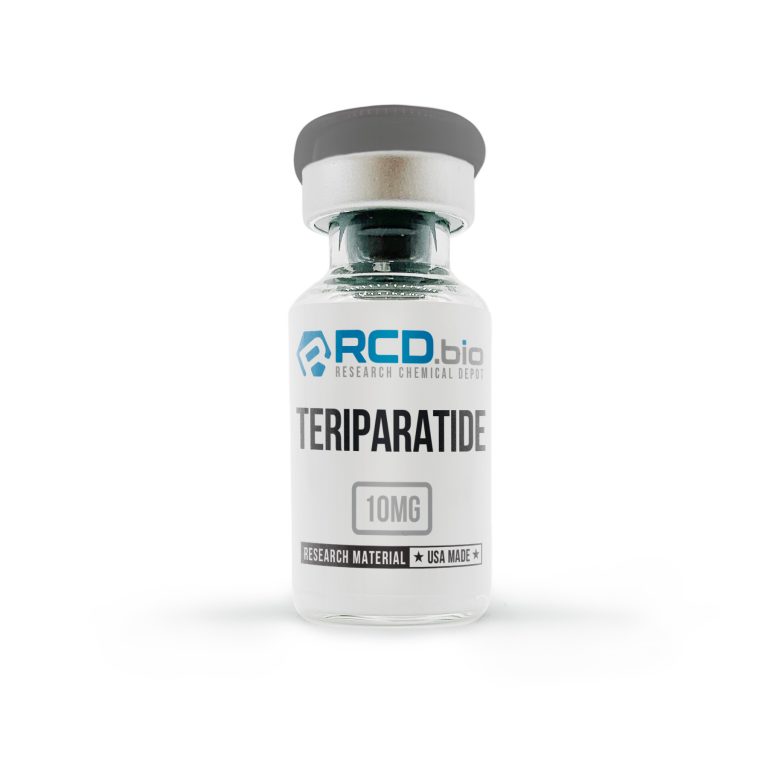
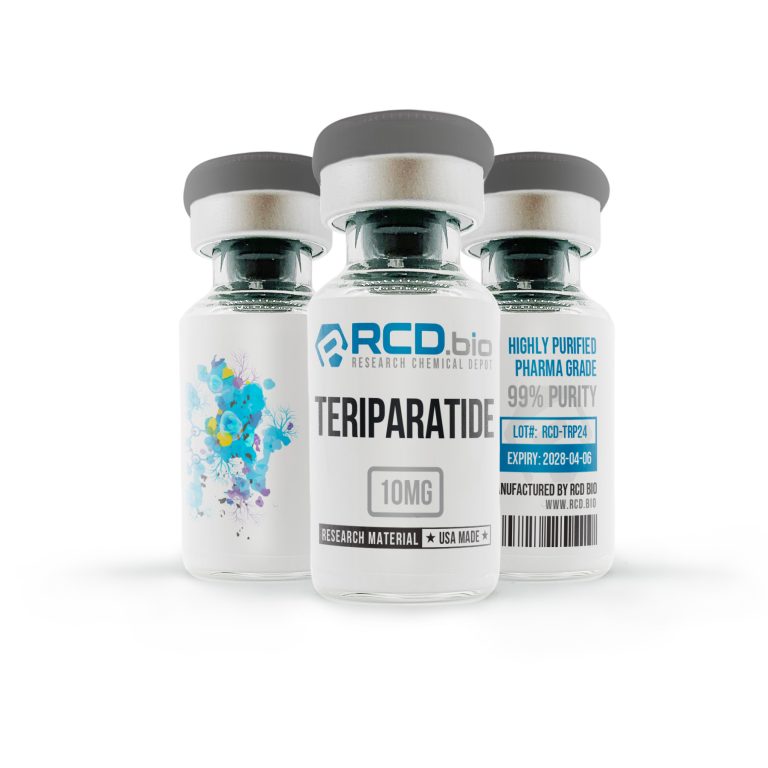
| Format | 10mg Lyophilized Vial |
| Application | Scientific / Research Use Only |
| CAS Number | 52232-67-4 (free peptide); 99294-94-7 (acetate salt form) |
| Molar Mass | 4,117.72 g/mol (free peptide, CAS 52232-67-4) |
| Chemical Formula | C₁₈₁H₂₉₁N₅₅O₅₁S₂ |
| Sequence | H-Ser¹-Val²-Ser³-Glu⁴-Ile⁵-Gln⁶-Leu⁷-Met⁸-His⁹-Asn¹⁰-Leu¹¹-Gly¹²-Lys¹³-His¹⁴-Leu¹⁵-Asn¹⁶-Ser¹⁷-Met¹⁸-Glu¹⁹-Arg²⁰-Val²¹-Glu²²-Trp²³-Leu²⁴-Arg²⁵-Lys²⁶-Lys²⁷-Leu²⁸-Gln²⁹-Asp³⁰-Val³¹-His³²-Asn³³-Phe³⁴-OH |
| IUPAC Name | (Full systematic IUPAC name; see PubChem CID 16132393 for the complete string. Condensed notation: L-tyrosyl-L-alanyl-L-alpha-aspartyl-L-alanyl-L-isoleucyl-L-phenylalanyl-L-threonyl-L-asparagyl-L-seryl-L-tyrosyl-L-arginyl-L-lysyl-L-valyl-L-leucyl-glycyl-L-glutaminyl-L-leucyl-L-seryl-L-alanyl-L-arginyl-L-lysyl-L-leucyl-L-leucyl-L-glutaminyl-L-alpha-aspartyl-L-isoleucyl-L-methionyl-L-seryl-L-arginyl-L-glutaminyl-L-glutaminyl-glycyl-L-alpha-glutamyl-L-serinamide) |
| Synonyms | PTH 1-34; hPTH(1-34); Parathyroid Hormone Fragment 1-34; rhPTH(1-34); Forteo (pharmaceutical grade only, not applicable to this RUO preparation) |
| Physical Form | White to off-white lyophilized powder |
| Solubility | Soluble in sterile water or dilute acetic acid (0.1% v/v); limited solubility in neat organic solvents; solubility is pH-sensitive (optimal at slightly acidic pH) |
| Storage (Lyophilized) | Store at −20°C in sealed, light-protected container with desiccant; protect from moisture and freeze-thaw cycling |
| Storage (Reconstituted) | Store at 4°C; use within 48–72 hours of reconstitution; do not subject to repeated freeze-thaw cycles; discard any solution appearing turbid, discolored, or particulate |
| PubChem CID | 16132393 (free peptide; confirmed Wikipedia/PubChem) |
| Purity | ≥98% (HPLC verified, independent third-party laboratory analysis; COA available per batch) |
| WADA Status | Teriparatide is not listed by name under the 2026 WADA Prohibited List. It does not fall under category S0 Non-Approved Substances (as a pharmaceutical analogue of an endogenous hormone, it holds regulatory approval). It may fall under S2.2 Peptide Hormones and Their Releasing Factors in specific competitive sport contexts pending regulatory interpretation. Researchers engaged in sport-adjacent studies should verify the current status at GlobalDRO.com before use. |
How Does Teriparatide (PTH 1-34) Work?
Teriparatide exerts its pharmacological activity through binding to PTH1R, a class B G protein-coupled receptor expressed on the surface of osteoblasts, osteocytes, renal tubular cells, and bone marrow stromal cells. PTH1R engagement initiates parallel intracellular signaling cascades that have been extensively characterized in isolated receptor systems and preclinical model organisms.
cAMP/PKA Signaling Pathway
PTH1R activation by teriparatide has been characterized in osteoblast-like cell preparations as primarily Gs-coupled, resulting in adenylate cyclase stimulation and intracellular cAMP accumulation. Elevated cAMP activates protein kinase A (PKA), which phosphorylates downstream transcription factors and regulates gene expression in osteoblastic lineage cells. In MC3T3-E1 murine osteoblastic cell culture systems, PTH1R-mediated cAMP responsiveness has been shown to vary markedly with the developmental stage of the culture, with intermittent versus continuous exposure producing divergent effects on extracellular matrix mineralization. cAMP/PKA signaling has been identified in comparative in vivo murine studies as the dominant mechanistic axis mediating the anabolic effects of intermittent PTH (1-34) on trabecular bone.
Protein Kinase C (PKC) Activation
In addition to cAMP-dependent signaling, PTH1R can also engage protein kinase C through both phospholipase C (PLC)-dependent and PLC-independent mechanisms mapped to distinct sequence domains within the teriparatide molecule. In C57BL/6J murine in vivo models comparing PTH(1-34) with signaling-restricted analogs, PLC-independent PKC activation (attributable to the PTH 29-34 sequence) was shown to accelerate the trabecular bone response and augment bone mineral density at specific skeletal sites, though cAMP/PKA remained the dominant pathway.
RANKL/OPG Axis Modulation
In isolated osteoblastic cell systems and bone marrow stromal preparations, PTH1R signaling by teriparatide has been investigated for its capacity to modulate the receptor activator of nuclear factor kappa-B ligand (RANKL) and osteoprotegerin (OPG) expression balance. Intermittent PTH1R stimulation in human bone marrow stromal cell preparations has been observed to suppress adipocyte differentiation and promote markers of early osteoblastic commitment, with the anti-adipogenic effect attributed primarily to the cAMP/PKA pathway rather than MAP kinase-dependent mechanisms.
Jagged1/Notch Ligand Upregulation
In UMR106 osteoblastic cell systems and C57BL/6J in vivo murine models, PTH1R-mediated AC/PKA activation has been observed to increase expression of the Notch ligand Jagged1 in osteoblastic cells. This pathway has been investigated for its potential role in hematopoietic stem cell niche regulation and osteoblast differentiation dynamics, with Jagged1 induction attributable to the adenylate cyclase/PKA axis rather than conventional PKC signaling.
TRPV4-Mediated Calcium Influx
In MG-63 osteoblast-like cell preparations, PTH (1-34) has been observed to promote extracellular calcium entry through TRPV4 (transient receptor potential vanilloid 4) channels through a cAMP/PKA-dependent mechanism. This calcium influx pathway, distinct from voltage-dependent calcium channels, has been characterized as modulating cell migration in MG-63 preparations and represents an additional second-messenger component of PTH1R signaling under investigation in isolated osteoblastic cell systems.
Key Research Findings
- cAMP/PKA dominance: In comparative C57BL/6J murine in vivo studies, cAMP/PKA signaling was identified as the dominant mechanistic axis for the anabolic effects of intermittent PTH(1-34) on trabecular bone, with PLC-independent PKC activation providing an acceleratory effect at some skeletal sites. [Yang et al., 2007]
- Adipogenic suppression: Intermittent PTH1R stimulation in human bone marrow stromal cell preparations suppressed adipocyte differentiation and upregulated osteoblastic markers; effect was blocked by PKA inhibitor H89, confirming cAMP-dependence. [Rickard et al., 2006]
- Notch pathway activation: In UMR106 osteoblastic cell systems, PTH1R activation via AC/PKA upregulated Jagged1 expression, implicating Notch signaling as a downstream component of PTH1R-mediated osteoblast biology. [Weber et al., 2006]
- TRPV4 calcium entry: In MG-63 osteoblast-like cells, PTH(1-34) promoted cAMP/PKA-dependent calcium influx through TRPV4 channels, with functional effects on cell migration in isolated cell preparations. [Pozo et al., 2019]
- Multi-pathway signaling: PTH activates Wnt, cAMP/PKA, cAMP/PKC, and RANKL/RANK/OPG pathways in preclinical bone remodeling model systems, with the signaling profile dependent on administration mode and cellular context. [Chen et al., 2021]
All findings listed above are derived from preclinical or in vitro data. No conclusions regarding human therapeutic efficacy can be drawn from these observations. These findings do not constitute evidence of safety or efficacy in any human condition or organism.
What are the Potential Research Applications of Teriparatide (PTH 1-34)?
These are observed in preclinical and in vitro contexts only and do not constitute claims of efficacy or safety in any organism.
PTH1R Receptor Pharmacology and GPCR Signaling Studies
Teriparatide serves as the primary reference agonist in studies characterizing PTH1R binding kinetics, receptor activation dynamics, and G protein coupling selectivity. It is employed in radioligand displacement assays, cAMP reporter systems, BRET/FRET signaling experiments, and signal bias investigations to examine the relative contributions of Gs-cAMP/PKA versus Gq-PLC-PKC pathways in PTH1R pharmacology. Its well-defined N-terminal activation domain and C-terminal receptor binding domain make it useful for structure-activity relationship studies comparing truncated and modified PTH fragments.
Osteoblast Biology and Bone Formation Pathway Investigation
In primary osteoblast cultures and osteoblast-like cell line systems (MC3T3-E1, MG-63, UMR106), teriparatide is employed as a pharmacological stimulus for investigating osteoblast differentiation, extracellular matrix mineralization, and apoptosis pathway modulation. Its intermittent versus continuous administration model provides a widely used paradigm for examining the switch between anabolic and catabolic bone remodeling phenotypes in controlled in vitro systems.
Mesenchymal Stem Cell Lineage Commitment Research
In bone marrow stromal and mesenchymal stem cell preparations, PTH1R stimulation by teriparatide has been investigated for effects on osteogenic versus adipogenic differentiation decisions. This application supports research into stem cell niche biology, lineage plasticity, and the molecular determinants of trabecular bone mass regulation in preclinical model systems.
RANKL/OPG Signaling Axis Research
Teriparatide is used in preclinical studies investigating how PTH1R activation modulates the RANKL/OPG balance in bone remodeling model systems. Researchers employ it to examine the coupling between bone formation and resorption pathways, and to investigate downstream effects on osteoclast precursor cell biology through osteoblast-mediated RANKL secretion.
Comparative PTH Fragment Pharmacology
In receptor pharmacology research, teriparatide serves as the reference standard for comparing the signaling profiles of truncated PTH fragments, PTHrP-derived sequences, and novel PTH1R agonist analogs. Its extensive preclinical characterization makes it a well-validated tool for establishing comparative baselines in PTH1R pharmacology studies.
What are the Potential Side Effects of Teriparatide (PTH 1-34)?
The following observations are derived from preclinical and in vitro experimental systems. No human safety or tolerability data pertaining to research-grade teriparatide has been established. These observations should not be extrapolated to human or animal outcomes.
- Transient hypercalcemia observed in rodent in vivo models following PTH1R stimulation, consistent with pharmacological mobilization of calcium through bone resorption and renal reabsorption pathways; dose and frequency-dependent
- Hypercalciuria reported in preclinical rodent models at supraphysiological exposures; reflects PTH1R-mediated effects on renal tubular calcium handling
- Increased osteosarcoma incidence observed in rat in vivo models at high chronic doses over extended exposure periods; this finding led to a black box warning on the pharmaceutical form and is a consideration in preclinical study design
- Transient hypotension observed in some preclinical models following acute systemic PTH1R activation; consistent with known vasodilatory effects of cAMP-dependent signaling in vascular smooth muscle
- Suppression of serum phosphorus levels (hypophosphatemia) observed in preclinical in vivo models, reflecting PTH1R-mediated inhibition of renal phosphate reabsorption
- Modulation of osteoclast activity through RANKL pathway induction has been characterized in preclinical model systems; the balance between anabolic and catabolic bone remodeling depends critically on exposure frequency and duration
- cAMP pathway overstimulation at supraphysiological concentrations in PTH1R-overexpressing cell systems; findings are not uniform across all cell types and model conditions
Risk & Handling
Risk Tier: HIGH
Teriparatide is a potent PTH1R agonist with well-characterized systemic endocrine activity in preclinical models. It is pharmacologically active at physiologically relevant concentrations, modulates calcium homeostasis, bone remodeling dynamics, and cAMP-dependent gene expression cascades across multiple tissue types. At high chronic doses in rodent in vivo models, dose-limiting effects, including hypercalcemia and osteosarcoma, have been documented. No human safety data has been established for the research-grade formulation supplied here.
Handling Precautions
Teriparatide should be handled exclusively in a controlled laboratory environment by trained personnel familiar with potent bioactive peptide handling. Standard PPE is required at all times: nitrile gloves, laboratory coat, and eye protection as a minimum. Reconstitution of lyophilized powder should be performed carefully to avoid aerosol generation. The compound has no disulfide bridge and is not sensitive to reducing agents; however, it is susceptible to degradation by proteases and should be handled promptly after reconstitution. Avoid exposure to elevated temperatures and repeated freeze-thaw cycling of the reconstituted solution.
Exposure Risks
Teriparatide is a PTH1R agonist with documented systemic activity in preclinical models at microgram-range doses. Inadvertent parenteral exposure could produce PTH1R-mediated effects, including acute hypercalcemia, hypophosphatemia, and cardiovascular effects consistent with cAMP-mediated vasodilation, based on preclinical pharmacology data. The subcutaneous elimination half-life in clinical pharmacokinetic studies (pharmaceutical grade) has been reported at approximately 1 hour; preclinical rodent data may differ. No human safety data has been established for research-grade teriparatide. No chronic toxicity or dependency data is available for research-grade material. Researchers should exercise caution appropriate to handling a potent endocrine-active peptide.
Storage
- Lyophilized form: Store at −20°C in a sealed, light-protected container with desiccant; protect from moisture at all times
- Reconstituted form: Store at 4°C; use within 48–72 hours of reconstitution
- Do not subject reconstituted solution to repeated freeze-thaw cycles; peptide integrity degrades with each cycle
- Teriparatide is susceptible to protease degradation; do not store in the presence of protease-containing biological media without appropriate protease inhibitors
- Discard any reconstituted solution that appears turbid, discolored, or shows particulate matter
FAQs
Q: What is Teriparatide (PTH 1-34) and what is it investigated for in research? A: Teriparatide is a synthetic 34-amino-acid PTH1R agonist corresponding to the N-terminal fragment of human parathyroid hormone, investigated in preclinical and in vitro model systems for PTH1R receptor pharmacology, bone remodeling pathway dynamics, and cAMP/PKA-dependent signaling cascades. The RCDbio preparation is a research-grade lyophilized vial produced strictly for laboratory use only.
Q: How does the RCDbio research-grade preparation differ from pharmaceutical teriparatide? A: A pharmaceutical formulation of teriparatide is FDA-approved for specific clinical indications and supplied as a sterile, isotonic, pharmaceutical-grade solution for subcutaneous injection under medical supervision. The research-grade 10mg lyophilized vial supplied by RCDbio is a distinct laboratory preparation produced under RUO conditions. It is not a pharmaceutical product, is not subject to GMP manufacturing requirements applicable to drugs, and is not supplied for any human application. Researchers using teriparatide as a reference compound should note that preparation differences may affect solubility, stability, and experimental results.
Q: What is the half-life of Teriparatide in preclinical models? A: In clinical pharmacokinetic data for the pharmaceutical form (subcutaneous injection), the elimination half-life of teriparatide has been reported at approximately 1 hour, reflecting nonspecific hepatic proteolysis and renal clearance of metabolites. Preclinical rodent pharmacokinetic data may differ, and these figures should not be applied to research-grade material. These data are derived from pharmaceutical-grade formulations and do not represent pharmacokinetic parameters for the RCDbio research preparation.
Q: How should Teriparatide be reconstituted for laboratory use? A: In laboratory research settings, teriparatide is typically reconstituted in sterile water or 0.1% acetic acid solution at acidic to neutral pH to maintain solubility. Reconstitution in neat organic solvents is not recommended. Working concentrations in cell culture systems vary by experimental design; researchers should refer to primary literature for concentration ranges used in PTH1R signaling and osteoblast biology studies. These guidelines are for laboratory reference only.
Q: What storage conditions maintain Teriparatide stability? A: Lyophilized teriparatide should be stored at −20°C in a sealed, light-protected container with desiccant. After reconstitution, store at 4°C and use within 48–72 hours. Repeated freeze-thaw cycling should be avoided, as peptide integrity degrades with each cycle. Teriparatide is susceptible to proteolytic degradation and should not be stored in protease-containing media without appropriate inhibitors.
Q: What toxicity observations have been reported in preclinical studies of Teriparatide? A: In rodent in vivo models, preclinical observations have included dose-dependent hypercalcemia, hypercalciuria, transient hypophosphatemia, and, at high chronic doses over extended periods, an increased incidence of osteosarcoma in rat studies. These findings were observed at doses and exposure durations that substantially exceed those used in typical in vitro research applications. No human safety data has been established for the research-grade formulation supplied here.
Q: What is the significance of intermittent versus continuous PTH1R stimulation in laboratory research? A: Intermittent versus continuous PTH1R stimulation by teriparatide produces divergent cellular responses in preclinical model systems and represents a widely studied paradigm in bone remodeling research. Intermittent exposure in isolated osteoblastic cell systems and murine in vivo models has been associated with anabolic outcomes, including osteoblast differentiation, matrix mineralization, and adipogenic lineage suppression. Continuous exposure has been associated with catabolic responses including RANKL upregulation and bone resorption. The molecular basis of this differential response remains an active area of preclinical investigation and involves time-dependent variation in cAMP signaling, receptor desensitization, and downstream transcriptional responses.
Related Research Compounds
BPC-157 Peptide: A pentadecapeptide investigated in preclinical musculoskeletal and connective tissue models for its interactions with growth factor signaling pathways; employed in comparative bone and tendon biology studies alongside PTH1R agonists.
GDF-8 (Myostatin) Peptide: A TGF-beta superfamily member investigated in preclinical skeletal muscle and bone remodeling models; relevant to studies examining cross-talk between muscle-bone signaling in preclinical systems.
Kisspeptin-10 Peptide: A neuropeptide GPCR agonist investigated in preclinical endocrine signaling models; employed in comparative GPCR pharmacology studies relevant to researchers studying class B receptor activation dynamics.
All products listed are for laboratory and research purposes only.
References
- Chen T, Wang Y, Hao Z, Hu Y, Li J. (2021). Parathyroid hormone and its related peptides in bone metabolism. Biochemical Pharmacology, 192:114669. https://pubmed.ncbi.nlm.nih.gov/34224692/
- Yang D, Singh R, Divieti P, Guo J, Bouxsein ML, Bringhurst FR. (2007). Contributions of parathyroid hormone (PTH)/PTH-related peptide receptor signaling pathways to the anabolic effect of PTH on bone. Bone, 40(6):1453–1461. https://pubmed.ncbi.nlm.nih.gov/17376756/
- Rickard DJ, Wang FL, Rodriguez-Rojas AM, Wu Z, Trice WJ, Hoffman SJ, Votta B, Stroup GB, Kumar S, Nuttall ME. (2006). Intermittent treatment with parathyroid hormone (PTH) as well as a non-peptide small molecule agonist of the PTH1 receptor inhibits adipocyte differentiation in human bone marrow stromal cells. Bone, 39(6):1361–1372. https://pubmed.ncbi.nlm.nih.gov/16904389/
- Weber JM, Forsythe SR, Christianson CA, Frisch BJ, Gigliotti BJ, Jordan CT, Milner LA, Guzman ML, Calvi LM. (2006). Parathyroid hormone stimulates expression of the Notch ligand Jagged1 in osteoblastic cells. Bone, 39(3):485–493. https://pubmed.ncbi.nlm.nih.gov/16647886/
- Pozo A, Regnier M, Lizotte J, Martineau C, Scorza T, Moreau R. (2019). Cyclic adenosine monophosphate-dependent activation of transient receptor potential vanilloid 4 (TRPV4) channels in osteoblast-like MG-63 cells. Cellular Signalling, 66:109486. https://pubmed.ncbi.nlm.nih.gov/31778738/
Disclaimer
Teriparatide (PTH 1-34) is exclusively for laboratory research purposes. RCDbio products are not intended to diagnose, prevent, treat, or cure any disease or medical condition.
The Food and Drug Administration has not evaluated the statements on our website. This product is not approved for human or veterinary use. Researchers must comply with all applicable local, state, and federal laws and regulations governing the purchase and use of research compounds. By purchasing, you agree to our Terms and Conditions. RCDbio reserves the right to refuse sales to unauthorized individuals.
ATTENTION: All RCDbio products are strictly for LABORATORY AND RESEARCH PURPOSES ONLY. They are not intended for human consumption, veterinary use, or any other non-research application. For queries, complaints, or support, contact support@legacy.rcdbio.co

Reviews
There are no reviews yet