

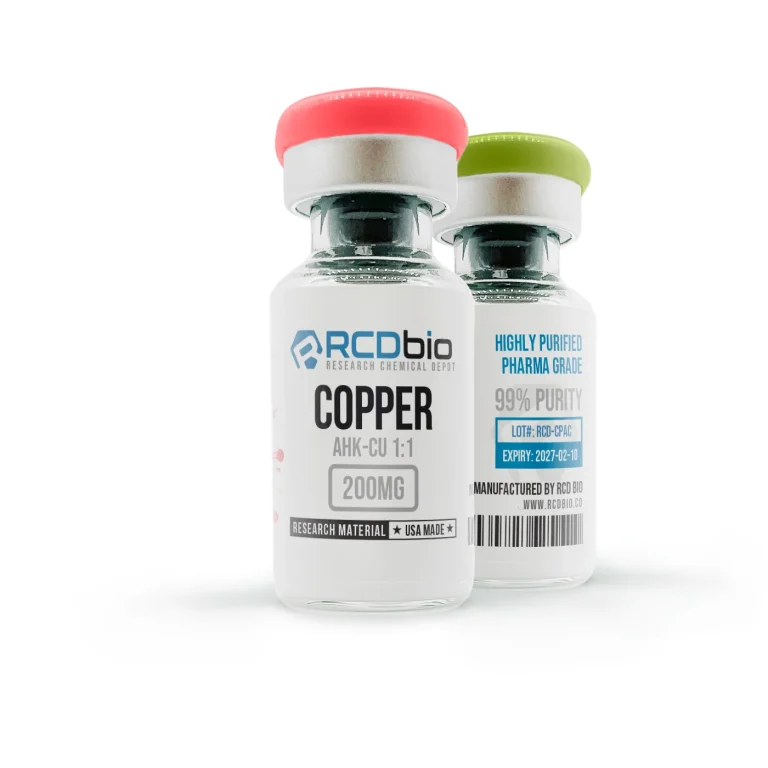
Description
What is Copper Peptide AHK-Cu 1:1?
Copper Peptide AHK-Cu 1:1 (L-Alanyl-L-Histidyl-L-Lysine Copper(II)) is a synthetic copper-chelated tripeptide consisting of alanine, histidine, and lysine complexed with a divalent copper(II) ion (Cu²⁺) in a 1:1 peptide-to-copper molar ratio. It is the closest structural analogue of the naturally occurring copper peptide GHK-Cu (Gly-His-Lys Copper; glycyl-L-histidyl-L-lysine copper complex) — differing only in the substitution of glycine at the N-terminal position with alanine, which adds a single methyl group to the alpha-carbon of the first residue. This single-residue substitution distinguishes AHK from the parent GHK sequence while preserving the His-Lys dipeptide sequence essential for copper(II) coordination. Both peptides are members of the broader family of XHK copper-coordinating tripeptides, which also includes VHK-Cu (valine-histidine-lysine copper), representing systematic N-terminal residue variations of the same His-Lys copper-binding scaffold.
Copper coordination in AHK-Cu follows the same square-planar mechanism established for GHK-Cu: the copper(II) ion is coordinated by the N-terminal alpha-amino nitrogen of alanine, deprotonated amide nitrogens of the His and Lys peptide bonds, and the imidazole nitrogen of the histidine side chain. The resulting 1:1 tripeptide-copper complex has a characteristic blue colour in aqueous solution, consistent with a d-d electronic transition of the square-planar Cu²⁺ complex. The INCI name for AHK-Cu is Copper Tripeptide-3 (versus Copper Tripeptide-1 for GHK-Cu).
The primary published research context distinguishing AHK-Cu from GHK-Cu is its potent activity in human hair follicle biology. The foundational 2007 study by Pyo et al. in the Archives of Pharmacal Research specifically characterised AHK-Cu’s stimulatory effects on human hair follicle elongation in ex vivo organ culture and dermal papilla cell (DPC) proliferation in vitro — demonstrating significant activity at concentrations as low as 10⁻¹² M and identifying anti-apoptotic mechanisms as part of the follicle-protective mechanism. This hair follicle-targeted activity profile has made AHK-Cu the preferred copper peptide research compound for dermal papilla cell biology and hair follicle research. AHK-Cu is not approved by the Food and Drug Administration for human or veterinary use. It is not a dietary supplement and is not intended for human consumption or therapeutic self-administration. All RCDbio research compounds are supplied strictly for laboratory and research purposes only.
Chemical Properties
| Property | Detail |
| Product Type | Synthetic Copper-Chelated Tripeptide Complex (XHK Copper Peptide Series; Copper Tripeptide-3) |
| Product Name | Copper Peptide AHK-Cu 1:1 |
| Application | Scientific / Research Use Only |
| CAS Number | 682809-81-0 (AHK-Cu complex; monohydrochloride salt most commonly supplied) |
| Molar Mass (Free Base Complex) | 416.9 g/mol (C15H24CuN6O4) |
| Molar Mass (HCl Salt) | 452.40 g/mol (C15H25ClCuN6O4) — verify form from COA |
| Chemical Formula (Free Base) | C15H24CuN6O4 |
| Chemical Formula (HCl Salt) | C15H25ClCuN6O4 |
| INCI Name | Copper Tripeptide-3 |
| IUPAC Name (HCl) | copper;(2S)-6-amino-2-[[(2S)-2-[(2S)-2-azanidylpropanoyl]azanidyl-3-(1H-imidazol-4-yl)propanoyl]amino]hexanoate;hydrochloride |
| Peptide Sequence | Ala-His-Lys (AHK); 3 amino acids; L-alanine at N-terminus (distinguishes from GHK-Cu, where glycine occupies position 1) |
| Copper Coordination | Square-planar Cu²⁺ complex; coordination sites: N-terminal alpha-amino N (Ala), deprotonated amide N (Ala-His bond), deprotonated amide N (His-Lys bond), imidazole N of histidine |
| Copper Ratio | 1:1 (one Cu²⁺ ion per one AHK tripeptide molecule) |
| Parent Compound | GHK-Cu (Gly-His-Lys Copper; CAS 89030-95-5; MW 401.9 g/mol; C14H22CuN6O4; Copper Tripeptide-1) |
| Structural Distinction | AHK-Cu vs GHK-Cu: alanine (methyl) at N-terminus instead of glycine (H); adds +14 Da to free tripeptide and +14 Da to copper complex |
| Synonyms | AHK-Cu; Copper Tripeptide-3; L-Alanyl-L-Histidyl-L-Lysine Copper(II); AHK:Cu; Copper Peptide 1:1 (AHK); [L-Alanyl-κN-L-histidyl-κN,κN3-L-lysinato(2-)]copper monohydrochloride |
| Appearance | Blue to blue-green solid/powder (characteristic of Cu²⁺ d-d transition); aqueous solution is blue |
| Solubility | Freely soluble in water; soluble in PBS |
| Storage (Lyophilized) | −20°C; sealed container; protected from light and moisture |
| Storage (Reconstituted) | 4°C; use within 48–72 hours; protect from light; avoid repeated freeze-thaw cycles |
| Purity | ≥98% (HPLC verified, independent third-party laboratory analysis) |
| WADA Status | AHK-Cu is not explicitly named on the 2026 WADA Prohibited List. As a non-approved synthetic copper peptide complex, S0 (Non-Approved Substances) provisions may apply in sport-adjacent research contexts. Verify at GlobalDRO.com before use. |
How Does AHK-Cu Work?
AHK-Cu’s biological activity is mediated through its copper-coordinated tripeptide structure, with the free copper ion serving as a cofactor for enzymatic processes and the AHK peptide delivering the copper to specific intracellular and extracellular targets while simultaneously interacting with cell surface receptors and growth factor signalling pathways.
Copper(II) Coordination Chemistry and Delivery
AHK-Cu delivers bioavailable Cu²⁺ to tissues through the high-affinity square-planar coordination complex. The Cu²⁺ ion participates as a cofactor in lysyl oxidase (LOX) the enzyme responsible for cross-linking collagen and elastin in the extracellular matrix and in superoxide dismutase (SOD), the primary intracellular antioxidant enzyme. In research preparations, copper peptide complexes have been shown to deliver copper more effectively to LOX and SOD than simple copper salts, attributed to the peptide’s cell membrane interaction properties and targeted tissue distribution. This copper chaperone function is the proposed mechanistic basis for enhanced collagen/elastin cross-linking and antioxidant activity observed in AHK-Cu and GHK-Cu preparations.
Dermal Papilla Cell Signalling and Hair Follicle Biology
In the foundational 2007 study by Pyo et al. (Arch Pharm Res), AHK-Cu at concentrations of 10⁻¹² to 10⁻⁹ M produced statistically significant elongation of isolated human scalp hair follicles in 12-day ex vivo organ culture, with effects significant at p<0.01 vs. vehicle control from 10⁻¹² M [Pyo et al., 2007]. In dermal papilla cell culture preparations, AHK-Cu stimulated DPC proliferation and metabolic activity, and shifted the apoptosis regulatory balance: caspase-3 (a cell death marker) was reduced by 42.7% and PARP (poly(ADP-ribose) polymerase, a downstream caspase substrate) by 77.5%, indicating anti-apoptotic protection of DPCs. VEGF production was elevated, and TGF-β1 was reduced in AHK-Cu-treated DPC preparations mechanisms consistent with enhanced follicle vascularisation and attenuation of DHT-pathway-associated follicle miniaturisation signalling.
Collagen and ECM Pathway Modulation — Inferred from GHK-Cu and AHK-Cu Series Literature
AHK-Cu shares with GHK-Cu the same copper coordination mechanism and structural His-Lys scaffold and is expected to share GHK-Cu’s characterised collagen/elastin synthesis stimulation pathway in fibroblast preparations [Pickart & Margolina, 2018]. GHK-Cu at 1–10 μM concentrations stimulates collagen type I and III synthesis, fibronectin, and glycosaminoglycan production in isolated human dermal fibroblast preparations. AHK-Cu’s alanine N-terminal substitution may alter the peptide’s receptor interaction geometry or cellular uptake efficiency relative to GHK-Cu, but direct comparative fibroblast collagen synthesis data for AHK-Cu versus GHK-Cu in matched experimental conditions are not available in the published literature.
Antioxidant and Anti-Inflammatory Pathway Activity
GHK-Cu has been characterised as a potent modulator of gene expression affecting over 4,000 genes in human fibroblast preparations, with effects on antioxidant gene networks (SOD1, SOD2, catalase), anti-inflammatory pathways (NF-κB suppression, TNF-α reduction), and DNA repair pathway genes [Pickart et al., 2015]. AHK-Cu is expected to share this broad gene expression modulatory activity through the conserved His-Lys copper coordination scaffold, though AHK-Cu-specific gene expression profiling has not been published independently.
Key Research Findings
In preclinical and in vitro research contexts, AHK-Cu has been associated with the following observations:
- Hair follicle elongation at 10⁻¹² M: AHK-Cu produced statistically significant elongation of isolated human scalp hair follicles in 12-day ex vivo organ culture from concentrations as low as 10⁻¹² M; the finding was consistent across 240 hair follicles from 3 donors [Pyo et al., 2007].
- Dermal papilla cell anti-apoptotic protection: AHK-Cu reduced caspase-3 by 42.7% and PARP by 77.5% in DPC preparations; Bcl-2/Bax ratio shifted toward cell survival; DPC proliferation increased [Pyo et al., 2007].
- VEGF upregulation and TGF-β1 reduction: AHK-Cu elevated VEGF production and reduced TGF-β1 in DPC preparations — consistent with mechanisms for improved follicle vascularisation and reduced DHT-related miniaturisation signalling.
- Hair follicle anagen maintenance: In mouse model preparations, topical AHK-Cu formulations maintained hair follicle viability during chemotherapy treatment and stimulated anagen phase maintenance in treated skin areas versus vehicle controls.
- GHK-Cu class-level ECM remodelling: GHK-Cu (shared His-Lys scaffold and coordination mechanism) stimulates collagen I/III, fibronectin, and glycosaminoglycan synthesis at 1–10 μM in human fibroblast preparations; modulates >4,000 genes, including antioxidant, anti-inflammatory, and DNA repair networks [Pickart & Margolina, 2018; Pickart et al., 2015].
All findings listed above are derived from preclinical in vitro and ex vivo data. No regulatory-grade human clinical trial data have been established for AHK-Cu. These observations do not constitute evidence of efficacy or safety in any human condition or organism.
What are the Potential Research Applications of AHK-Cu?
In controlled laboratory environments, AHK-Cu has been investigated for the following research applications. These do not constitute claims of efficacy or safety in any organism.
Hair Follicle Biology and Dermal Papilla Cell Research AHK-Cu is the primary copper peptide reference compound for hair follicle biology research, having been directly characterised in human follicle ex vivo and DPC in vitro preparations. Research employs AHK-Cu in organ culture hair follicle elongation assays, DPC proliferation studies, apoptosis pathway analysis (caspase-3/PARP/Bcl-2/Bax), VEGF/TGF-β1 signalling characterisation, and Wnt/β-catenin pathway activation studies.
Copper Peptide SAR Studies — XHK Series Comparative Research AHK-Cu is employed alongside GHK-Cu (Gly-His-Lys-Cu) and VHK-Cu (Val-His-Lys-Cu) in structure-activity relationship studies characterising how N-terminal residue substitution (Gly→Ala→Val) alters copper affinity, cell penetration, receptor interaction profiles, and biological activity in hair follicle and fibroblast model systems.
ECM Remodelling and Fibroblast Collagen Synthesis Research Based on the conserved His-Lys copper coordination scaffold, AHK-Cu is investigated in human dermal fibroblast cell culture systems for collagen synthesis pathway modulation, MMP regulatory activity, fibronectin and glycosaminoglycan expression, and LOX-mediated ECM cross-linking pathway studies.
Antioxidant and Gene Expression Profiling AHK-Cu is employed in gene expression profiling studies examining antioxidant gene network modulation (SOD, catalase), anti-inflammatory pathway effects (NF-κB, TNF-α), and DNA repair gene expression changes in human fibroblast and keratinocyte preparations.
Hair Loss Model Preclinical Research In mouse hair growth model preparations and chemotherapy-induced alopecia models, AHK-Cu is investigated for anagen phase induction, follicle maintenance under cytotoxic stress conditions, and topical versus injectable delivery efficacy comparison studies.
What are the Potential Side Effects of AHK-Cu?
The following observations are from preclinical research in cell culture and animal model systems.
- Generally well-tolerated profile in in vitro and in vivo preclinical systems at research-relevant concentrations; no significant acute toxicity reported in published AHK-Cu studies at hair follicle-effective doses (10⁻¹² to 10⁻⁹ M)
- Copper toxicity potential at high concentrations: free copper ions are cytotoxic at micromolar concentrations; the peptide-chelated form provides copper in a controlled stoichiometric release that is significantly less cytotoxic than equivalent copper salt concentrations in preclinical preparations
- The blue colour of AHK-Cu solutions is a visual indicator of complex integrity; bleaching or colour change may indicate copper dissociation from the complex and altered activity profile in experimental systems
- No human safety or tolerability data have been established for AHK-Cu as a research compound. These observations are derived from experimental systems and should not be extrapolated to human or animal outcomes.
Risk & Handling
Handling Precautions
AHK-Cu should only be handled by trained laboratory personnel. Appropriate PPE is required: nitrile gloves, a laboratory coat, and eye protection at a minimum. When working with lyophilized powder, use within a laminar flow cabinet. Avoid aerosol generation during reconstitution. The blue colour of reconstituted AHK-Cu solution confirms copper complexation — do not use if the solution is colourless (indicates copper dissociation) or precipitated.
Exposure Risks
Risk Tier: LOW
AHK-Cu has demonstrated a well-tolerated profile at hair follicle-active concentrations in published preclinical studies. Its copper-chelated form provides controlled copper delivery, significantly less cytotoxic than equivalent copper salt concentrations. At research-relevant concentrations (sub-micromolar), no significant adverse effects are reported. No human safety or tolerability data have been established for AHK-Cu.
Storage
- Lyophilized form: Store at −20°C in original sealed, light-protected container with desiccant; protect from moisture
- Reconstituted form: Store at 4°C; use within 48–72 hours; protect from light; do not freeze reconstituted copper peptide solutions, as freezing/thawing may alter copper coordination equilibrium
- Avoid alkaline pH conditions (>7.5), which may promote copper precipitation from the complex
- Monitor solution colour — blue indicates intact Cu²⁺ complex; colour loss indicates degradation
Frequently Asked Questions
Q: What is AHK-Cu, and how does it differ from GHK-Cu? A: AHK-Cu (Copper Tripeptide-3; L-Ala-His-Lys-Cu²⁺) is the closest structural analogue of GHK-Cu (Copper Tripeptide-1; L-Gly-His-Lys-Cu²⁺), differing only in the N-terminal residue: alanine in AHK versus glycine in GHK. This adds a single methyl group (+14 Da) at the alpha-carbon. The copper coordination mechanism (square-planar, through N-terminal amine, amide nitrogens, and histidine imidazole) is identical in both compounds. The primary research distinction is that AHK-Cu is the directly characterised compound in the foundational hair follicle elongation and DPC research (Pyo et al., 2007), while GHK-Cu has the larger body of published literature across collagen synthesis, gene expression modulation, and general ECM remodelling research.
Q: What were the key findings in the Pyo et al. 2007 study? A: Pyo et al. (Arch Pharm Res, 2007; PMID 17703734) isolated human scalp hair follicles from 3 donors and cultured them for 12 days with AHK-Cu at concentrations from 10⁻¹³ to 10⁻⁷ M. AHK-Cu produced statistically significant follicle elongation from 10⁻¹² M, with 240 follicles analysed across conditions. In DPC culture preparations, AHK-Cu stimulated cell proliferation and reduced apoptotic markers: caspase-3 reduced 42.7%, and PARP reduced 77.5%. VEGF was elevated, and TGF-β1 was reduced. These findings are from ex vivo and in vitro experimental systems and do not constitute evidence of efficacy in human hair loss conditions.
Q: What does the 1:1 designation mean? A: The 1:1 designation in “Copper Peptide AHK-Cu 1:1” refers to the molar ratio of AHK tripeptide to copper(II) ion in the complex — one AHK molecule per one Cu²⁺ ion. This is the standard coordination stoichiometry for single-amino-acid copper peptide complexes of this class. A 2:1 ratio (two AHK molecules per one Cu²⁺) is possible at higher peptide concentrations, but the 1:1 complex is the characterised form. The copper content by weight in the 1:1 complex is approximately 15.3% (Cu atomic weight 63.55 / complex MW 416.9 × 100%).
Q: Is AHK-Cu more effective than GHK-Cu for hair research? A: The direct comparison has not been published in a peer-reviewed head-to-head study using matched experimental conditions. The Pyo 2007 study characterised AHK-Cu specifically in hair follicle systems; most other copper peptide biological activity data uses GHK-Cu. The alanine substitution at the N-terminus may alter cell uptake efficiency, receptor interaction geometry, or DPC-specific pathway engagement relative to GHK-Cu — but this has not been published. Researchers should consider both compounds as relevant tools in hair follicle biology research with complementary literature bases.
Q: How should AHK-Cu be stored? A: Lyophilized AHK-Cu should be stored at −20°C in a sealed, light-protected container with desiccant. Once reconstituted, store at 4°C and use within 48–72 hours. Protect from light and avoid repeated freeze-thaw cycles. Do not freeze reconstituted copper peptide solutions — freezing may alter copper coordination equilibrium and complex stability. Monitor the characteristic blue colour as an indicator of complex integrity.
Related Research Compounds
Researchers investigating Copper Peptide AHK-Cu 1:1 may also be interested in the following compounds currently available for laboratory research at RCDbio:
- Copper Peptide GHK-Cu 1:1 The parent naturally occurring copper tripeptide (Gly-His-Lys-Cu); the primary reference compound with the largest published literature base for ECM remodelling, collagen synthesis, and gene expression modulation research.
- PAL-GHK N-terminally palmitoylated GHK tripeptide (Copper Tripeptide-1 lipopeptide precursor); investigated for membrane-penetrant collagen synthesis pathway research; shares the GHK sequence and ECM signalling research context with AHK-Cu.
All products listed are for laboratory and research purposes only.
References
- Pyo, H. K., Yoo, H. G., Won, C. H., Lee, S. H., Kang, Y. J., Eun, H. C., Cho, K. H., & Kim, K. H. (2007). The effect of the tripeptide-copper complex on human hair growth in vitro. Archives of Pharmacal Research, 30(7), 834–839. https://pubmed.ncbi.nlm.nih.gov/17703734/
- Pickart, L., & Margolina, A. (2018). Regenerative and Protective Actions of the GHK-Cu Peptide in the Light of the New Gene Data. International Journal of Molecular Sciences, 19(7), 1987. https://pubmed.ncbi.nlm.nih.gov/29970841/
- Lintner, K., & Peschard, O. (2000). Biologically active peptides: From a laboratory bench curiosity to a functional skin care product. International Journal of Cosmetic Science, 22(3), 207–218. https://pubmed.ncbi.nlm.nih.gov/18503476/
- Pickart, L., Vasquez-Soltero, J. M., & Margolina, A. (2015). GHK Peptide as a Natural Modulator of Multiple Cellular Pathways in Skin Regeneration. BioMed Research International, 2015, 648108. https://pubmed.ncbi.nlm.nih.gov/26236730/
Disclaimer
Copper Peptide AHK-Cu 1:1 is exclusively for laboratory research purposes. RCDbio products are not intended to diagnose, prevent, treat, or cure any disease or medical condition.
The Food and Drug Administration has not evaluated the statements on our website. This product is not approved for human or veterinary use. Researchers must comply with all applicable local, state, and federal laws and regulations governing the purchase and use of research compounds. By purchasing, you agree to our Terms and Conditions. RCDbio reserves the right to refuse sales to unauthorized individuals.
ATTENTION: All RCDbio products are strictly for LABORATORY AND RESEARCH PURPOSES ONLY. They are not intended for human consumption, veterinary use, or any other non-research application. For queries, complaints, or support, contact support@legacy.rcdbio.co
Reviews
There are no reviews yet