

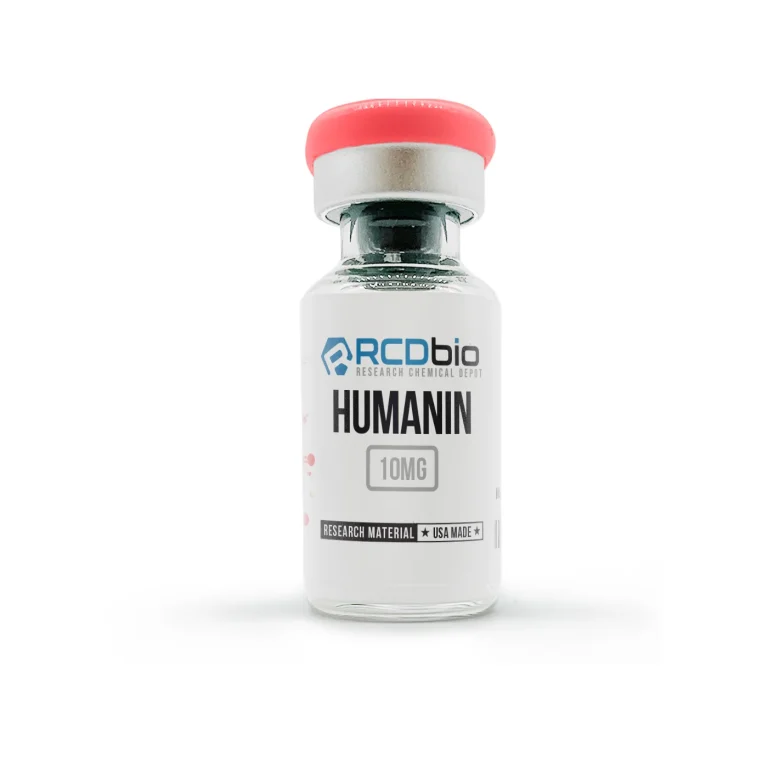
Description
What is Humanin?
Humanin (HN) is a synthetic 24-amino acid micropeptide encoded by a small open reading frame within the MT-RNR2 (16S ribosomal RNA) locus of the human mitochondrial genome. It belongs to the family of mitochondria-derived peptides (MDPs) — a class of small, bioactive peptides encoded directly by mitochondrial DNA and investigated for their roles in cell survival and mitochondrial communication. Humanin is the first and most extensively characterized MDP identified in the scientific literature, with its initial characterization reported in 2001 by Hashimoto, Niikura, and Nishimoto at Keio University School of Medicine, via functional cDNA library screening of occipital cortex tissue from an Alzheimer’s disease patient.
The expressed form of Humanin depends on its site of synthesis. When translated inside the mitochondrial matrix, the ribosomal processing generates the 21-amino acid form (MAPRGFSCLLLLTSEIDLPV). When produced in the cytosol from nuclear-integrated copies of mitochondrial DNA (nuclear mitochondrial DNA segments, or NUMTs), the full-length 24-amino acid form (MAPRGFSCLLLLTSEIDLPVKRRA) is generated, retaining four C-terminal residues. Both forms have demonstrated biological activity in preclinical experimental systems. The peptide adopts a predominantly alpha-helical secondary structure, with a beta-sheet domain spanning residues 6–14 and an alpha-helix spanning residues 19–24, as characterized by bioinformatic and structural analyses.
Humanin is the most phylogenetically conserved of the mitochondria-derived peptides, with functional homologs characterized in rodents (designated Rattin), nematodes, and other mammalian species, suggesting evolutionary conservation of its cytoprotective signaling role. Serum concentrations of Humanin have been observed to decline with advancing age in rodent models and in human observational studies, positioning it as a subject of interest in preclinical aging and neurodegeneration pathway research.
In research settings, Humanin has been investigated in preclinical models and in vitro systems for its roles in Bax-mediated mitochondrial apoptosis inhibition, CNTFR/WSX-1/gp130 cytokine receptor complex activation, IGFBP-3 binding, neuroprotection against Alzheimer’s disease-associated neuronal death stimuli, cerebral ischemia-reperfusion injury models, and insulin sensitivity pathway investigations. A well-characterized synthetic analogue, HNG (S14G-Humanin), carries a serine-to-glycine substitution at position 14 and demonstrates up to 1,000-fold greater potency than native Humanin in neuroprotection assay systems, making it the primary analogue employed in rodent AD model studies.
Synthetic Humanin supplied by RCDbio is intended strictly for laboratory and research purposes. It is not approved by the Food and Drug Administration for human or veterinary use in this research-grade, non-pharmaceutical form. It is not a dietary supplement and is not intended for human consumption or therapeutic self-administration.
All preclinical studies referenced in this document were conducted under institutional oversight consistent with IRB, IACUC, and AWA guidelines. Humanin is supplied by RCDbio exclusively for use under equivalent institutional research compliance frameworks.
Chemical Properties
| Property | Detail |
| Product Type | Synthetic Mitochondria-Derived Neuropeptide (MDP) |
| Product Name | Humanin |
| Application | Scientific / Research Use Only |
| CAS Number | 330936-69-1 (24-AA human cytosolic free base form) |
| Molar Mass | 2,687.28 g/mol (24-AA cytosolic free base form) |
| Chemical Formula | C₁₁₉H₂₀₄N₃₄O₃₂S₂ |
| Sequence | MAPRGFSCLLLLTSEIDLPVKRRA (24-AA cytosolic form); MAPRGFSCLLLLTSEIDLPV (21-AA mitochondrial form) |
| IUPAC Name | (4S)-5-[[(2S,3S)-1-[[(2S)-1-[[(2S)-1-[(2S)-2-[[(2S)-1-[[(2S)-6-amino-1-[[(2S)-5-carbamimidamido-1-[[(2S)-5-carbamimidamido-1-[[(1S)-1-carboxyethyl]amino]-1-oxopentan-2-yl]amino]-1-oxopentan-2-yl]amino]-1-oxohexan-2-yl]amino]-3-methyl-1-oxobutan-2-yl]carbamoyl]pyrrolidin-1-yl]-4-methyl-1-oxopentan-2-yl]amino]-3-carboxy-1-oxopropan-2-yl]amino]-3-methyl-1-oxopentan-2-yl]amino]-4-[[(2S)-2-[[(2S,3R)-2-[[(2S)-2-[[(2S)-2-[[(2S)-2-[[(2S)-2-[[(2R)-2-[[(2S)-2-[[(2S)-2-[[2-[[(2S)-2-[[(2S)-1-[(2S)-2-[[(2S)-2-amino-4-methylsulfanylbutanoyl]amino]propanoyl]pyrrolidine-2-carbonyl]amino]-5-carbamimidamidopentanoyl]amino]acetyl]amino]-3-phenylpropanoyl]amino]-3-hydroxypropanoyl]amino]-3-sulfanylpropanoyl]amino]-4-methylpentanoyl]amino]-4-methylpentanoyl]amino]-4-methylpentanoyl]amino]-4-methylpentanoyl]amino]-3-hydroxybutanoyl]amino]-3-hydroxypropanoyl]amino]-5-oxopentanoic acid |
| Synonyms | HN; HN-24; Mitochondrial-derived peptide (MDP); Rattin (rat homolog); HNG (S14G analogue — distinct compound) |
| Physical Form | Lyophilized white to off-white powder |
| Solubility | Soluble in sterile water and phosphate-buffered saline (PBS); slightly acidic aqueous buffers may improve solubility; contains a free cysteine residue at position 8 susceptible to oxidative dimerization under aerobic conditions |
| Storage (Lyophilized) | −20°C; sealed, light-protected container with desiccant; protect from moisture and temperature fluctuation |
| Storage (Reconstituted) | 4°C; use within 48–72 hours of reconstitution; protect from atmospheric oxygen; avoid repeated freeze-thaw cycles; discard any solution that appears turbid, discolored, or contains particulate matter |
| PubChem CID | 16131438 (24-AA cytosolic free base form) |
| Purity | ≥98% (HPLC verified, independent third-party laboratory analysis; COA available per batch) |
| WADA Status | Not explicitly listed by name on the 2026 WADA Prohibited List. As a non-approved synthetic mitochondria-derived peptide with documented cytoprotective activity, S0 (Non-Approved Substances) category provisions may apply in sport-adjacent research contexts. Researchers engaged in sport-adjacent studies should verify the current status at GlobalDRO.com before use. |
How Does Humanin Work?
Humanin exerts its cytoprotective and neuroprotective effects through multiple intersecting intracellular and receptor-mediated signaling pathways. Its activity is best characterized by direct Bax inhibition, cytokine receptor complex activation via CNTFR/WSX-1/gp130, and competitive IGFBP-3 binding, though additional mechanistic contributions continue to be characterized in ongoing preclinical research.
Bax Inhibition and Mitochondrial Apoptosis Pathway
The most extensively characterized mechanism of Humanin is direct inhibition of Bax, a pro-apoptotic member of the Bcl-2 protein family. In isolated cell preparations and reconstituted lipid bilayer systems, Humanin binds Bax and prevents its translocation to the mitochondrial outer membrane, thereby blocking cytochrome c release and downstream caspase activation cascade initiation [Guo et al., 2003]. Single-molecule fluorescence and FRET studies in artificial lipid bilayer preparations confirmed that Humanin at 100 nmol/L inhibits Bax self-association, tBid-activated membrane association, and tetramer formation. The free cysteine residue at position 8 (Cys8) has been identified as a critical determinant of this Bax-binding activity; site-directed substitution of Cys8 abolishes neuroprotective function in isolated cell assay systems [Hashimoto et al., 2001]. Anti-apoptotic binding to tBid and BimEL has additionally been characterized as contributing to Humanin’s inhibition of cytochrome c release in cell-based systems.
CNTFR/WSX-1/gp130 Cytokine Receptor Complex Activation
Humanin has been characterized as a ligand for a heterotrimeric cytokine receptor complex comprising ciliary neurotrophic factor receptor (CNTFR), interleukin-27 receptor subunit alpha (WSX-1), and the shared signal transducer gp130. Receptor complex engagement initiates JAK/STAT3 signaling, with STAT3 phosphorylation characterized as a downstream effector of Humanin-mediated neuroprotection in both isolated cell preparations and rodent in vivo models [Hashimoto et al., 2001]. This pathway shares signaling architecture with the ciliary neurotrophic factor (CNTF) system, implicating shared receptor machinery in the cytoprotective response.
IGFBP-3 Binding and Anti-Apoptotic Modulation
In isolated cell systems, Humanin has been demonstrated to bind insulin-like growth factor binding protein-3 (IGFBP-3), a pro-apoptotic factor capable of inducing cell death via IGF-independent pathways. Humanin binding to IGFBP-3 inhibits IGFBP-3-induced nuclear translocation and downstream apoptotic signaling in isolated cell preparations. The IGFBP-3 binding domain has been mapped to amino acid residues 6–21 of the Humanin sequence [Hashimoto et al., 2001].
Insulin Sensitivity and Hypothalamic Metabolic Pathway
In rodent in vivo models, including Zucker diabetic fatty rat preparations, intracerebroventricular and systemic administration of HNG has been investigated for effects on peripheral insulin sensitivity and glucose homeostasis. Observations suggest engagement of central hypothalamic CNTFR/gp130 receptor pathways as a mechanism linking mitochondria-derived peptide signaling to systemic metabolic regulation. These observations are derived exclusively from rodent in vivo models and have not been replicated in human clinical studies.
Key Research Findings
In preclinical and in vitro research contexts, Humanin has been associated with the following observations:
- Bax inhibition: Humanin prevents Bax translocation to the mitochondrial outer membrane and cytochrome c release in isolated cell preparations and lipid bilayer systems; Cys8 is identified as the critical binding residue. [Guo et al., 2003]
- Neuronal cell death suppression: Humanin treatment associated with suppression of neuronal cell death induced by multiple familial AD mutant genes (APP V642I, NL-APP, PS1 M146L, PS2 N141I) and Aβ1-43 in isolated neuronal cell preparations; effect was stimulus-specific and did not extend to polyglutamine or SOD1 mutant toxicity. [Hashimoto et al., 2001]
- HNG potency: S14G substitution (HNG) produces up to 1,000-fold greater neuroprotective potency than native Humanin in isolated cell death assay systems; HNG is the primary analogue employed in rodent AD model studies. [Hashimoto et al., 2001]
- Cerebral ischemia model: HNG administration associated with reduced infarct volume and improved neuronal viability in focal cerebral ischemia/reperfusion mouse models; PI3K/Akt pathway identified as a contributing mechanistic component. [Hashimoto et al., 2001 — PNAS]
- Age-related serum decline: Humanin serum concentrations decrease significantly with age in rodent models; associated with increased vulnerability to age-related cellular pathologies in observational preclinical studies. [Muzumdar et al.]
All findings listed above are derived from preclinical or in vitro data. No conclusions regarding human therapeutic efficacy can be drawn from these observations. These findings do not constitute evidence of safety or efficacy in any human condition or organism.
What are the Potential Research Applications of Humanin?
In controlled laboratory environments, Humanin has been investigated for the following research applications. These are observed in preclinical and in vitro contexts only and do not constitute claims of efficacy or safety in any organism.
Bax Inhibition and Mitochondrial Apoptosis Research
Humanin is employed as a primary tool compound for investigating Bax-mediated mitochondrial apoptosis pathways in isolated cell preparations and reconstituted lipid bilayer systems. It is utilized in single-molecule fluorescence microscopy, FRET assay systems, and cytochrome c release assays to characterize the mechanisms by which Bax membrane association, oligomerization, and downstream caspase activation can be inhibited. The compound’s defined Cys8-dependent binding domain makes it useful for structure-activity relationship investigations within the Bcl-2 family interaction landscape.
Alzheimer’s Disease Neuronal Death Model Studies
In isolated neuronal cell preparations transfected with familial AD mutant genes and in amyloid beta (Aβ)-treated cell cultures, Humanin serves as a neuroprotective reference compound for probing the relationship between AD-associated pathological stimuli and neuronal survival pathway engagement. Research employs dose-response characterization, receptor dependency analysis, and structural mutant comparisons to map the mechanistic requirements for activity. HNG is commonly employed as the higher-potency analogue in rodent AD model investigations.
CNTFR/gp130/STAT3 Signaling Research
Humanin is investigated as an endogenous ligand for the CNTFR/WSX-1/gp130 heterotrimeric receptor complex in isolated cell systems. Research employs JAK-STAT3 pathway reporter assays, STAT3 phosphorylation immunoblotting, and co-immunoprecipitation studies to characterize receptor binding kinetics and downstream signaling cascade specificity. This application is relevant to research on shared cytokine receptor signaling architecture and the biology of class I cytokine receptors.
Cerebral Ischemia-Reperfusion Injury Models
In rodent focal cerebral ischemia/reperfusion models, Humanin and HNG are investigated for effects on infarct volume, neuronal viability, and PI3K/Akt pathway activation following ischemic challenge. Research examines the mechanistic relationship between Bax inhibition, PI3K/Akt-mediated survival signaling, and neuronal outcomes under transient ischemic conditions in murine model systems.
Mitochondria-Derived Peptide Biology and Aging Research
Humanin is investigated as a primary MDP reference compound in preclinical studies characterizing mitochondrial communication pathways, age-related MDP serum decline, and the relationship between mitochondrial signaling and cellular resilience. Research platforms include aged rodent model preparations, longitudinal serum concentration studies, and comparative MDP pathway analysis alongside other MDPs such as MOTS-c and SS-31.
What are the Potential Side Effects of Humanin?
Researchers in preclinical and in vitro settings have noted the following observations. Long-term safety profiles in humans have not been established, and no clinical trial data exist for research-grade Humanin.
- No significant toxicity observed in rodent preclinical studies at neuroprotective concentrations; acute toxicity profile has been characterized as low in published rodent studies
- Free cysteine residue at position 8 (Cys8) renders native Humanin susceptible to oxidative dimerization under aerobic storage or reconstitution conditions; oxidized or dimerized forms may exhibit reduced or abolished activity in cell-based assay systems
- Anti-apoptotic pathway engagement, the compound’s primary characterized mechanism, is a theoretical consideration for experimental designs in which normal programmed cell death signaling must be preserved as a control variable
- Antibody formation against the Humanin peptide sequence is a theoretical consideration in chronic in vivo administration rodent models; no instances have been reported in the published preclinical literature to date
- HNG analogue (S14G) shares a comparable safety profile with native Humanin in published rodent studies, with no adverse effects reported at cytoprotective concentrations
No human safety or tolerability data have been established for Humanin. These observations are derived from in vitro and rodent experimental systems and should not be extrapolated to human or animal outcomes.
Risk & Handling
Handling Precautions
Humanin should be handled exclusively by trained laboratory personnel familiar with synthetic neuropeptide research compounds. Required personal protective equipment includes nitrile gloves, a laboratory coat, and eye protection at minimum. When handling lyophilized powder, work within a laminar flow cabinet or clean bench environment to avoid inhalation of fine particulate matter. Avoid aerosol generation during reconstitution. The free cysteine residue at position 8 (Cys8) renders the native peptide susceptible to oxidative modification and disulfide-linked dimerization; all reconstitution and handling procedures should minimize exposure to atmospheric oxygen and oxidizing agents. Nitrogen or argon blanketing of reconstituted working stock solutions is appropriate in laboratory settings where extended use is anticipated.
Exposure Risks
Risk Tier: LOW
Humanin has demonstrated a low acute toxicity profile in published preclinical rodent studies at neuroprotective concentrations. The peptide’s primary pharmacological mechanisms — Bax inhibition and CNTFR/gp130/STAT3 anti-apoptotic signaling — are active at nanomolar concentrations in isolated cell systems. No systemic toxicity findings, organ-specific damage, or adverse pharmacological effects have been reported in the published preclinical literature at research-relevant concentrations. Plasma clearance of native Humanin in rodent models is relatively rapid due to proteolytic degradation; the HNG analogue demonstrates improved metabolic stability in preclinical systems. No human safety or tolerability data has been established for Humanin.
Storage
- Lyophilized form: Store at −20°C in the original sealed, light-protected container with desiccant; protect from moisture and temperature excursions
- Reconstituted form: Store at 4°C; use within 48–72 hours of reconstitution
- Protect reconstituted solutions from atmospheric oxygen; the free Cys8 residue is susceptible to oxidative dimerization under aerobic conditions — nitrogen or argon overlay is recommended for working stocks with extended anticipated use
- Do not subject to repeated freeze-thaw cycles; peptide integrity and Cys8 redox state may be progressively compromised with each cycle
- Discard any reconstituted solution that appears turbid, discolored, or contains visible particulate matter
Frequently Asked Questions
Q: What is Humanin and what is it investigated for in research? A: Humanin (HN) is a synthetic mitochondria-derived 24-amino acid micropeptide, encoded within the MT-RNR2 locus of the mitochondrial genome, investigated in preclinical and in vitro research contexts for Bax-mediated apoptosis inhibition, neuroprotection against Alzheimer’s disease-associated neuronal death stimuli, CNTFR/WSX-1/gp130 cytokine receptor complex signaling, and cerebral ischemia-reperfusion injury models. It is not approved by the FDA for human use and is intended strictly for laboratory and research purposes.
Q: What is HNG and how does it differ from native Humanin? A: HNG (Humanin-glycine) is a synthetic analogue of Humanin carrying a serine-to-glycine substitution at amino acid position 14 (S14G). In neuroprotection assay systems, HNG has been characterized as up to 1,000-fold more potent than native Humanin depending on the experimental system. HNG is the primary analogue employed in Alzheimer’s disease rodent model studies. The S14G substitution is associated with reduced helical propensity and increased conformational flexibility relative to wild-type Humanin, which is proposed to contribute to its enhanced receptor-binding affinity and Bax inhibition activity in preclinical experimental systems.
Q: Why is the Cys8 residue critical for Humanin’s activity in research assays? A: Cysteine at amino acid position 8 (Cys8) has been identified as a critical determinant of Humanin’s Bax-binding and neuroprotective activity in isolated cell assay systems. Substitution of Cys8 with any of the 19 other standard amino acids results in significant loss of neuroprotective function in cell-based assay systems. Because Cys8 is a free thiol, native Humanin is susceptible to oxidative dimerization under aerobic storage and reconstitution conditions. Oxidized or dimerized forms may have substantially altered or abolished activity profiles in cell-based assays, making Cys8 integrity a critical experimental variable for researchers.
Q: What is the half-life of Humanin in preclinical models? A: The plasma half-life of native Humanin in rodent in vivo models has been characterized as relatively short, attributable to rapid proteolytic degradation in biological matrices. The HNG analogue (S14G) demonstrates increased resistance to enzymatic degradation and improved in vivo stability relative to native Humanin in rodent preclinical systems. Lyophilized powder is stable for extended periods under appropriate −20°C storage conditions. These figures are derived from rodent preclinical models and do not represent pharmacokinetic data for research-grade material in human systems.
Q: How should Humanin be stored to maintain stability? A: Lyophilized Humanin should be stored at −20°C in a sealed, light-protected container with desiccant. Once reconstituted, solutions should be stored at 4°C and used within 48–72 hours. Repeated freeze-thaw cycles should be avoided. Due to the free Cys8 residue’s susceptibility to oxidative dimerization, reconstituted solutions should be protected from atmospheric oxygen; a nitrogen or argon overlay is recommended for working stocks requiring extended use.
Q: What toxicity observations have been reported for Humanin in preclinical studies? A: Published preclinical studies in rodent models have not reported significant toxicity at neuroprotective concentrations of Humanin or HNG. No acute toxicity findings have been characterized at research-relevant concentrations in the published literature. No human safety or tolerability data have been established for research-grade Humanin. These observations are derived from in vitro and rodent experimental systems and should not be extrapolated to human or animal outcomes.
Q: What reconstitution vehicle is typically used for Humanin in laboratory research? A: In published preclinical studies, Humanin has been reconstituted in sterile water, phosphate-buffered saline (PBS), or slightly acidic aqueous buffers. Due to the free Cys8 thiol, reconstitution under reduced-oxygen conditions is recommended to minimize oxidative dimerization. Nitrogen or argon blanketing of working stock solutions is appropriate in laboratory settings where extended use is anticipated. Researchers should verify compatibility of solubilization conditions against their specific experimental system requirements.
Related Research Compounds
Researchers investigating Humanin may also be interested in the following compounds available for laboratory research at RCDbio:
- Colivelin — A chimeric neuroprotective peptide fusing HNG17 and ADNF9 sequences, investigated in preclinical models for STAT3-mediated neuroprotection; directly derived from and compared against Humanin in Alzheimer’s disease rodent model research, sharing the CNTFR/gp130/STAT3 signaling axis.
- SS-31 (Elamipretide) — A synthetic tetrapeptide targeting mitochondrial cardiolipin, investigated in preclinical models for mitochondrial membrane stabilization and ischemia-reperfusion injury; relevant to comparative mitochondria-targeted cytoprotective peptide research alongside Humanin.
- Epithalon — A synthetic tetrapeptide investigated in preclinical cellular aging models for telomerase activity modulation; relevant to comparative mitochondria-derived peptide and cellular longevity pathway research.
All products listed are for laboratory and research purposes only.
References
- Hashimoto, Y., Ito, Y., Niikura, T., Shao, Z., Hata, M., Oyama, F., & Nishimoto, I. (2001). Mechanisms of neuroprotection by a novel rescue factor humanin from Swedish mutant amyloid precursor protein. Biochemical and Biophysical Research Communications, 283(2), 460–468. https://pubmed.ncbi.nlm.nih.gov/11327724/
- Hashimoto, Y., Niikura, T., Tajima, H., Yasukawa, T., Sudo, H., Ito, Y., Kita, Y., Kawasumi, M., Kouyama, K., Doyu, M., Sobue, G., Koide, T., Tsuji, S., Lang, J., Kurokawa, K., & Nishimoto, I. (2001). A rescue factor abolishing neuronal cell death by a wide spectrum of familial Alzheimer’s disease genes and Aβ. Proceedings of the National Academy of Sciences USA, 98(11), 6336–6341. https://pubmed.ncbi.nlm.nih.gov/11371646/
- Guo, B., Zhai, D., Cabezas, E., Welsh, K., Nouraini, S., Satterthwait, A. C., & Reed, J. C. (2003). Humanin peptide suppresses apoptosis by interfering with Bax activation. Nature, 423(6938), 456–461. https://pubmed.ncbi.nlm.nih.gov/12732850/
- Hashimoto, Y., Niikura, T., Ito, Y., Sudo, H., Hata, M., Arakawa, E., Abe, Y., Kita, Y., & Nishimoto, I. (2001). Detailed characterization of neuroprotection by a rescue factor humanin against various Alzheimer’s disease-relevant insults. Journal of Neuroscience, 21(23), 9235–9245. https://pubmed.ncbi.nlm.nih.gov/11717357/
- Zhu, S., Hu, X., Bennett, S., Xu, J., & Mai, Y. (2022). The molecular structure and role of humanin in neural and skeletal diseases, and in tissue regeneration. Frontiers in Cell and Developmental Biology, 10, 823354. https://www.frontiersin.org/journals/cell-and-developmental-biology/articles/10.3389/fcell.2022.823354/full
Disclaimer
Humanin is exclusively for laboratory research purposes. RCDbio products are not intended to diagnose, prevent, treat, or cure any disease or medical condition.
The Food and Drug Administration has not evaluated the statements on our website. This product is not approved for human or veterinary use. Researchers must comply with all applicable local, state, and federal laws and regulations governing the purchase and use of research compounds. By purchasing, you agree to our Terms and Conditions. RCDbio reserves the right to refuse sales to unauthorized individuals.
ATTENTION: All RCDbio products are strictly for LABORATORY AND RESEARCH PURPOSES ONLY. They are not intended for human consumption, veterinary use, or any other non-research application. For queries, complaints, or support, contact support@legacy.rcdbio.co
Reviews
There are no reviews yet