

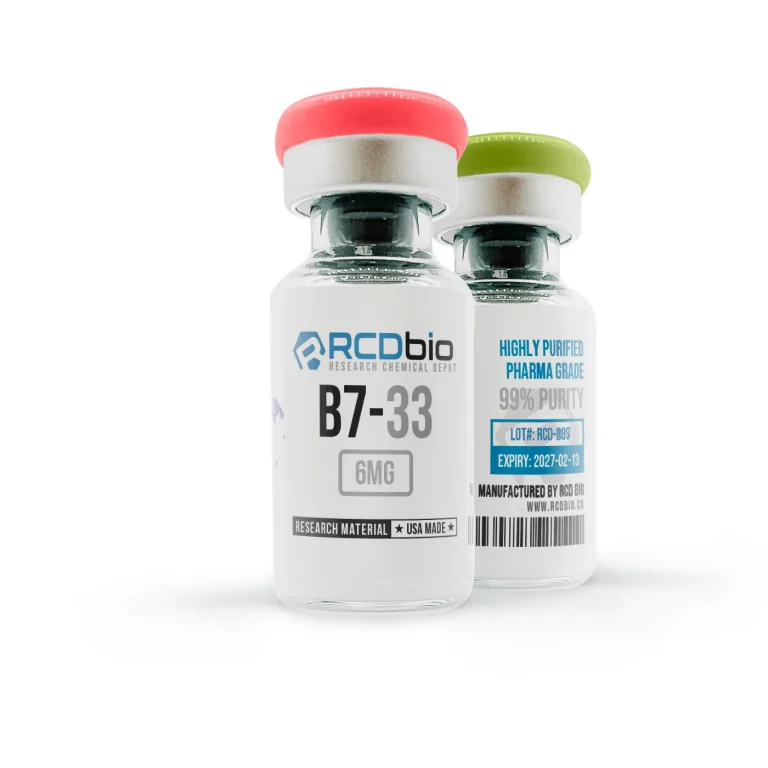
Description
What is B7-33?
B7-33 is a synthetic 26-amino acid single-chain peptide derived from the B-chain of human relaxin-2 (H2 relaxin), designed and developed by Mohammed Akhter Hossain, Ross Bathgate, and colleagues at the Florey Institute of Neuroscience and Mental Health, University of Melbourne, Australia. Its sequence (Val-Ile-Lys-Leu-Ser-Gly-Arg-Glu-Leu-Val-Arg-Ala-Gln-Ile-Ala-Ile-Ser-Gly-Met-Ser-Thr-Trp-Ser-Lys-Arg-Ser-Leu-NH2; VIKLSGRELVRAQIAISGMSTWSKRSL-NH2) was derived by truncating six residues from the N-terminus and extending four residues (Lys-Arg-Ser-Leu) at the C-terminus of the native H2 relaxin B-chain (B1-29) — producing a soluble, single-chain linear peptide that overcomes a fundamental synthesis limitation of native H2 relaxin (whose B1-29 chain is insoluble when isolated).
The most significant pharmacological feature of B7-33 is its functional selectivity at RXFP1 (Relaxin Family Peptide Receptor 1) — it is the first confirmed functionally selective agonist of this receptor. Native H2 relaxin activates RXFP1 through both cAMP/PKA and ERK1/2 signalling pathways. B7-33 selectively activates the pERK1/2 pathway with minimal cAMP stimulation in cells endogenously expressing RXFP1, establishing it as a biased agonist. This pathway selectivity is pharmacologically significant because cAMP signalling through RXFP1 is believed to mediate the tumour-promoting activity reported for full-length H2 relaxin — B7-33 demonstrated equivalent anti-fibrotic efficacy to H2 relaxin in four preclinical rodent models without the tumour-promoting activity observed with the parent hormone [Hossain et al., 2016].
Beyond its pharmacological profile, B7-33 offers a practical research advantage: whereas H2 relaxin requires two separate peptide chain assemblies, four regioselective disulfide bond formation reactions, and six purification steps, B7-33 is assembled directly on resin in a single synthetic step with one purification after cleavage. This dramatically reduced synthesis complexity has made B7-33 a widely adopted tool compound in fibrosis biology research.
B7-33 is not approved by the Food and Drug Administration for human or veterinary use. It is not a dietary supplement and is not intended for human consumption or therapeutic self-administration. All RCDbio research compounds are supplied strictly for laboratory and research purposes only.
Chemical Properties
| Property | Detail |
| Product Type | Synthetic 26-Amino Acid Single-Chain Relaxin B-Chain Analogue / Functionally Selective RXFP1 Biased Agonist |
| Product Name | B7-33 |
| Application | Scientific / Research Use Only |
| CAS Number | 1818415-56-3 |
| Molar Mass | 2986.58 g/mol |
| Chemical Formula | C131H229N41O36S |
| PubChem CID | 162662592 |
| IUPAC Name | Full canonical IUPAC available at PubChem CID 162662592; 26-residue linear single-chain peptide with C-terminal amide |
| Amino Acid Sequence | Val-Ile-Lys-Leu-Ser-Gly-Arg-Glu-Leu-Val-Arg-Ala-Gln-Ile-Ala-Ile-Ser-Gly-Met-Ser-Thr-Trp-Ser-Lys-Arg-Ser-Leu-NH2 (VIKLSGRELVRAQIAISGMSTWSKRSL-NH2); 26 amino acids; C-terminal amide; no disulfide bonds |
| Parent Compound | H2 relaxin (human relaxin-2) B-chain; B7-33 derived by N-terminal truncation (positions 1–6 removed) + C-terminal extension (+Lys-Arg-Ser-Leu) |
| Receptor Target | RXFP1 (Relaxin Family Peptide Receptor 1; Class A GPCR); B7-33 pKi = 5.54 in HEK-RXFP1 cells (vs H2 relaxin pKi = 8.96) |
| Signalling Profile | Biased/functionally selective RXFP1 agonist: preferentially activates pERK1/2 with minimal cAMP stimulation in cells endogenously expressing RXFP1 — the first functionally selective RXFP1 agonist |
| Mechanism | RXFP1-AT2R (angiotensin II type 2 receptor) heterodimer activation → selective pERK1/2 signalling → MMP-2 upregulation → collagen degradation |
| Key Distinction from H2 Relaxin | No cAMP activation in endogenous RXFP1 cells; does NOT promote prostate tumour growth (H2 relaxin does); linear single-chain structure (no disulfide bonds); ~5-fold lower molecular weight; dramatically simpler synthesis |
| Serum Half-Life (In Vitro) | ~6 minutes (in vitro serum stability assay); short due to rapid proteolysis; lipidated analogues extend this to ~60 min in vitro |
| Synonyms | B7-33; H2 relaxin B-chain analogue; RXFP1 biased agonist; VIKLSGRELVRAQIAISGMSTWSKRSL |
| Physical Form | Lyophilized white to off-white powder |
| Solubility | Freely soluble in water; soluble in PBS and standard aqueous buffers |
| Storage (Lyophilized) | −20°C; sealed container; protected from light and moisture |
| Storage (Reconstituted) | 4°C; use within 48–72 hours; avoid repeated freeze-thaw cycles |
| Purity | ≥98% (HPLC verified, independent third-party laboratory analysis) |
| WADA Status | B7-33 is not explicitly named on the 2026 WADA Prohibited List. As a non-approved synthetic peptide hormone analogue, S0 (Non-Approved Substances) and potentially S2 (Peptide Hormones and Related Substances) provisions may apply in sport-adjacent research contexts. Verify at GlobalDRO.com prior to use. |
How Does B7-33 Work?
B7-33’s pharmacology is defined by its biased agonism at RXFP1 — activating the receptor’s pERK1/2 pathway while avoiding the cAMP/PKA cascade that is responsible for certain adverse effects of full-length H2 relaxin.
RXFP1-AT2R Heterodimer and pERK1/2 Biased Signalling
RXFP1 (Relaxin Family Peptide Receptor 1) is a Class A Leucine-rich repeat-containing GPCR. Full H2 relaxin activates RXFP1 to stimulate both adenylyl cyclase (cAMP/PKA pathway) and extracellular signal-regulated kinases 1/2 (ERK1/2 pathway). B7-33 produces preferential activation of the pERK1/2 pathway with minimal cAMP stimulation in cells that endogenously express RXFP1 — a biased agonism profile first characterised by Hossain et al. in 2016 [Hossain et al., 2016]. The molecular mechanism behind this pathway selectivity involves B7-33’s specific activation of RXFP1-angiotensin II type 2 receptor (AT2R) heterodimers — receptor complexes between RXFP1 and AT2R that signal through pERK1/2 rather than cAMP. This selective signalling through RXFP1-AT2R heterodimers is the proposed mechanistic basis for B7-33’s anti-fibrotic efficacy without cAMP-associated tumour-promoting effects.
ERK1/2 Phosphorylation Kinetics
The pERK1/2 response to B7-33 occurs rapidly in cell preparations endogenously expressing RXFP1. In rat renal myofibroblasts, pERK1/2 elevation was detected within 10 minutes of B7-33 exposure [Hossain et al., 2016]. In primary adult cardiomyocytes, pERK1/2 was elevated within 15 minutes. ERK1/2 activation is associated with cardioprotective signalling — multiple protective strategies including ischaemic preconditioning activate ERK1/2 to reduce infarct size — providing the mechanistic rationale for B7-33’s cardioprotective activity in preclinical ischaemia-reperfusion models.
MMP-2 Upregulation and ECM Collagen Degradation
Downstream of pERK1/2 activation, B7-33 upregulates matrix metalloproteinase-2 (MMP-2) — a collagenase responsible for degradation of type I and IV collagens and other extracellular matrix components. In rat renal myofibroblast preparations, B7-33 at 30 nM significantly promoted MMP-2 levels, comparable to H2 relaxin — confirming this collagen-degrading enzyme pathway as a direct effector of B7-33’s anti-fibrotic activity [Hossain et al., 2016]. This MMP-2 upregulation provides the molecular mechanism for the reduced collagen deposition observed in B7-33-treated preclinical fibrosis models.
TGF-β1/Myofibroblast Pathway Inhibition
TGF-β1-induced myofibroblast differentiation and activation is the central driver of pathological fibrosis in cardiac, pulmonary, and renal tissues. In cell-based and preclinical in vivo preparations, B7-33 inhibited TGF-β1-induced myofibroblast activation through pERK1/2-dependent signalling, reducing myofibroblast accumulation, α-SMA expression, and procollagen synthesis in fibroblast preparations. In isoproterenol-induced cardiomyopathy mouse model preparations, B7-33 reduced myofibroblast accumulation and TGF-β1 expression alongside ~40% reduction in LV collagen deposition.
No Prostate Tumour Promotion — cAMP Pathway Absence
In vivo prostate tumour growth studies confirmed that B7-33, unlike H2 relaxin, did not exacerbate prostate tumour growth at doses of 0.075 mg/kg/day. This is proposed to be a direct consequence of the absent cAMP activation — the pathway through which H2 relaxin’s tumour-promoting effects are mediated — providing pharmacological validation that pathway selectivity through biased agonism has meaningful safety implications in preclinical anti-tumour contexts [Hossain et al., 2016].
Key Research Findings
In preclinical and in vitro research contexts, B7-33 has been associated with the following observations:
- First functionally selective RXFP1 agonist: B7-33 preferentially activates pERK1/2 over cAMP at RXFP1 in cells endogenously expressing the receptor; confirmed as the first biased agonist of this complex GPCR [Hossain et al., 2016].
- Anti-fibrotic efficacy in three rodent models: Prevented or reversed organ fibrosis and dysfunction in three preclinical rodent models of heart and lung disease with similar potency to H2 relaxin [Hossain et al., 2016].
- Myocardial infarction cardioprotection: B7-33 reduced infarct size to 21.99% versus 45.32% vehicle (p=0.02) and preserved fractional shortening (29% vs 23% at 24 hours, p=0.02) in mouse ischaemia-reperfusion model preparations [Devarakonda et al., 2020].
- Cardiomyopathy anti-fibrotic effects: ~40% reduction in LV interstitial collagen deposition, 70–75% reduction in cardiomyocyte hypertrophy, and 65–75% reduction in macrophage infiltration versus vehicle in isoproterenol-induced cardiomyopathy model preparations.
- No tumour promotion: B7-33 did not exacerbate prostate tumour growth in vivo at anti-fibrotic doses — mechanistically attributed to absent cAMP pathway activation, distinguishing it from H2 relaxin [Hossain et al., 2016].
All findings listed above are derived from preclinical in vitro and in vivo rodent model data. No human clinical trial data has been established for B7-33. These observations do not constitute evidence of efficacy or safety in any human condition or organism.
What are the Potential Research Applications of B7-33?
In controlled laboratory environments, B7-33 has been investigated for the following research applications. These do not constitute claims of efficacy or safety in any organism.
RXFP1 Biased Agonism and Functional Selectivity Research B7-33 is the primary reference compound for studying functionally selective agonism at RXFP1. Research employs cAMP accumulation assays, ERK1/2 phosphorylation time-course studies, and RXFP1-AT2R heterodimer characterisation to dissect the molecular basis of biased signalling at this complex receptor — with broader implications for understanding biased agonism across GPCR pharmacology.
Cardiac Fibrosis and Heart Failure Models In rodent models of cardiac fibrosis, cardiomyopathy, and myocardial ischaemia-reperfusion, B7-33 is employed to characterise pERK-mediated cardioprotective and anti-fibrotic pathway modulation, collagen deposition reduction, myofibroblast activation inhibition, and functional cardiac parameter preservation.
Pulmonary Fibrosis and Airway Remodelling Research In OVA-induced asthma and pulmonary fibrosis rodent models, B7-33 is investigated as an anti-fibrotic reference compound, examining RXFP1-mediated MMP-2 upregulation, ECM collagen turnover, and airway function restoration in preclinical preparations.
TGF-β1/Myofibroblast Biology and ECM Research In primary fibroblast and myofibroblast cell culture preparations, B7-33 is employed to characterise TGF-β1 signalling pathway inhibition, myofibroblast differentiation suppression, procollagen synthesis modulation, and MMP/TIMP balance regulation — core research questions in ECM remodelling biology.
Biased GPCR Agonist Design Reference B7-33 represents the first example of minimising a two-chain cyclic insulin-like peptide to a single-chain linear peptide retaining potent agonistic effects with altered signalling bias — making it a reference compound for structure-activity studies examining how B-chain truncation and C-terminal extension determine receptor binding geometry and pathway selectivity at RXFP1.
What are the Potential Side Effects of B7-33?
The following observations are from preclinical research and limited pharmacological studies.
- No significant adverse effects reported in published preclinical studies at anti-fibrotic effective doses across cardiac, pulmonary, and renal model preparations
- Unlike H2 relaxin, B7-33 did not exacerbate prostate tumour growth in vivo — a key distinction attributed to absent cAMP activation
- In vitro serum half-life of approximately 6 minutes means rapid proteolytic clearance in biological systems, limiting systemic exposure duration in standard in vivo protocols
- The Met residue at position 19 of the sequence is susceptible to oxidative modification under aerobic storage conditions — relevant to preparation quality control
- No human safety or tolerability data has been established for B7-33. These observations are derived from preclinical experimental systems and should not be extrapolated to human or animal outcomes.
Risk & Handling
Handling Precautions
B7-33 should only be handled by trained laboratory personnel. Appropriate PPE is required: nitrile gloves, laboratory coat, and eye protection at minimum. When working with lyophilized powder, use within a laminar flow cabinet. Avoid aerosol generation during reconstitution.
Exposure Risks
Risk Tier: LOW–MODERATE
B7-33 is a pharmacologically active RXFP1 agonist with characterised pERK-mediated anti-fibrotic, vasodilatory, and cardioprotective activity. Accidental systemic exposure may produce cardiovascular and fibrosis pathway-related pharmacological effects. The short in vitro serum half-life (~6 min) suggests rapid clearance in biological systems, but this has not been characterised for research-grade material in standardised in vivo protocols. No human safety data has been established.
Storage
- Lyophilized form: Store at −20°C in original sealed, light-protected container with desiccant
- Reconstituted form: Store at 4°C; use within 48–72 hours
- Do not subject to repeated freeze-thaw cycles; Met19 oxidation and Trp22 photodegradation risks increase with each cycle
- Protect from light — the Trp22 residue (tryptophan at position 22 of the sequence) is photosensitive
Frequently Asked Questions
Q: What is B7-33 and what makes it different from full H2 relaxin? A: B7-33 (VIKLSGRELVRAQIAISGMSTWSKRSL-NH2; CAS 1818415-56-3) is a synthetic 26-amino acid single-chain linear peptide derived from the H2 relaxin B-chain. Its critical distinction from H2 relaxin is functional selectivity (biased agonism) at RXFP1: B7-33 activates pERK1/2 without significantly stimulating cAMP in endogenous RXFP1-expressing cells. This selectivity means it retains H2 relaxin’s anti-fibrotic efficacy without the tumour-promoting cAMP-mediated effects. It also lacks H2 relaxin’s three disulfide bonds — making it dramatically easier to synthesise and structurally modify. It is not FDA approved and is intended strictly for laboratory research purposes.
Q: What is biased agonism at RXFP1 and why does it matter? A: Full H2 relaxation activates RXFP1 to stimulate both cAMP/PKA and ERK1/2 pathways. B7-33 activates pERK1/2 selectively with minimal cAMP stimulation in endogenous RXFP1 cells — this is called biased or functionally selective agonism. The importance is that the cAMP pathway is proposed to mediate H2 relaxin’s tumour-promoting activity in prostate cancer models, whereas pERK1/2 mediates the anti-fibrotic and cardioprotective effects. By selectively engaging pERK1/2, B7-33 can be investigated for anti-fibrotic activity without the oncogenic risk associated with full receptor activation.
Q: How does B7-33 activate pERK1/2 without cAMP? A: The proposed mechanism involves B7-33’s specific activation of RXFP1-angiotensin II type 2 receptor (AT2R) heterodimers. RXFP1 and AT2R can form heterodimeric complexes on cell surfaces; B7-33’s binding mode at RXFP1 preferentially engages the receptor in this heterodimeric configuration, which signals through pERK1/2 rather than through the cAMP-coupled configuration of RXFP1 alone. This heterodimer-dependent signalling mechanism was characterised in the original Hossain et al. 2016 study [Hossain et al., 2016].
Q: What were the key myocardial infarction findings for B7-33? A: In mouse cardiac ischaemia-reperfusion preparations (30-minute LAD ligation followed by 24-hour or 7-day reperfusion), B7-33 significantly reduced infarct size to 21.99% versus 45.32% vehicle (p=0.02) and preserved fractional shortening (29% vs 23%; p=0.02) at 24 hours post-MI. At 7 days, fractional shortening further favoured B7-33 (29% vs 20%). These are from preclinical mouse model studies [Devarakonda et al., 2020] and do not constitute evidence of efficacy in human myocardial infarction.
Q: Why does B7-33 have such a short serum half-life? A: B7-33’s in vitro serum half-life of approximately 6 minutes reflects rapid proteolytic degradation by plasma serine proteases. Unlike H2 relaxin — which is stabilised by its disulfide bond-constrained structure — B7-33 is a fully linear unprotected peptide susceptible to endoproteolytic cleavage. Research into lipidated and PEGylated B7-33 analogues has demonstrated that fatty acid conjugation via spacer linkers can extend in vitro serum stability to approximately 60 minutes without loss of RXFP1 binding affinity, representing an active area of B7-33 pharmacokinetic optimisation research.
Q: How should B7-33 be stored? A: Lyophilized B7-33 should be stored at −20°C in a sealed, light-protected container with desiccant. Once reconstituted, store at 4°C and use within 48–72 hours. The methionine at position 19 is susceptible to oxidative modification; the tryptophan at position 22 is photosensitive. Repeated freeze-thaw cycles should be avoided.
Related Research Compounds
Researchers investigating B7-33 may also be interested in the following compounds currently available for laboratory research at RCDbio:
- BPC-157 — A synthetic gastric pentadecapeptide investigated for VEGF/VEGFR2 angiogenic signalling and tissue repair pathways; shares the ECM remodelling and fibrotic tissue repair research context with B7-33’s MMP-2 upregulation and anti-fibrotic pathway studies.
- KPV — A synthetic alpha-MSH tripeptide investigated for NF-κB pathway inhibition and anti-inflammatory signalling; shares the ECM and anti-inflammatory pathway research context with B7-33’s TGF-β1/myofibroblast inhibition mechanism studies.
All products listed are for laboratory and research purposes only.
References
- Hossain, M. A., Kocan, M., Yao, S. T., Royce, S. G., Nair, V. B., Siwek, C., Patil, N. A., Harrison, I. P., Rosengren, K. J., Selemidis, S., Summers, R. J., Samuel, C. S., Bhave, M., Hartley, B. J., Bathgate, R. A. D. (2016). A single-chain derivative of the relaxin hormone is a functionally selective agonist of the G protein-coupled receptor, RXFP1. Chemical Science, 7(6), 3805–3819. https://pubmed.ncbi.nlm.nih.gov/30155023/
- Devarakonda, T., Mauro, A. G., Guzman, G., Hovsepian, S., Cain, C., Das, A., Praveen, P., Hossain, M. A., & Salloum, F. N. (2020). B7-33, a Functionally Selective Relaxin Receptor 1 Agonist, Attenuates Myocardial Infarction-Related Adverse Cardiac Remodeling in Mice. Journal of the American Heart Association, 9(8), e015748. https://pubmed.ncbi.nlm.nih.gov/32281447/
- Alam, F., Javad, A., Wu, H., Praveen, P., Hossain, M. A. (2022). The single-chain relaxin mimetic, B7-33, maintains the cardioprotective effects of relaxin and more rapidly reduces left ventricular fibrosis compared to perindopril in an experimental model of cardiomyopathy. Frontiers in Pharmacology, 13, 834556. https://pubmed.ncbi.nlm.nih.gov/35370710/
Disclaimer
B7-33 is exclusively for laboratory research purposes. RCDbio products are not intended to diagnose, prevent, treat, or cure any disease or medical condition.
The Food and Drug Administration has not evaluated the statements on our website. This product is not approved for human or veterinary use. Researchers must comply with all applicable local, state, and federal laws and regulations governing the purchase and use of research compounds. By purchasing, you agree to our Terms and Conditions. RCDbio reserves the right to refuse sales to unauthorized individuals.
ATTENTION: All RCDbio products are strictly for LABORATORY AND RESEARCH PURPOSES ONLY. They are not intended for human consumption, veterinary use, or any other non-research application. For queries, complaints, or support, contact support@legacy.rcdbio.co
Reviews
There are no reviews yet