

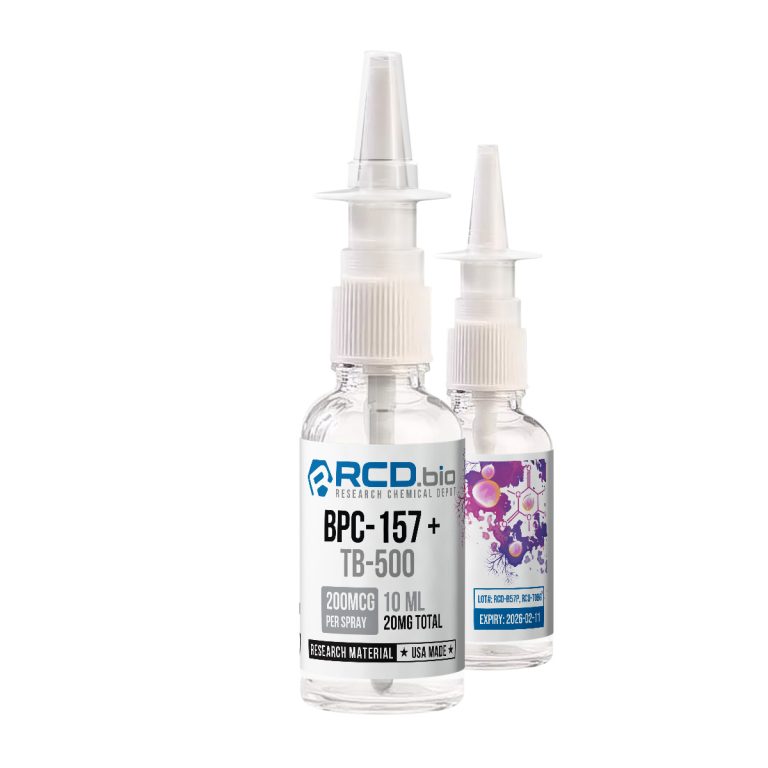
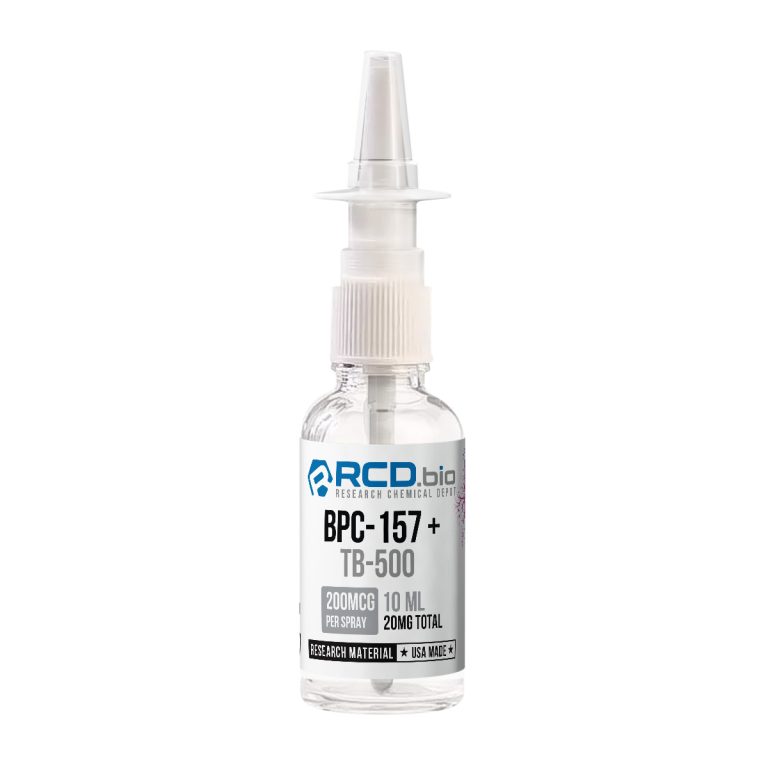
Description
What is BPC-157 + TB-500 Blend Nasal Spray?
BPC-157 + TB-500 Blend Nasal Spray is a dual-peptide research formulation combining two structurally and mechanistically distinct peptides in a single intranasal delivery vehicle: BPC-157 (Body Protection Compound-157; stable gastric pentadecapeptide; GEPPPGKPADDAGLV; 15 amino acids; MW 1419.556 g/mol; CAS 137525-51-0) and TB-500 (the N-terminal acetylated active fragment of thymosin beta-4; Ac-LKKTETQ; CAS 885340-08-9). BPC-157 is a synthetic pentadecapeptide first isolated and characterized by Predrag Sikiric and colleagues at the University of Zagreb School of Medicine from the partial sequence of the endogenous body protection compound found in human gastric juice. TB-500 is a synthetic N-terminal-acetylated heptapeptide fragment corresponding to residues 17-23 of thymosin beta-4 (Tb4), a 43-amino acid endogenous polypeptide involved in actin sequestration, cell migration, angiogenesis, and tissue repair. The acetylation at the N-terminus of the LKKTETQ sequence provides resistance to aminopeptidase-mediated degradation relative to the non-acetylated form. Both compounds are supplied as research-grade substances only.
Neither BPC-157 nor TB-500 has been approved as a registered pharmaceutical in any country. Both compounds were previously restricted under the FDA 503A Category 2 designation. BPC-157 was removed from Category 2 effective April 22, 2026; TB-500 was removed from Category 2 effective April 15, 2026. Both are scheduled for Pharmacy Compounding Advisory Committee (PCAC) evaluation at the July 23-24, 2026, hearing under Docket No. FDA-2025-N-6895, which will determine whether each compound may be added to the 503A authorized bulk substances list for compounding. Removal from Category 2 does not authorize compounding; no FDA-approved product contains BPC-157 or TB-500 in any formulation. Neither compound has completed human Phase 1 efficacy or safety trials for any indication as of June 2026.
No published peer-reviewed study has directly investigated the combination of BPC-157 and TB-500 in any model system as of June 2026. The rationale for co-formulation is based on the complementary but mechanistically distinct pathways of the two components: BPC-157 operates primarily through nitric oxide (NO) system modulation, EGR-1 gene expression, Fos and c-Jun proto-oncogene activation, and vascular endothelial recruitment; TB-500 operates primarily through actin-binding and sequestration, ILK/Akt pathway activation, and endothelial progenitor cell survival signaling. These are parallel rather than overlapping pathways in tissue repair and cytoprotection research contexts. The blend is supplied for investigation of these independent pathways under concurrent exposure conditions in preclinical cell and rodent model preparations.
The nasal spray formulation is investigated as a delivery route in preclinical research contexts, based on evidence of olfactory bulb-mediated CNS transport for peptide compounds administered intranasally in rodent models. Intranasal delivery has been studied for its potential to bypass hepatic first-pass metabolism and enhance CNS bioavailability relative to systemic routes in preclinical pharmacokinetic models. The nasal mucosa’s proximity to the central nervous system via the olfactory nerve makes it a research-relevant delivery route for CNS-active research compounds.
DISCLAIMER: BPC-157 + TB-500 Blend Nasal Spray as supplied by RCDbio is not a dietary supplement and has not been approved by the Food and Drug Administration for human use, veterinary use, consumption, or any therapeutic application. This product is not intended for human consumption or therapeutic self-administration. It is supplied exclusively for in vitro and preclinical laboratory research purposes. All RCDbio research compounds are for laboratory and research purposes only.
Chemical Properties of BPC-157 + TB-500 Blend
| Property | Detail |
| Product Type | Dual-Peptide Research Blend (BPC-157 + TB-500) |
| Product Name | BPC-157 + TB-500 Blend |
| Application | Scientific / Research Use Only |
| BPC-157 Component | |
| BPC-157 CAS Number | 137525-51-0 |
| BPC-157 Molar Mass | 1419.556 g/mol |
| BPC-157 Chemical Formula | C62H98N16O22 |
| BPC-157 PubChem CID | 9941957 |
| BPC-157 Sequence | Gly-Glu-Pro-Pro-Pro-Gly-Lys-Pro-Ala-Asp-Asp-Ala-Gly-Leu-Val (GEPPPGKPADDAGLV); 15 amino acids |
| BPC-157 Synonyms | Body Protection Compound-157; Bepecin; PL 14736; Stable gastric pentadecapeptide |
| TB-500 Component | |
| TB-500 CAS (Fragment) | 885340-08-9 (Ac-LKKTETQ, 7 AA active fragment; MW 889.018 g/mol; C38H68N10O14) |
| TB-500 CAS (Full Tβ4) | 77591-33-4 (full 43 AA thymosin beta-4; MW 4963.44 g/mol; C212H350N56O78S) – listed for disambiguation only; this product supplies the Ac-LKKTETQ fragment, not full Tβ4. Verify from COA. |
| TB-500 PubChem CID | 62707662 (Ac-LKKTETQ fragment) / 16132341 (full Tβ4) |
| TB-500 Active Sequence | Ac-Leu-Lys-Lys-Thr-Glu-Thr-Gln (Ac-LKKTETQ; residues 17–23 of Tβ4 = actin-binding domain) |
| TB-500 Synonyms | Thymosin Beta-4 fragment; Tβ4 fragment 17-23; Ac-LKKTETQ |
| Supplier Clarification | TB-500 designation varies — may refer to the 7 AA active fragment (MW 889) or the full 43 AA Tβ4 (MW 4963). Verify from the product COA which form is supplied. |
| Physical Form | Lyophilized white to off-white powder (blend) |
| Solubility | Both components soluble in sterile water and PBS |
| Storage (Lyophilized) | −20°C; sealed container; protected from light and moisture |
| Storage (Reconstituted) | 4°C; use within 48–72 hours; avoid repeated freeze-thaw cycles |
| Purity | ≥98% each component (HPLC verified, independent third-party laboratory analysis) |
| WADA Status | Both BPC-157 and TB-500 are prohibited under the 2026 WADA Prohibited List. BPC-157 falls under S0 (Non-Approved Substances). TB-500/Thymosin Beta-4 is explicitly prohibited under S2.3 (Growth Factors and Growth Factor Modulators), where “Thymosin-β4 and its derivatives e.g. TB-500” are named. Researchers in sport-adjacent contexts must verify the current status at GlobalDRO.com before use. |
How Does BPC-157 + TB-500 Blend Work?
The BPC-157 + TB-500 blend provides two mechanistically distinct compounds acting through complementary but non-overlapping signaling pathways in cytoprotection, tissue repair, and vascular biology research contexts. Neither compound operates through a single confirmed receptor; their effects are pleiotropic and have been characterized in multiple cell-type and tissue-type preparations. The following mechanistic observations are from preclinical and in vitro data only. No published study has directly characterized the mechanism of the combination of BPC-157 and TB-500 in any model system.
BPC-157: NO-System, EGR-1, and Vascular Endothelial Recruitment
BPC-157 has been characterized as a cytoprotective mediator that modulates the nitric oxide (NO) system, counteracts the effects of both L-NAME (NO synthesis inhibition) and L-arginine (NO system overactivation), and modulates dopamine, serotonin, and GABA neurotransmitter system function in rodent model preparations. BPC-157 activates EGR-1 gene expression and Fos/c-Jun proto-oncogenes, and has been demonstrated to promote vascular recruitment toward injury sites. As a cytoprotective mediator, BPC-157 demonstrates protective effects on both stomach cells and endothelial cells across multiple organ preparations, providing broad-based organoprotective effects in the GI tract and extra-GI tissue preparations including skin, tendon, ligament, muscle, bone, nerve, and brain-gut axis preparations [Sikiric et al., 2018; PMID 29879879; Sikiric et al., 2017; PMID 28228068].
BPC-157: GI Mucosa, Angiogenesis, and Stress Response Signaling
In gastrointestinal preparation model systems, BPC-157 demonstrates strong angiogenic potential, acts protectively on endothelium, prevents and reverses thrombus formation, and exhibits neuroprotective properties. BPC-157 healing activity has been investigated in intestinal anastomosis, gastrocutaneous, duodenocutaneous, and colocutaneous fistula preparations in rats, and has demonstrated efficacy in short-bowel syndrome preparations. BPC-157’s integrative mediator function encompasses gastrointestinal stress coping responses, including modulation of NO-system homeostasis, cytoprotective gene activation, and intestinal healing cascade initiation [Sikiric et al., 2011; PMID 21548867].
TB-500 (Ac-LKKTETQ): Actin-Binding, ILK/Akt Signaling, and Endothelial Progenitor Cell Survival
TB-500 (Ac-LKKTETQ) corresponds to the actin-binding domain of thymosin beta-4. The LKKTETQ sequence within the parent Tb4 protein is responsible for G-actin sequestration — binding monomeric actin and regulating actin polymerization dynamics critical for cell migration, cytoskeletal remodeling, and wound edge advancement. The parent compound thymosin beta-4 activates integrin-linked kinase (ILK) and inhibits apoptosis in endothelial progenitor cell (EPC) preparations under serum deprivation conditions. Tb4 causes concentration-dependent increases in EPC viability and proliferation activity, decreases caspase-3 and -9 expression, and markedly increases the Bcl-2/Bax ratio in EPC preparations. ILK-Akt activation is required for the anti-apoptotic effect, and JNK MAPK activation is also involved [Zhao et al., 2011; PMID 21935929]. These mechanistic observations characterize the parent 43 AA thymosin beta-4 protein; the extent to which the Ac-LKKTETQ fragment recapitulates ILK/Akt signaling has not been established in the published peer-reviewed literature as of June 2026.
Complementary Research Rationale for the Blend
BPC-157 and TB-500 address distinct aspects of cytoprotection and tissue repair signaling: BPC-157 operates primarily through NO-system modulation, EGR-1/Fos/c-Jun gene expression, and vascular recruitment; TB-500/Ac-LKKTETQ operates through actin-binding dynamics, ILK/Akt pathway activation, and EPC survival signaling. The dual-peptide blend is supplied to enable investigation of these complementary research pathways under concurrent exposure conditions. No published peer-reviewed study has directly investigated BPC-157 and TB-500 in combination; all mechanistic observations above apply to each component independently.
Intranasal Delivery & Pharmacokinetics
Olfactory Bulb-Mediated CNS Transport
When administered intranasally in preclinical rodent model systems, peptide compounds can access the central nervous system through the olfactory nerve (cranial nerve I) pathway. Compounds deposited on the olfactory mucosa are transported along olfactory axons through the cribriform plate to the olfactory bulb, from which access to deeper CNS structures has been characterized in rodent preparations. The olfactory and trigeminal nerve pathways for nose-to-brain peptide transport have been investigated in preclinical studies of peptide and protein delivery [Wong et al., 2024; PMID 38441832]. No compound-specific intranasal CNS delivery data has been published for either BPC-157 or TB-500 as of June 2026.
Class-Level Stability Context: BPC-157 Oral Bioactivity
BPC-157 is stable in human gastric juice for more than 24 hours and demonstrates oral bioactivity in rodent preparations, establishing baseline proteolytic resistance, distinguishing it from many research peptides. The N-terminal acetylation of Ac-LKKTETQ (TB-500) provides some resistance to aminopeptidase degradation relative to the non-acetylated form. Intranasal delivery bypasses GI proteolytic exposure for both components. These observations do not constitute evidence of intranasal efficacy in human subjects.
Nasal Mucosal Absorption
BPC-157 has a molar mass of 1419.556 g/mol (~1.42 kDa) and TB-500 (Ac-LKKTET,Q) has a molar mass of 889.018 g/mol (~0.89 kDa). Both compounds fall within the sub-1.5 kDa range, indicating paracellular and transcellular absorption mechanisms are plausible at the nasal mucosa. The smaller TB-500 fragment would be expected to have more favorable nasal mucosal absorption kinetics than BPC-157 based on molecular weight alone. Specific nasal mucosal permeability coefficients for either component or the combination have not been published.
Compound-Specific Pharmacokinetics
No formal intranasal pharmacokinetic data has been published for either BPC-157 or TB-500 as of June 2026. No published data characterizes the pharmacokinetic interaction or potential competitive absorption dynamics of the dual-peptide combination via the intranasal route. The in-use shelf life of the dual-peptide blend in aqueous solution is shorter (48-72 hours) than for single-peptide formulations in this range, reflecting increased stability complexity in co-formulation. Researchers should account for the complete absence of published intranasal-specific pharmacokinetic parameters and the absence of combination pharmacology data when designing laboratory protocols.
Key Research Findings
BPC-157 as Cytoprotective Mediator: Vascular Recruitment and GI Tract Healing (Rodent In Vitro and In Vivo Preparations): BPC-157 demonstrated cytoprotective mediator activity across multiple organ preparations, providing endothelium protection, activating blood vessels toward perforated defects and collateral pathways toward obstructed vessels, counteracting effects of L-NAME and L-arginine on the NO system, and demonstrating broad organoprotective activity in GI tract and extra-GI tissue preparations [Sikiric et al., 2018; PMID 29879879]
BPC-157 in GI Tract Therapy — Angiogenesis, Endothelium Protection, NO-System, and Neural Modulation (Rodent In Vitro and In Vivo Preparations): BPC-157 demonstrated strong angiogenic potential, endothelium-protective effects, prevention and reversal of thrombus formation, and healing activity across GI tract tissue model systems; neuroprotective properties and NO-system modulation were also characterized [Sikiric et al., 2011; PMID 21548867]
Thymosin Beta-4 Activates ILK/Akt and Inhibits Endothelial Progenitor Cell Apoptosis (Human EPC Cell Preparation): Thymosin beta-4 (full 43 AA form) caused concentration-dependent increases in EPC viability and proliferation, inhibited apoptosis under serum deprivation, decreased caspase-3 and -9 expression, increased Bcl-2/Bax ratio, and activated integrin-linked kinase (ILK)-Akt; ILK-siRNA abolishment confirmed ILK-Akt as the required anti-apoptotic pathway [Zhao et al., 2011; PMID 21935929]
Rows 1 and 2 characterize BPC-157 in rodent preparations originating from the Sikiric group at the University of Zagreb — a concentrated, single-source, evidence-based. Row 3 characterizes the full-length 43 AA thymosin beta-4 protein in human EPC cell preparations; the extent to which the Ac-LKKTETQ (TB-500) 7 AA fragment recapitulates ILK/Akt anti-apoptotic activity has not been established in the published peer-reviewed literature as of June 2026. No peer-reviewed study has directly investigated BPC-157 and TB-500 in combination in any model system. These observations do not constitute evidence of efficacy or safety for the BPC-157 + TB-500 blend nasal spray in any organism.
What are the Potential Research Applications?
In controlled laboratory environments, the BPC-157 + TB-500 blend nasal spray has been investigated for the following research applications. These are observed in preclinical and in vitro contexts only and do not constitute claims of efficacy or safety in any organism.
Complementary Cytoprotection and Tissue Repair Pathway Research
The dual-peptide blend enables concurrent investigation of two mechanistically distinct tissue repair signaling pathways. Research applications include comparative pathway analysis of NO-system modulation (BPC-157) versus actin-binding/ILK-Akt activation (TB-500/Tb4) in matched cell preparations, concurrent cytoprotection assay systems investigating contributions of each component, and investigation of whether the two pathways exhibit additive, neutral, or antagonistic interactions under concurrent exposure in GI mucosa, endothelial, and connective tissue cell preparations.
Vascular Biology and Angiogenesis Research
BPC-157 vascular recruitment signaling and TB-500/Tb4 endothelial progenitor cell survival and proliferation effects represent complementary vascular biology research tools. Research applications include endothelial tube formation and angiogenesis assays in HUVEC and EPC preparations, collateral vessel activation model systems, and comparative vascular recruitment characterization for each component and the blend in rodent ischemia model preparations.
GI Mucosa and Cytoprotection Research
BPC-157 is the primary research tool for NO-system modulation and GI mucosal cytoprotection in rodent model systems. Research applications include gastric and intestinal mucosal integrity assays, alcohol- and NSAID-induced lesion model preparations, and investigation of fistula healing and anastomosis model systems using BPC-157 as the cytoprotective reference compound, with TB-500 as a parallel actin-dynamics comparator.
Intranasal Dual-Peptide Delivery Research
The blend’s dual-peptide composition makes it a research tool for investigating co-delivery pharmacokinetics, potential competitive nasal mucosal absorption between two peptides of different molecular weights, and nose-to-brain transport of the smaller TB-500 fragment versus the larger BPC-157 component in rodent olfactory model preparations.
What are the Potential Side Effects?
Researchers in preclinical and in vitro settings have noted the following observations. Long-term safety and toxicity profiles remain incompletely characterized for the research-grade dual-peptide nasal spray blend.
- BPC-157 preclinical safety profile — favorable but single-source (preclinical): BPC-157 has demonstrated no lethal dose (LD1 not achieved) in toxicology studies and no reported toxicity in phase II ulcerative colitis trials cited in the Sikiric group literature; this observation does not constitute a formal toxicology assessment for the nasal spray formulation or for human use, and the single-source nature of the BPC-157 evidence base limits independent validation
- TB-500/Ac-LKKTETQ safety profile — incompletely characterized (preclinical): No completed human clinical trials for TB-500 (the Ac-LKKTETQ fragment) have been published as of June 2026; human clinical data involving the full-length 43 AA thymosin beta-4 protein does not transfer directly to the TB-500 fragment administered intranasally
- NO-system modulation risk via inadvertent intranasal self-exposure (BPC-157): BPC-157 modulates both L-NAME and L-arginine pathways of the NO system; inadvertent intranasal self-exposure carries a theoretical risk of NO-system perturbation, including transient blood pressure effects consistent with NO-system modulation
- Combination interaction — unknown: No published safety or pharmacological interaction data exists for BPC-157 and TB-500 in combination via any route; potential interaction between NO-system (BPC-157) and ILK/Akt (TB-500/Tb4) pathways under concurrent intranasal exposure has not been characterized in any model system
- Increased aqueous instability of the dual-peptide blend: The 48-72 hour in-use shelf life is substantially shorter than for single-peptide formulations; degradation products in aged blend solutions may carry safety implications not characterized for either component alone
- Absence of intranasal-specific safety data for either component: No safety or tolerability data specific to the intranasal route of administration for BPC-157 or TB-500 has been published in the peer-reviewed literature as of June 2026
No human safety or tolerability data has been established for the BPC-157 + TB-500 blend nasal spray. These observations are derived from experimental systems and should not be extrapolated to human or animal outcomes.
Risk & Handling
Handling Precautions
Standard laboratory PPE is required: nitrile gloves, a laboratory coat, and eye protection. The following nasal spray-specific precautions apply:
- Do not direct the nasal spray actuator toward the face, eyes, or mucous membranes during handling, testing, or transfer. BPC-157 modulates the NO system; TB-500/Ac-LKKTETQ activates ILK/Akt signaling in endothelial and progenitor cell preparations. Inadvertent intranasal self-exposure carries a theoretical risk of systemic NO-system and vascular signaling effects for which no human safety data has been established.
- Handle the nasal spray solution in a clean laboratory environment. For aliquoting or analytical sampling, use a laminar flow cabinet.
- The nasal spray solution is a dual-peptide formulation with a substantially shorter in-use shelf life (48-72 hours) than single-peptide formulations. Handle under aseptic conditions. Discard if the solution appears cloudy, discolored, or shows particulate matter, or after 48-72 hours from first actuation, regardless of appearance.
- Avoid aerosol generation during any manipulation of the nasal spray solution.
Exposure Risks
Risk Tier: LOW-MODERATE (dual-component; combination interaction not characterized)
BPC-157 has a well-documented favorable preclinical safety profile across multiple rodent preparation model systems. TB-500 (Ac-LKKTETQ) has a limited published safety profile with no completed human trials for the fragment form. The pharmacological interaction of the two components under concurrent intranasal exposure has not been characterized in any model system. No human safety or tolerability data has been established for either component via the intranasal route. Researchers should treat this blend with precautions appropriate to two pharmacologically active peptides with WADA-prohibited status.
Storage
In-use nasal spray: Store at 2-8 degrees C. Use within 48-72 hours of first actuation. Protect from light. Keep upright. Discard after 48-72 hours from first actuation regardless of remaining volume.
DO NOT FREEZE the ready-to-use nasal spray formulation. Freezing alters pH, buffer integrity, excipient stability, and spray actuation properties.
Lyophilized bulk stock (if applicable): Store at -20 degrees C in sealed, desiccated, light-protected containers. Avoid repeated freeze-thaw cycles.
Discard any solution that appears cloudy, discolored, or shows visible particulate matter.
FAQs
Q: How does intranasal delivery of the BPC-157 + TB-500 blend access relevant research targets in preclinical models?
A: Both components are small peptides (BPC-157 ~1.42 kDa; TB-500 ~0.89 kDa) with favorable molecular weights for nasal mucosal absorption. The intranasal route bypasses hepatic first-pass metabolism and provides access to systemic circulation and, via olfactory nerve transport, to CNS targets. BPC-157 is stable in human gastric juice and demonstrates oral bioactivity in rodent preparations, suggesting baseline peptidase resistance. The N-terminal acetylation of Ac-LKKTETQ provides some resistance to aminopeptidase degradation. No compound-specific intranasal data exists for either component [Wong et al., 2024; PMID 38441832]. No human intranasal delivery data has been established for either component or the combination.
Q: What is the in-use shelf life, and why is it shorter than other RCDbio nasal spray formulations?
A: Once first actuated, the blend should be used within 48-72 hours and stored at 2-8 degrees C. The shorter shelf life reflects the increased stability complexity of co-formulating two structurally distinct peptides in aqueous solution. Both components may interact with the shared vehicle in ways that accelerate degradation relative to single-peptide formulations. DO NOT FREEZE. Discard after 48-72 hours regardless of remaining volume.
Q: Is the BPC-157 + TB-500 blend nasal spray suitable for cell culture or in vitro assay systems?
A: The formulation is prepared in sterile PBS (pH 7.0-7.4) without preservatives. Dilution into culture medium before application is recommended to normalize osmolarity. Researchers should account for both BPC-157 (NO-system modulator) and TB-500/Tb4 class (ILK/Akt activator, G-actin binding) activity when designing assay systems, including endothelial or progenitor cell populations. Researchers are responsible for confirming compatibility with their specific assay system.
Q: What is the mechanistic rationale for combining BPC-157 and TB-500 in a single formulation?
A: BPC-157 and TB-500 operate through complementary but mechanistically distinct pathways. BPC-157 acts through NO-system modulation, EGR-1 and Fos/c-Jun gene activation, and vascular endothelial recruitment [Sikiric et al., 2018; PMID 29879879]. TB-500/Ac-LKKTETQ acts through G-actin sequestration and ILK/Akt signaling as characterized for the Tb4 parent protein in EPC preparations [Zhao et al., 2011; PMID 21935929]. The rationale is the investigation of these parallel pathways under concurrent exposure conditions. No published peer-reviewed study has directly investigated BPC-157 and TB-500 in combination; interaction data do not exist.
Q: What is the WADA status of this blend?
A: Both components are prohibited under the 2026 WADA Prohibited List. BPC-157 falls under S0 (Non-Approved Substances — unapproved pharmacological substances prohibited at all times). TB-500 is explicitly prohibited under S2 (Peptide Hormones, Growth Factors, Related Substances and Mimetics), with thymosin beta-4 and its derivatives, including TB-500, named under S2.3. Researchers in sport-adjacent contexts must verify their current status at GlobalDRO.com. RCDbio products are for laboratory research purposes only.
Q: What is the FDA regulatory status of this blend?
A: Neither BPC-157 nor TB-500 is FDA-approved for any indication. Both were removed from FDA 503A Category 2 in April 2026 and are scheduled for PCAC evaluation at the July 23-24, 2026 hearing (Docket No. FDA-2025-N-6895). Removal from Category 2 does not authorize compounding. The research-grade blend nasal spray is for laboratory research use only.
Q: How does the TB-500 component differ from full-length thymosin beta-4?
A: TB-500 (Ac-LKKTETQ; CAS 885340-08-9; MW ~889 g/mol) is a synthetic N-terminal-acetylated heptapeptide fragment corresponding to the actin-binding domain of thymosin beta-4 at residues 17-23. Full-length Tb4 (CAS 77591-33-4; MW ~4963 g/mol) is a 43-amino acid protein with a broader activity profile. Human clinical data were generated with full-length Tb4, not the TB-500 fragment. The two molecules are chemically distinct with different CAS numbers and regulatory histories. Verify from the product COA which form is supplied.
Related Research Compounds
Researchers investigating BPC-157 + TB-500 blend nasal spray may also be interested in the following compounds currently available for laboratory research at RCDbio:
BPC-157 Nasal Spray — The single-component stable gastric pentadecapeptide formulation for researchers investigating BPC-157 cytoprotective signaling, NO-system modulation, and vascular recruitment independently of TB-500 activity.
PEG-MGF Nasal Spray— A pegylated mechano growth factor E-peptide analog investigated for skeletal muscle satellite cell activation and IGF-1 receptor-related anabolic signaling in tissue repair research contexts.
MOTS-c Nasal Spray — A mitochondrial-derived peptide investigated for AMPK-mediated metabolic homeostasis and cytoprotection in preclinical model systems relevant to cellular stress and repair pathway research.
All products listed are for laboratory and research purposes only.
References
- Sikiric, P., Rucman, R., Turkovic, B., Sever, M., Klicek, R., Radic, B., Drmic, D., Stupnisek, M., Misic, M., Vuletic, L.B., Pavlov, K.H., Barisic, I., Kokot, A., Peklic, M., Strbe, S., Blagaic, A.B., Tvrdeic, A., Rokotov, D.S., Vrcic, H., Staresinic, M., & Seiwerth, S. (2018). Novel cytoprotective mediator, stable gastric pentadecapeptide BPC 157. Vascular recruitment and gastrointestinal tract healing. Current Pharmaceutical Design, 24(18), 1990-2001.
https://pubmed.ncbi.nlm.nih.gov/29879879/
- Sikiric, P., Seiwerth, S., Rucman, R., Turkovic, B., Rokotov, D.S., Brcic, L., Sever, M., Klicek, R., Radic, B., Drmic, D., Ilic, S., Kolenc, D., Vrcic, H., & Sebecic, B. (2011). Stable gastric pentadecapeptide BPC 157: novel therapy in the gastrointestinal tract. Current Pharmaceutical Design, 17(16), 1612-1632.
https://pubmed.ncbi.nlm.nih.gov/21548867/
- Sikiric, P., Seiwerth, S., Rucman, R., Drmic, D., Stupnisek, M., Kokot, A., Sever, M., Zoricic, I., Zoricic, Z., Batelja, L., Ziger, T., Luetic, K., Vlainic, J., Rasic, Z., & Bencic, M.L. (2017). Stress in the gastrointestinal tract and stable gastric pentadecapeptide BPC 157. Finally, do we have a solution? Current Pharmaceutical Design, 23(27), 4012-4028.
https://pubmed.ncbi.nlm.nih.gov/28228068/
- Zhao, Y., Qiu, F., Xu, S., Yu, L., & Fu, G. (2011). Thymosin beta4 activates integrin-linked kinase and decreases endothelial progenitor cells’ apoptosis under serum deprivation. Journal of Cellular Physiology, 226(11), 2798-2806.
https://pubmed.ncbi.nlm.nih.gov/21935929/
- Wong, C.Y.J., Baldelli, A., Hoyos, C.M., et al. (2024). Insulin delivery to the brain via the nasal route: unraveling the potential for Alzheimer’s Disease therapy. Drug Delivery and Translational Research, 14(7), 1776-1793.
https://pubmed.ncbi.nlm.nih.gov/38441832/
Research Transparency Note: No peer-reviewed publications specific to intranasal delivery of BPC-157, TB-500, or their combination are available as of June 2026. References 1, 2, and 3 characterize BPC-157 in rodent preparations from a single research group (Sikiric group, University of Zagreb); independent replication of the full range of reported BPC-157 effects is limited. Reference 4 characterizes the full-length 43 AA thymosin beta-4 protein (not the TB-500 Ac-LKKTETQ fragment) in human EPC cell preparations; ILK/Akt data for the Ac-LKKTETQ fragment has not been published as of June 2026. Reference 5 provides class-level intranasal peptide delivery evidence. No published peer-reviewed study has directly investigated BPC-157 and TB-500 in combination; all combination research rationale is mechanistic inference only.
Disclaimer
BPC-157 + TB-500 Blend Nasal Spray is exclusively for laboratory research purposes. RCDbio products are not intended to diagnose, prevent, treat, or cure any disease or medical condition.
The Food and Drug Administration has not evaluated the statements on our website. This product is not approved for human or veterinary use. Researchers must comply with all applicable local, state, and federal laws and regulations governing the purchase and use of research compounds. By purchasing, you agree to our Terms and Conditions. RCDbio reserves the right to refuse sales to unauthorized individuals.
ATTENTION: All RCDbio products are strictly for LABORATORY AND RESEARCH PURPOSES ONLY. They are not intended for human consumption, veterinary use, or any other non-research application. For queries, complaints, or support, contact support@legacy.rcdbio.co
Reviews
There are no reviews yet