

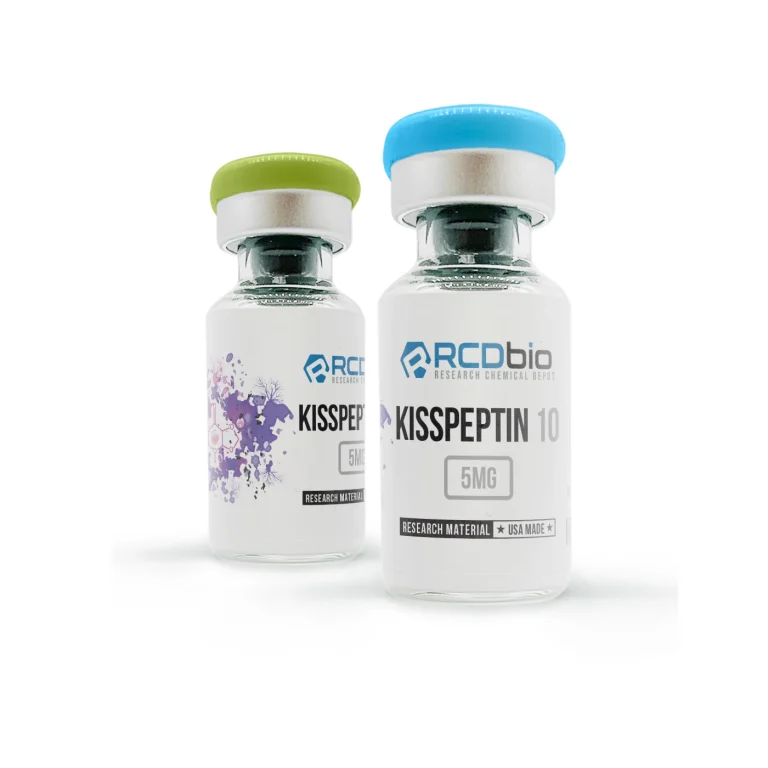
Description
What is Kisspeptin-10?
Kisspeptin-10 (KP-10) is a synthetic decapeptide corresponding to the C-terminal 10 amino acids of the KISS1 gene product (kisspeptin-54) — specifically, residues 112–121 of the KISS1 protein, also referred to as Metastin(45–54). Its sequence is Tyr-Asn-Trp-Asn-Ser-Phe-Gly-Leu-Arg-Phe-NH2 (YNWNSFGLRF-NH2) with a C-terminal amide. Kisspeptin-10 is the minimum peptide length required to bind and fully activate KISS1R (also designated GPR54), the endogenous kisspeptin receptor, making it the smallest biologically active kisspeptin isoform. It binds both rat and human KISS1R with high affinity (rat Ki = 1.59 nM; human Ki = 2.33 nM; Tocris).
The KISS1 gene was first identified in 1996 by Lee et al. during a systematic study of human melanoma metastasis — it was named after Hershey’s Kisses chocolates, as it was discovered near the famous confectionery’s birthplace in Hershey, Pennsylvania. The gene was initially described as a metastasis suppressor. Subsequently, KISS1 was independently identified as the gene encoding metastin — a neuropeptide characterised in Japan for its regulation of pituitary gonadotropin secretion —, and the connection between KISS1, its receptor GPR54/KISS1R, and the hypothalamic-pituitary-gonadal (HPG) axis was established in 2003 through two simultaneously published landmark studies demonstrating that loss-of-function mutations in GPR54 cause idiopathic hypogonadotropic hypogonadism in humans and mice.
Kisspeptin-10’s primary characterised biological activity is activation of hypothalamic GnRH (gonadotropin-releasing hormone) neurons — the master regulators of reproductive function — triggering GnRH pulse release and subsequent LH (luteinising hormone) and FSH (follicle-stimulating hormone) secretion from the anterior pituitary. Kisspeptin neurons in the arcuate nucleus (ARC) — specifically the KNDy (kisspeptin/neurokinin B/dynorphin) neuron population — are now recognised as the principal driver of pulsatile GnRH secretion and the conduit through which steroid hormone feedback (oestrogen and testosterone) regulates reproductive cyclicity.
Kisspeptin-10 is not approved by the Food and Drug Administration for human or veterinary use. It is not a dietary supplement and is not intended for human consumption or self-administration. All RCDbio research compounds are supplied strictly for laboratory and research purposes only.
Chemical Properties
| Property | Detail |
| Product Type | Synthetic Decapeptide / KISS1R Agonist / Minimum Active Kisspeptin Sequence |
| Product Name | Kisspeptin-10 (KP-10) |
| Application | Scientific / Research Use Only |
| CAS Number | 374675-21-5 |
| Molar Mass | 1302.45 g/mol |
| Chemical Formula | C63H83N17O14 |
| PubChem CID | 25240297 |
| IUPAC Name | (2S)-N-[(2S)-1-[[(2S)-4-amino-1-[[(2S)-1-[[(2S)-1-[[2-[[(2S)-1-[[(2S)-1-[[(2S)-1-amino-1-oxo-3-phenylpropan-2-yl]amino]-5-(diaminomethylideneamino)-1-oxopentan-2-yl]amino]-4-methyl-1-oxopentan-2-yl]amino]-2-oxoethyl]amino]-1-oxo-3-phenylpropan-2-yl]amino]-3-hydroxy-1-oxopropan-2-yl]amino]-1,4-dioxobutan-2-yl]amino]-3-(1H-indol-3-yl)-1-oxopropan-2-yl]-2-[[(2S)-2-amino-3-(4-hydroxyphenyl)propanoyl]amino]butanediamide |
| Amino Acid Sequence | Tyr-Asn-Trp-Asn-Ser-Phe-Gly-Leu-Arg-Phe-NH2 (YNWNSFGLRF-NH2); 10 amino acids; C-terminal amide |
| Origin in Full Sequence | Corresponds to KISS1 protein residues 112–121; C-terminal decapeptide of kisspeptin-54; also designated Metastin(45–54) |
| KISS1R Binding Affinity | Ki = 1.59 nM (rat KISS1R); Ki = 2.33 nM (human KISS1R) in competitive radioligand binding assays (Tocris) |
| Receptor | KISS1R (GPR54; Class A Gαq-coupled GPCR; also activates Gαi12/13, β-arrestin) |
| Signalling Pathway | Gαq/IP3/Ca²⁺ primary pathway; inositol phosphate accumulation; PKC activation; MAP kinase signalling |
| Parent Isoforms | Kisspeptin-54 (KP-54; 54 AA; most abundant natural isoform); KP-14 (14 AA); KP-13 (13 AA); KP-10 (10 AA; minimum active fragment) |
| Synonyms | KP-10; Metastin(45–54); KISS-1(112–121) amide; H-YNWNSFGLRF-NH2; KiSS-1 gene product (human, 112–121) |
| Discovery | KISS1 gene first identified by Lee et al. 1996 (melanoma metastasis suppressor); KISS1R role in HPG axis established 2003 (de Roux et al.; Seminara et al.) |
| Physical Form | Lyophilized white powder |
| Solubility | Freely soluble in water; soluble in PBS and standard aqueous buffers |
| Storage (Lyophilized) | −20°C; sealed container; protected from light and moisture |
| Storage (Reconstituted) | 4°C; use within 48–72 hours; avoid repeated freeze-thaw cycles |
| Purity | ≥98% (HPLC verified, independent third-party laboratory analysis) |
| WADA Status | Kisspeptin-10 is not explicitly named on the 2026 WADA Prohibited List by individual name. As a non-approved research-grade neuropeptide agonist with HPG axis-stimulating activity (LH/FSH elevation via GnRH), S2 (peptide hormones stimulating GnRH and downstream gonadotropins) provisions may apply in sport-adjacent research contexts. Verify at GlobalDRO.com before use. |
How Does Kisspeptin-10 Work?
Kisspeptin-10 activates KISS1R (GPR54) — a class A Gαq-coupled GPCR expressed predominantly on hypothalamic GnRH neurons and at lower levels in pituitary, gonads, and peripheral tissues — initiating a signalling cascade that drives GnRH pulse release and downstream HPG axis activation.
KISS1R Gαq/IP3/Calcium Pathway — GnRH Neuron Activation
Kisspeptin-10 binding to KISS1R on hypothalamic GnRH neurons initiates Gαq-mediated phospholipase C activation, generating IP3-mediated intracellular calcium release from the endoplasmic reticulum and DAG-mediated PKC activation. This calcium signalling depolarises GnRH neurons, triggering action potential firing and GnRH pulse release into the hypothalamo-hypophyseal portal system. In electrophysiology preparations of GnRH neurons, kisspeptin-10 increases GnRH neuron firing frequency and amplitude directly, establishing a direct excitatory connection between KISS1R signalling and GnRH pulse generation [Navarro et al., 2004].
Kisspeptin-10 as the GnRH Pulse Generator Trigger
KNDy neurons in the hypothalamic arcuate nucleus (ARC) — which co-express kisspeptin, neurokinin B (NKB), and dynorphin (Dyn) — are now recognised as the intrinsic GnRH pulse generator. The internal oscillator mechanism involves: NKB (via NK3R on KNDy neurons) triggering synchronised KNDy neuron activation → simultaneous kisspeptin release onto GnRH nerve terminals → coordinated GnRH pulse; then dynorphin providing autoinhibitory feedback to reset the oscillator for the next pulse. Kisspeptin-10 administered exogenously activates this system by directly stimulating KISS1R on GnRH neuron terminals.
LH and FSH Secretion Downstream
GnRH released by kisspeptin-10-stimulated GnRH neurons reaches anterior pituitary gonadotroph cells via the portal system, binding GnRH receptor (GnRHR) and triggering LH and FSH secretion. In rodent and human preparations, Kisspeptin-10 administration produces robust, dose-dependent LH pulses within 15–30 minutes — providing a pharmacological tool for studying gonadotropin secretion dynamics in preclinical fertility and reproductive endocrinology research [Navarro et al., 2004].
Steroid Hormone Feedback Gateway
Kisspeptin neurons are the primary integration point for estrogen and testosterone negative feedback regulation of GnRH secretion. Kisspeptin-10 can override this negative feedback in experimental conditions, making it useful for studying how steroid hormone levels modulate GnRH pulse frequency and amplitude in reproductive cycle research. In female rodents, the kisspeptin surge from anteroventral periventricular nucleus (AVPV) kisspeptin neurons is responsible for the preovulatory LH surge.
Anti-Metastatic Activity
The original KISS1 characterisation as a melanoma metastasis suppressor reflects a distinct biological function from the reproductive neuroendocrine pathway. In mouse melanoma cell preparations, kisspeptin-10 inhibits metastasis and invasion through KISS1R-mediated actin cytoskeletal remodelling and matrix metalloproteinase regulation — an activity that has generated research interest in KISS1R as a therapeutic target in cancer biology.
Key Research Findings
In preclinical and in vitro research contexts, Kisspeptin-10 has been associated with the following observations:
- GnRH/LH stimulation: ICV administration of Kisspeptin-10 produced significant LH and FSH increases in rodent preparations within 30 minutes; described as one of the most potent known stimulators of the GnRH/LH axis at that time [Navarro et al., 2004].
- Human KISS1R binding: Ki = 2.33 nM at human KISS1R in radioligand binding assays (Tocris); Ki = 1.59 nM at rat KISS1R — confirming high-affinity receptor engagement across species.
- KNDy neuron pulse generation: Kisspeptin-10 exogenous administration synchronises KNDy neuron activity and GnRH pulse release in rodent hypothalamic slice electrophysiology preparations; confirmed role as primary GnRH pulse generator trigger.
- Puberty regulation: Loss-of-function mutations in KISS1R cause idiopathic hypogonadotropic hypogonadism; gain-of-function mutations cause central precocious puberty — establishing KISS1R as the reproductive neuroendocrine master switch.
- Anti-metastatic activity: Kisspeptin-10 inhibited metastasis and invasion in mouse melanoma model preparations [Lee et al., 1996]; actin cytoskeletal remodelling and MMP regulation characterised as mechanisms.
All findings listed above are derived from preclinical in vitro and in vivo data. No regulatory-grade human clinical trial data have been established for research-grade Kisspeptin-10. These observations do not constitute evidence of efficacy or safety in any human condition or organism.
What are the Potential Research Applications?
GnRH Pulse Generator and HPG Axis Research Kisspeptin-10 is the primary pharmacological tool for investigating GnRH pulse generation, LH/FSH secretion dynamics, and HPG axis regulatory pharmacology. Research employs Kisspeptin-10 in hypothalamic slice electrophysiology, in vivo GnRH pulse monitoring (blood sampling), and ICV administration paradigms to characterise KNDy neuron oscillator function in rodent reproductive endocrinology models.
KISS1R Receptor Pharmacology In KISS1R-expressing cell preparations, Kisspeptin-10 is employed in radioligand binding assays, inositol phosphate accumulation assays, calcium mobilisation studies, and β-arrestin recruitment assays to define KISS1R pharmacology — providing the reference agonist for characterising KISS1R agonists, antagonists, and biased ligands in drug discovery research.
Fertility and Reproductive Cycle Research. In rodent models of reproductive dysfunction, hypogonadotropic hypogonadism, and polycystic ovary syndrome (PCOS), Kisspeptin-10 is investigated for its capacity to restore GnRH pulsatility, normalise LH/FSH secretion profiles, and trigger ovulation in anovulatory models.
Steroid Hormone Feedback and Puberty Research: Kisspeptin-10 is employed in ovariectomised and intact female rodent preparations to characterise estrogen-mediated negative and positive feedback on KNDy neuron kisspeptin release, investigating the neuroendocrine mechanisms governing reproductive cyclicity, preovulatory LH surge, and pubertal timing.
KISS1 Metastasis Suppressor and Cancer Biology Research. In melanoma, breast cancer, and prostate cancer cell line preparations, Kisspeptin-10 is investigated for KISS1R-mediated anti-metastatic pathway activation, actin cytoskeletal remodelling, and MMP regulation — research examining KISS1R as a therapeutic target in oncology contexts.
What are the Potential Side Effects?
The following observations are from preclinical research and limited human clinical study data on kisspeptin preparations.
- Generally well-tolerated profile in preclinical rodent studies and limited human kisspeptin infusion studies at research-relevant doses
- LH and FSH elevation is the primary expected pharmacological effect — relevant in research contexts where HPG axis activation would confound experimental outcomes
- Flushing and mild nausea were reported at low frequency in some human kisspeptin infusion studies — attributed to downstream LH pulse effects
- Tryptophan residue at position 3 (Trp3) is susceptible to photodegradation — light exposure during storage and handling must be minimised
- No human safety data established for research-grade Kisspeptin-10 outside approved study contexts
Risk & Handling
Handling Precautions
Kisspeptin-10 should only be handled by trained laboratory personnel. Appropriate PPE: nitrile gloves, lab coat, eye protection. Use in a laminar flow cabinet. Avoid aerosol generation. The tryptophan residue at position 3 is photosensitive — protect from UV and prolonged light exposure throughout handling and storage.
Exposure Risks
Risk Tier: LOW–MODERATE
Kisspeptin-10 is a potent HPG axis-stimulating neuropeptide. Accidental systemic exposure may produce GnRH pulse trigger and subsequent LH/FSH secretion — potentially significant confounders in reproductive endocrinology research contexts. The decapeptide’s expected rapid plasma clearance limits exposure duration. No human safety data for research-grade material.
Storage
- Lyophilized: −20°C; sealed; light-protected; desiccated
- Reconstituted: 4°C; 48–72 hours; protect from light; Trp3 photosensitive
Frequently Asked Questions
Q: What is Kisspeptin-10, and why is it important in reproductive biology research? A: Kisspeptin-10 (YNWNSFGLRF-NH2; CAS 374675-21-5; MW 1302.45 g/mol) is the minimum active C-terminal decapeptide of the KISS1 gene product, binding KISS1R with Ki = 1.59–2.33 nM. It is the primary pharmacological tool for activating hypothalamic GnRH neurons via the KISS1R/Gαq/IP3/calcium pathway, triggering GnRH pulse release and subsequent LH/FSH secretion. It is employed in reproductive endocrinology research investigating GnRH pulse generation, HPG axis regulation, fertility pathway modulation, and steroid hormone feedback mechanisms.
Q: What is the connection between Kisspeptin-10 and the GnRH pulse generator? A: KNDy neurons in the hypothalamic arcuate nucleus co-express kisspeptin, neurokinin B, and dynorphin. These neurons form the intrinsic GnRH pulse generator through a synchronised oscillation mechanism where NKB triggers KNDy neuron activation → kisspeptin release onto GnRH nerve terminals → coordinated GnRH pulse. Kisspeptin-10 exogenously activates this system by engaging KISS1R on GnRH terminals, making it the primary pharmacological tool for studying GnRH pulse generator biology.
Q: Why was KISS1 originally identified as a metastasis suppressor? A: The KISS1 gene was first identified in 1996 by Lee et al., comparing metastatic versus non-metastatic human melanoma cells — it was found to suppress metastasis and was named after Hershey’s Kisses. Only later was the gene product (metastin/kisspeptin) identified as a potent activator of GnRH secretion via KISS1R. Both functions are real: KISS1R activation inhibits melanoma and other cancer cell metastasis through actin remodelling and MMP regulation, while simultaneously being the endogenous regulator of reproductive HPG axis pulsatility.
Q: What is the relationship between Kisspeptin-10 and kisspeptin-54? A: Kisspeptin-54 (54 AA) is the most abundant naturally occurring KISS1 cleavage product — it contains the Kisspeptin-10 (YNWNSFGLRF) C-terminal sequence. Kisspeptin-10 is derived from the C-terminal end of kisspeptin-54. All kisspeptin isoforms (KP-54, KP-14, KP-13, KP-10) share this C-terminal sequence and produce comparable KISS1R activation per molecule. KP-10 is the minimum active sequence; longer forms add pharmacokinetic properties without adding receptor activation potency.
Q: How should Kisspeptin-10 be stored? A: Lyophilized Kisspeptin-10 should be stored at −20°C in a sealed, light-protected container with desiccant. Once reconstituted, store at 4°C and use within 48–72 hours. The tryptophan at position 3 is photosensitive — protect from UV and prolonged visible light throughout storage and handling. Avoid repeated freeze-thaw cycles.
Related Research Compounds
- VIP — 28-AA neuropeptide investigated for hypothalamic neuroendocrine modulation via VPAC1/VPAC2; shares the hypothalamic neuropeptide signalling and reproductive neuroendocrinology research context with Kisspeptin-10.
- DSIP — Synthetic nonapeptide investigated for neuroendocrine HPA axis modulation; shares the hypothalamic neuropeptide and neuroendocrine regulatory pathway research context with Kisspeptin-10.
- Selank — Synthetic heptapeptide investigated for GABAergic and neuroendocrine pathway modulation; shares the neuropeptide-mediated neuroendocrine signalling research context with Kisspeptin-10.
All products listed are for laboratory and research purposes only.
References
- Navarro, V. M., Fernández-Fernández, R., Castellano, J. M., Roa, J., Mayen, A., Barreiro, M. L., Gaytan, F., Aguilar, E., Pinilla, L., Dieguez, C., & Tena-Sempere, M. (2004). Advanced vaginal opening and precocious activation of the reproductive axis by KiSS-1 peptide, the endogenous ligand of GPR54. Journal of Physiology, 561(2), 379–386. https://pubmed.ncbi.nlm.nih.gov/15459241/
- de Roux, N., Genin, E., Carel, J. C., Matsuda, F., Chaussain, J. L., & Milgrom, E. (2003). Hypogonadotropic hypogonadism due to loss of function of the KiSS1-derived peptide receptor GPR54. Proceedings of the National Academy of Sciences USA, 100(19), 10972–10976. https://pubmed.ncbi.nlm.nih.gov/12944565/
- Seminara, S. B., Messager, S., Chatzidaki, E. E., Thresher, R. R., Acierno, J. S., Shagoury, J. K., Bo-Abbas, Y., Kuohung, W., Schwinof, K. M., Hendrick, A. G., Zahn, D., Dixon, J., Kaiser, U. B., Slaugenhaupt, S. A., Gusella, J. F., O’Rahilly, S., Carlton, M. B., Crowley, W. F., Bhatt, D. L., & Bhattacharya, K. (2003). The GPR54 gene is a regulator of puberty. New England Journal of Medicine, 349(17), 1614–1627. https://pubmed.ncbi.nlm.nih.gov/14573733/
- Muir, A. I., Chamberlain, L., Elshourbagy, N. A., Michalovich, D., Moore, D. J., Calamari, A., Szekeres, P. G., Sarau, H. M., Chambers, J. K., Murdock, P., Steplewski, K., Shabon, U., Miller, J. E., Middlemiss, D. N., Darker, J. G., Livi, G. P., Wilson, S., Bergsma, D. J., & Chambers, J. (2001). AXOR12, a novel human G protein-coupled receptor, is activated by the peptide KiSS-1. Journal of Biological Chemistry, 276(31), 28969–28975. https://pubmed.ncbi.nlm.nih.gov/11387446/
Disclaimer
Kisspeptin-10 is exclusively for laboratory research purposes. RCDbio products are not intended to diagnose, prevent, treat, or cure any disease or medical condition.
The Food and Drug Administration has not evaluated the statements on our website. This product is not approved for human or veterinary use. Researchers must comply with all applicable local, state, and federal laws and regulations governing the purchase and use of research compounds. By purchasing, you agree to our Terms and Conditions. RCDbio reserves the right to refuse sales to unauthorized individuals.
ATTENTION: All RCDbio products are strictly for LABORATORY AND RESEARCH PURPOSES ONLY. They are not intended for human consumption, veterinary use, or any other non-research application. For queries, complaints, or support, contact support@legacy.rcdbio.co

Reviews
There are no reviews yet