

Description
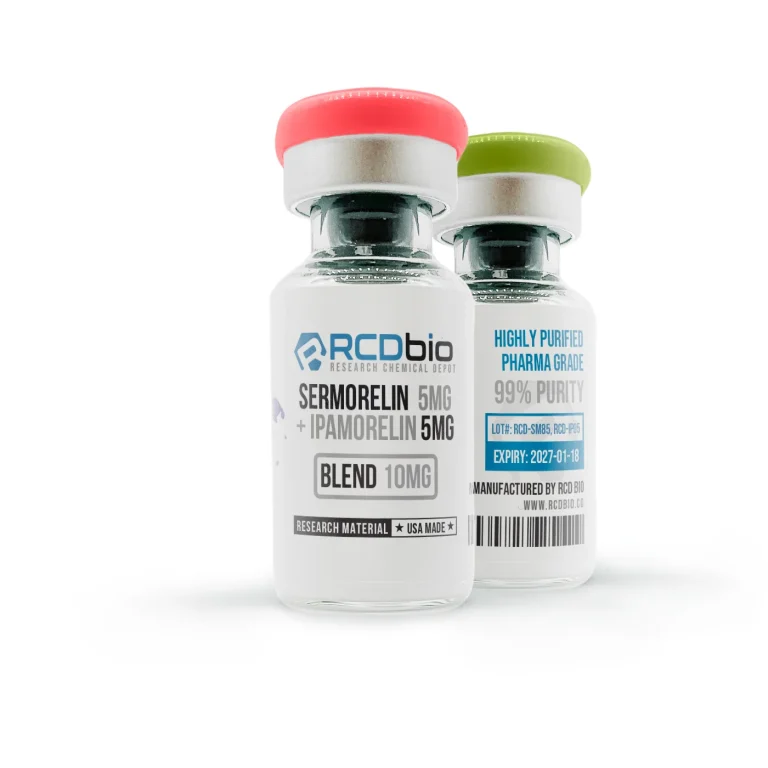
What is Sermorelin + Ipamorelin Blend?
The Sermorelin + Ipamorelin Blend is a research-grade lyophilized combination formulation comprising two mechanistically distinct synthetic peptides: sermorelin, a 29-amino acid analogue of endogenous growth hormone-releasing hormone (GHRH), and ipamorelin, a synthetic pentapeptide and selective agonist of the growth hormone secretagogue receptor type 1a (GHS-R1a). The two compounds engage separate receptor systems within the hypothalamic–pituitary somatotropic axis, providing a dual-pathway framework for investigating convergent and divergent intracellular signaling in neuroendocrine research contexts.
Sermorelin (GHRH 1–29) represents the shortest N-terminal fragment of endogenous GHRH retaining full biological activity at the GHRH receptor (GHRH-R), a class B G protein-coupled receptor expressed predominantly on anterior pituitary somatotroph cells. It was originally developed and studied as a diagnostic and therapeutic agent for growth hormone deficiency in children. Ipamorelin (Aib-His-D-2-Nal-D-Phe-Lys-NH2) is a pentapeptide developed by Novo Nordisk and characterized as the first GHS-R1a agonist to display a selectivity profile for growth hormone release comparable to that of endogenous GHRH, without the significant co-elevation of ACTH, cortisol, or prolactin observed with earlier growth hormone-releasing peptides such as GHRP-6 and GHRP-2.
In research settings, the simultaneous engagement of GHRH-R by sermorelin and GHS-R1a by ipamorelin in somatotroph cell preparations provides a platform for studying the synergistic integration of two distinct second-messenger pathways — cAMP/PKA (GHRH-R) and PLC/IP3/calcium (GHS-R1a) — and their combined influence on growth hormone gene expression and secretion dynamics.
This product is supplied by RCDbio as a lyophilized powder in research-grade vial format and is intended strictly for laboratory and research purposes. It is not approved by the Food and Drug Administration for use in this research-grade, non-pharmaceutical form. It is not a dietary supplement and is not intended for human consumption or therapeutic self-administration.
Chemical Properties
| Property | Detail |
| Product Type | Synthetic Peptide Blend (GHRH Analogue + GHS-R1a Pentapeptide) |
| Product Name | Sermorelin + Ipamorelin Blend |
| Application | Scientific / Research Use Only |
| CAS Number | Sermorelin: 86168-78-7 · Ipamorelin: 170851-70-4 |
| Molar Mass | Sermorelin: 3,357.93 g/mol · Ipamorelin: 711.87 g/mol |
| Chemical Formula | Sermorelin: C₁₄₉H₂₄₆N₄₄O₄₂S · Ipamorelin: C₃₈H₄₉N₉O₅ |
| Sequence | Sermorelin: Tyr-Ala-Asp-Ala-Ile-Phe-Thr-Asn-Ser-Tyr-Arg-Lys-Val-Leu-Gly-Gln-Leu-Ser-Ala-Arg-Lys-Leu-Leu-Gln-Asp-Ile-Met-Ser-Arg-NH₂ (GHRH 1–29 amide) · Ipamorelin: Aib-His-D-2-Nal-D-Phe-Lys-NH₂ |
| IUPAC Name | Sermorelin: L-Tyrosyl-L-alanyl-L-α-aspartyl-L-alanyl-L-isoleucyl-L-phenylalanyl-L-threonyl-L-asparaginyl-L-seryl-L-tyrosyl-L-arginyl-L-lysyl-L-valyl-L-leucylglycyl-L-glutaminyl-L-leucyl-L-seryl-L-alanyl-L-arginyl-L-lysyl-L-leucyl-L-leucyl-L-glutaminyl-L-α-aspartyl-L-isoleucyl-L-methionyl-L-seryl-L-argininamide · Ipamorelin: (2S)-6-amino-2-[[(2R)-2-[[(2R)-2-[[(2S)-2-[(2-amino-2-methylpropanoyl)amino]-3-(1H-imidazol-5-yl)propanoyl]amino]-3-naphthalen-2-ylpropanoyl]amino]-3-phenylpropanoyl]amino]hexanamide |
| Synonyms | Sermorelin: GRF 1–29, GHRH (1–29) amide, Geref (pharmaceutical, discontinued) · Ipamorelin: NNC 26-0161 (research designation) |
| Physical Form | Lyophilized white to off-white powder |
| Solubility | Both components are soluble in sterile water for injection and bacteriostatic water for injection; reconstitution in aqueous buffered systems (e.g., PBS pH 7.4) is suitable for in vitro applications. Avoid organic solvents. Ipamorelin is stable across a moderate pH range; sermorelin is susceptible to enzymatic degradation in serum-containing media. |
| Storage (Lyophilized) | Store at −20°C in sealed, light-protected vials with desiccant; minimize freeze-thaw exposure prior to reconstitution |
| Storage (Reconstituted) | Store at 4°C; use within 5–7 days of reconstitution; minimize freeze-thaw cycling; discard any reconstituted solution that is turbid, discolored, or shows visible particulate matter |
| PubChem CID | Sermorelin: CID 16132413 · Ipamorelin: CID 9831659 |
| Purity | ≥98% (HPLC verified, independent third-party laboratory analysis; COA available per batch) |
| WADA Status | Sermorelin is listed by name under the WADA Prohibited List as a GHRH analogue (S2 Peptide Hormones, Growth Factors, Related Substances and Mimetics). Ipamorelin is classified under S2 as a growth hormone secretagogue / GHS-R1a agonist. Both substances are prohibited in-competition and out-of-competition. Researchers engaged in sport-adjacent studies should verify the current status at GlobalDRO.com before use. |
How Does Sermorelin + Ipamorelin Blend Work?
The Sermorelin + Ipamorelin Blend engages two pharmacologically distinct receptor systems on anterior pituitary somatotroph cells, enabling concurrent investigation of parallel second-messenger pathways and their integrated influence on growth hormone secretion dynamics. The dual-receptor framework distinguishes this formulation from single-agent GHRH or GHS-R1a preparations in neuroendocrine research contexts.
Sermorelin: GHRH-R / cAMP-PKA Signaling Pathway
Sermorelin binds selectively to the growth hormone-releasing hormone receptor (GHRH-R), a class B (secretin family) Gαs protein-coupled receptor expressed predominantly on somatotroph cells of the anterior pituitary gland. GHRH-R engagement activates adenylyl cyclase, producing a dose-dependent increase in intracellular cyclic AMP (cAMP). Elevated cAMP levels activate protein kinase A (PKA), which phosphorylates the transcription factor CREB (cAMP response element-binding protein), driving increased transcription of the growth hormone (GH) gene and stimulating exocytosis of pre-formed GH-containing secretory granules. PKA activation also triggers voltage-gated calcium channel opening, augmenting intracellular calcium influx and further potentiating vesicular release. The downstream output, observed in anterior pituitary somatotroph cell preparations, is pulsatile GH secretion that preserves sensitivity to somatostatin-mediated negative feedback, maintaining physiological modulation of the somatotropic axis.
Ipamorelin: GHS-R1a / PLC-IP3-Calcium Signaling Pathway
Ipamorelin binds selectively to the growth hormone secretagogue receptor type 1a (GHS-R1a), the endogenous receptor for ghrelin, which is a Gαq/11 protein-coupled receptor expressed on somatotroph cells and in hypothalamic nuclei. GHS-R1a activation by ipamorelin initiates phospholipase C (PLC)-mediated hydrolysis of phosphatidylinositol 4,5-bisphosphate (PIP2), generating inositol trisphosphate (IP3) and diacylglycerol (DAG). IP3-mediated calcium release from intracellular endoplasmic reticulum stores, in combination with DAG-mediated protein kinase C (PKC) activation, stimulates GH secretory granule exocytosis in rat and porcine pituitary cell preparations. In contrast to GHRP-6 and GHRP-2, which produce concurrent ACTH and cortisol release at GH-releasing doses in swine models, ipamorelin does not significantly elevate ACTH or cortisol even at doses exceeding 200-fold the ED50 for GH release, as characterized in porcine in vivo studies.
Convergent Dual-Receptor Signaling and Research Context
In isolated somatotroph cell preparations and in vivo animal models, concurrent engagement of GHRH-R and GHS-R1a by their respective ligands has been investigated for additive or synergistic effects on GH secretory output. The mechanistic basis proposed in preclinical systems involves convergent calcium mobilization from two sources — cAMP/PKA-driven voltage-gated calcium entry (GHRH-R) and IP3-driven intracellular calcium release (GHS-R1a) — potentially amplifying the integrated calcium signal driving GH granule exocytosis. Preclinical models also suggest that GHS-R1a agonism may enhance GHRH-R sensitivity or alter receptor trafficking behavior under conditions of concurrent stimulation, although these interactions are not fully characterized across all experimental systems.
Key Research Findings
- Ipamorelin GHS-R1a selectivity: In primary rat pituitary cell preparations and conscious swine models, ipamorelin released GH with potency comparable to GHRP-6 (EC50 = 1.3 ± 0.4 nmol/L in vitro) while producing no significant elevation in ACTH or cortisol even at 200-fold the GH-releasing ED50. [Raun et al., 1998]
- Sermorelin GHRH-R activity: Sermorelin, as the shortest 29-amino acid GHRH fragment retaining full receptor activity, specifically stimulates GH secretion from the anterior pituitary in both intravenous and subcutaneous administration models, with a plasma half-life of approximately 11–12 minutes characterized in pharmacokinetic studies. [Prakash & Goa, 1999]
- Somatotropic axis restoration: GHRH-(1–29) administered twice daily in aged male subjects produced measurable reversal of age-associated decreases in GH and IGF-1 circulating levels in studied cohorts, representing a model for investigating somatotropic axis responsiveness to GHRH-class compounds. [Corpas et al., 1992]
- GHS combination IGF-1 response: In a retrospective review of hypogonadal men receiving combined GHRP-2, GHRP-6, and sermorelin, circulating IGF-1 levels were significantly elevated over baseline in a defined study cohort, providing a preclinical and human-model research basis for combination secretagogue protocols. [Sigalos et al., 2017]
- GHS pharmacology and body composition research: A comprehensive review of GHS agents including sermorelin and ipamorelin characterized their pharmacodynamics, receptor specificity, and investigational applications across hypogonadal and metabolic research contexts. [Sinha et al., 2020]
All findings listed above are derived from preclinical or in vitro data, or from early-phase clinical investigations in pharmaceutical-grade contexts not directly applicable to research-grade material. No conclusions regarding human therapeutic efficacy can be drawn from these observations. These findings do not constitute evidence of safety or efficacy in any human condition or organism.
What are the Potential Research Applications of Sermorelin + Ipamorelin Blend?
Dual-Pathway Somatotroph Signaling Research
The concurrent engagement of GHRH-R and GHS-R1a in somatotroph cell preparations provides a platform for investigating the integration of cAMP/PKA and PLC/IP3/calcium second-messenger cascades within a single cell type. Researchers may employ this formulation to study how convergent receptor activation affects GH gene transcription, secretory granule dynamics, and intracellular calcium kinetics compared with single-pathway stimulation models. These are observed in preclinical and in vitro contexts only and do not constitute claims of efficacy or safety in any organism.
Neuroendocrine Axis Modulation Studies
In rodent and porcine in vivo models, the GHRH-R and GHS-R1a pathways represent two of the three major positive regulatory inputs to hypothalamic–pituitary GH secretion (alongside endogenous ghrelin). Research applications include investigating how simultaneous activation of both pathways modulates somatostatin counter-regulation, IGF-1 negative feedback sensitivity, and pulsatile GH secretory patterns in experimental animal preparations.
Age-Related Somatotropic Axis Research
The progressive decline in pituitary somatotroph responsiveness and GHRH secretory output, termed somatopause, has been investigated in aged rodent and primate models using GHRH analogs and GHS-R1a agonists. This blend may serve as a research tool for exploring receptor sensitivity, GHRH-R expression changes, and the capacity of dual-pathway stimulation to modulate GH axis function in aged animal preparations.
Growth Hormone Secretagogue Pharmacology Comparisons
Ipamorelin’s selectivity profile — characterized by GH release without co-stimulation of ACTH/cortisol at pharmacologically relevant concentrations — makes the Sermorelin + Ipamorelin Blend a useful comparator in studies evaluating receptor bias, selectivity, and off-target hormone activation across different GHS compound classes. Researchers may use this blend alongside GHRP-2, GHRP-6, or hexarelin preparations to characterize differential receptor signaling outcomes in controlled cellular models.
IGF-1 Axis and Metabolic Research Models
In preclinical metabolic research using rodent models of GH deficiency or altered body composition, GHRH analogs and GHS-R1a agonists have been studied for their downstream effects on hepatic IGF-1 production, lean tissue anabolism, and lipid metabolism. These applications are confined to controlled animal and in vitro experimental systems.
These applications are observed in preclinical and in vitro contexts only and do not constitute claims of efficacy or safety in any organism.
What are the Potential Side Effects of Sermorelin + Ipamorelin Blend?
The following adverse findings have been observed in preclinical experimental systems and early-phase pharmacological investigations. No human safety or tolerability data pertaining to research-grade Sermorelin + Ipamorelin Blend has been established. These observations are derived from experimental systems and should not be extrapolated to human or animal outcomes.
- Injection site reactions: Transient local reactions including erythema and discomfort at the subcutaneous injection site have been documented in rodent in vivo models and in early human pharmacological studies involving pharmaceutical-grade sermorelin; these are not established for research-grade formulations.
- Transient GH and IGF-1 elevation: Supraphysiological GH secretion following combined GHS-R1a and GHRH-R stimulation in rodent models may produce downstream IGF-1 elevation; the degree of elevation is dose-dependent and not uniform across models or species.
- Cortisol and ACTH: ipamorelin-specific selectivity: Unlike GHRP-2 and GHRP-6, ipamorelin demonstrated no significant elevation of ACTH or cortisol at doses up to 200-fold the GH-releasing ED50 in porcine in vivo models. This finding is compound-specific and does not eliminate the possibility of HPA axis effects at suprapharmacological concentrations or in different model systems.
- Fluid retention: GHRH-class compounds have been associated with transient sodium and water retention in rodent models, consistent with GH-mediated effects on renal tubular function; findings are dose-dependent and model-specific.
- Tachyphylaxis with repeated exposure: In rodent in vivo models, repeated administration of GHRH analogs has been associated with progressive attenuation of GH secretory response, consistent with receptor desensitization or downregulation of GHRH-R expression; findings vary by administration interval and dose.
- Antibody formation: Immune responses to exogenous synthetic GHRH fragments have been characterized in long-term rodent and primate studies; the relevance to short-term in vitro applications is not established.
No human safety or tolerability data pertaining to research-grade Sermorelin + Ipamorelin Blend has been established. These observations are derived from experimental systems and should not be extrapolated to human or animal outcomes.
Risk & Handling
Handling Precautions
This formulation should be handled exclusively by trained laboratory personnel with experience working with lyophilized peptide compounds. Minimum personal protective equipment includes nitrile gloves, a laboratory coat, and appropriate eye protection. Reconstitution should be performed in a laminar flow hood or biosafety cabinet to minimize aerosol generation. Both components are biologically active at nanomolar concentrations in receptor-expressing systems; standard precautions for potent peptide ligands apply. As neither component contains disulfide bridges, reducing agent exposure (DTT, β-mercaptoethanol, TCEP) does not present the same structural risk as with cyclic disulfide-bonded peptides; however, maintaining a reducing-agent-free reconstitution environment is recommended to preserve peptide integrity.
Exposure Risks
Risk Tier: MODERATE
Both sermorelin and ipamorelin are pharmacologically active at low nanomolar concentrations in GHRH-R- and GHS-R1a-expressing systems, respectively. Neither compound has demonstrated acute lethality in preclinical rodent or swine models at research-relevant concentrations. Dose-dependent endocrine effects — including GH secretion, downstream IGF-1 elevation, and fluid retention — have been characterized in animal models. Ipamorelin does not produce significant ACTH or cortisol co-elevation at pharmacological concentrations in swine models, as established by Raun et al. (1998). Sermorelin has a short plasma half-life of approximately 11–12 minutes in intravenous and subcutaneous models and is rapidly cleared via enzymatic proteolysis. No human safety data has been established for research-grade material in this combined formulation. Long-term endocrine effects of repeated combined administration have not been characterized in preclinical systems with sufficient longitudinal data. Researchers should exercise precautions appropriate to handling potent, biologically active neuroendocrine peptides.
Storage
- Lyophilized form: Store at −20°C in sealed, light-protected vials with desiccant; avoid temperature cycling during storage
- Reconstituted form: Store at 4°C; use within 5–7 days of reconstitution when stored in bacteriostatic water; reduce to 24–48 hours for sterile water without preservative
- Freeze-thaw cycles: Minimize freeze-thaw cycling of reconstituted material; repeated cycling degrades peptide integrity over time
- Stability precautions: Both components are susceptible to enzymatic degradation in biological media; in vitro stability in aqueous solution is considerably extended under low-temperature, protein-free conditions
- Discard any reconstituted solution that appears turbid, discolored, or shows particulate matter
FAQs
Q: What is Sermorelin + Ipamorelin Blend and what is it investigated for in research?
A: The Sermorelin + Ipamorelin Blend is a research-grade lyophilized formulation combining sermorelin (GHRH 1–29 amide), a GHRH receptor agonist, and ipamorelin (Aib-His-D-2-Nal-D-Phe-Lys-NH2), a selective GHS-R1a agonist. It is investigated in laboratory and preclinical settings for its capacity to engage two distinct second-messenger pathways within anterior pituitary somatotroph cells — cAMP/PKA (via GHRH-R) and PLC/IP3/calcium (via GHS-R1a) — enabling dual-pathway neuroendocrine signaling research. This product is for laboratory research use only and is not approved by the FDA for human or veterinary use.
Q: How do sermorelin and ipamorelin differ mechanistically in preclinical models?
A: Sermorelin engages GHRH-R, a class B Gαs-coupled GPCR, activating adenylyl cyclase and elevating intracellular cAMP, which stimulates PKA and downstream CREB-mediated GH gene transcription. Ipamorelin activates GHS-R1a, a Gαq/11-coupled GPCR (the ghrelin receptor), initiating PLC-mediated IP3 generation and intracellular calcium mobilization from endoplasmic reticulum stores. The two pathways converge on calcium-dependent GH granule exocytosis in somatotroph cell preparations, representing mechanistically complementary rather than redundant activation modes.
Q: What is the half-life of sermorelin and ipamorelin in preclinical models?
A: Sermorelin has a plasma half-life of approximately 11–12 minutes following intravenous or subcutaneous administration in pharmacokinetic models, reflecting rapid degradation by serum endopeptidases. Ipamorelin has a reported half-life of approximately 2 hours in rodent plasma models, attributable to its non-natural amino acid residues (D-2-Nal, D-Phe, Aib) conferring resistance to standard proteolytic cleavage. These figures are derived from laboratory and preclinical models and do not represent human pharmacokinetic data for research-grade material.
Q: How should the Sermorelin + Ipamorelin Blend be stored to maintain stability?
A: The lyophilized blend should be stored at −20°C in sealed, light-protected vials with desiccant. Following reconstitution in sterile or bacteriostatic water, the solution should be stored at 4°C and used within 5–7 days. Repeated freeze-thaw cycles should be minimized, as thermal cycling accelerates peptide degradation. Any reconstituted solution showing turbidity, color change, or particulate formation should be discarded.
Q: What toxicity observations have been reported in preclinical studies?
A: Neither sermorelin nor ipamorelin has demonstrated acute lethality at pharmacologically relevant research concentrations in rodent or swine models. Ipamorelin does not co-elevate ACTH or cortisol at doses up to 200-fold the GH-releasing ED50 in porcine in vivo models, a selectivity profile distinguishing it from GHRP-2 and GHRP-6. GH-class downstream effects — including transient fluid retention and dose-dependent IGF-1 elevation — have been characterized in rodent models. Long-term toxicity data for the combination formulation at research-grade purity is not established. No human safety data exists for research-grade material.
Q: What is the recommended reconstitution solvent for this blend in laboratory research?
A: In laboratory research contexts, sterile water for injection and bacteriostatic water for injection (0.9% benzyl alcohol) are commonly employed reconstitution solvents for lyophilized peptide blends of this class. Bacteriostatic water provides an extended post-reconstitution use window (5–7 days at 4°C) compared with preservative-free sterile water (24–48 hours). Phosphate-buffered saline (pH 7.4) is suitable for cell-based assay applications. Reconstitution should be performed by adding solvent slowly along the vial wall and allowing gentle dissolution without vigorous agitation.
Q: How does research-grade Sermorelin + Ipamorelin Blend differ from pharmaceutical-grade sermorelin?
A: Pharmaceutical-grade sermorelin (formerly marketed as Geref; manufacturer production discontinued in 2008) was formulated and approved by the FDA for subcutaneous administration in children with idiopathic growth hormone deficiency under strict dosing, purity, and sterility standards. Research-grade Sermorelin + Ipamorelin Blend supplied by RCDbio is produced for in vitro and preclinical laboratory applications and is not manufactured under pharmaceutical GMP standards for clinical use. It is not approved by the FDA for human administration and is not equivalent to any pharmaceutical product.
Related Research Compounds
Sermorelin Peptide — Sermorelin as a standalone GHRH(1–29) analogue for researchers investigating isolated GHRH-R pharmacology, cAMP/PKA signaling cascades, and anterior pituitary somatotroph function without concurrent GHS-R1a engagement.
Ipamorelin Nasal Spray — Ipamorelin formulated for intranasal delivery, enabling investigation of mucosal GHS-R1a absorption kinetics and systemic GH secretory response in preclinical models evaluating non-injectable administration routes.
CJC-1295 With DAC Peptide — A long-acting GHRH analogue with a drug affinity complex (DAC) for extended plasma half-life compared to sermorelin, employed in preclinical studies investigating sustained GHRH-R engagement, extended somatotropic axis stimulation, and GH/IGF-1 secretion kinetics over prolonged observation windows.
References
- Raun K, Hansen BS, Johansen NL, Thøgersen H, Madsen K, Ankersen M, Andersen PH. (1998). Ipamorelin, the first selective growth hormone secretagogue. European Journal of Endocrinology, 139(5):552–561. https://pubmed.ncbi.nlm.nih.gov/9849822/
- Prakash A, Goa KL. (1999). Sermorelin: a review of its use in the diagnosis and treatment of children with idiopathic growth hormone deficiency. BioDrugs, 12(2):139–157. https://pubmed.ncbi.nlm.nih.gov/18031173/
- Sigalos JT, Pastuszak AW, Allison A, Ohlander SJ, Herati A, Lindgren MC, Lipshultz LI. (2017). Growth hormone secretagogue treatment in hypogonadal men raises serum insulin-like growth factor-1 levels. American Journal of Men’s Health, 11(6):1752–1757. https://pubmed.ncbi.nlm.nih.gov/28830317/
- Sinha DK, Balasubramanian A, Tatem AJ, Rivera-Mirabal J, Yu J, Kovac J, Pastuszak AW, Lipshultz LI. (2020). Beyond the androgen receptor: the role of growth hormone secretagogues in the modern management of body composition in hypogonadal males. Translational Andrology and Urology, 9(Suppl 2):S149–S159. https://pubmed.ncbi.nlm.nih.gov/32257855/
- Corpas E, Harman SM, Pineyro MA, Roberson R, Blackman MR. (1992). Continuous subcutaneous infusions of growth hormone (GH) releasing hormone 1-44 for 14 days increase GH and insulin-like growth factor-I levels in old men. Journal of Clinical Endocrinology and Metabolism, 74(6):1292–1297. https://pubmed.ncbi.nlm.nih.gov/1569173/
Disclaimer
Sermorelin + Ipamorelin Blend is exclusively for laboratory research purposes. RCDbio products are not intended to diagnose, prevent, treat, or cure any disease or medical condition.
The Food and Drug Administration has not evaluated the statements on our website. This product is not approved for human or veterinary use. Researchers must comply with all applicable local, state, and federal laws and regulations governing the purchase and use of research compounds. By purchasing, you agree to our Terms and Conditions. RCDbio reserves the right to refuse sales to unauthorized individuals.
ATTENTION: All RCDbio products are strictly for LABORATORY AND RESEARCH PURPOSES ONLY. They are not intended for human consumption, veterinary use, or any other non-research application. For queries, complaints, or support, contact support@legacy.rcdbio.co
Reviews
There are no reviews yet