

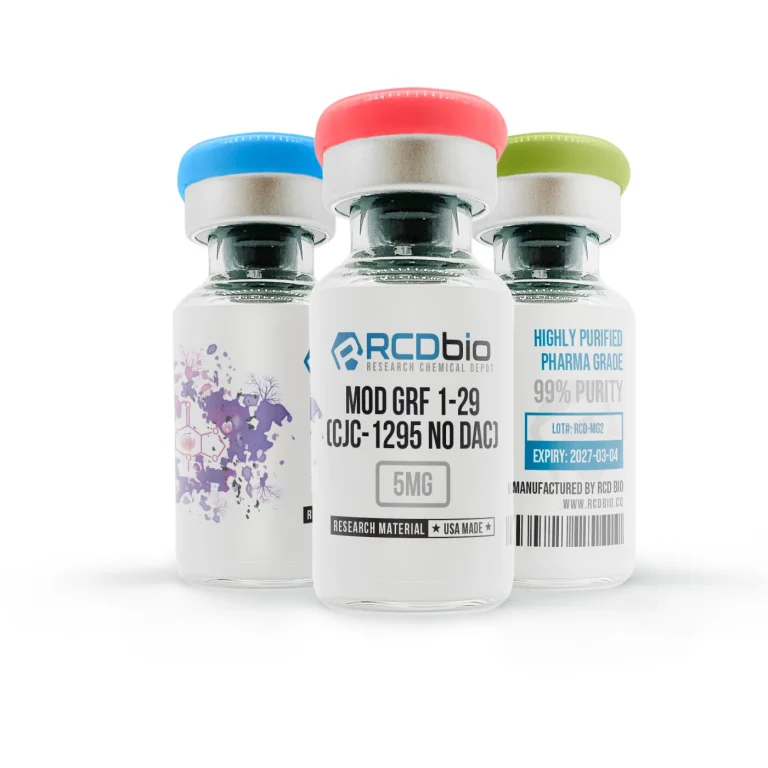
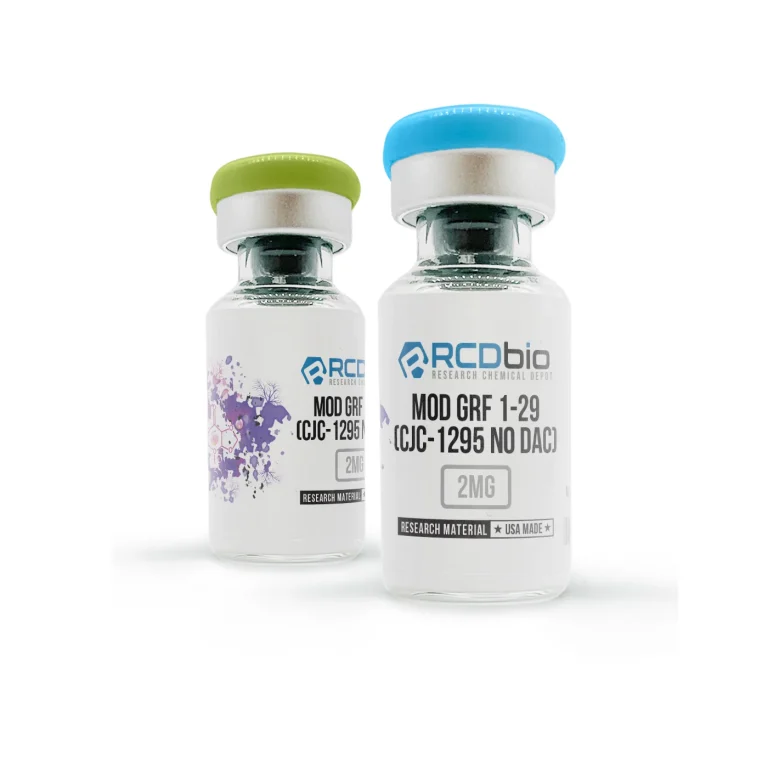
Description
What is Mod GRF 1-29 (CJC-1295 No DAC)?
Mod GRF 1-29, also designated CJC-1295 without DAC (Drug Affinity Complex), is a synthetic 29-amino acid peptide analogue of endogenous growth hormone-releasing hormone (GHRH). It corresponds to the biologically active N-terminal fragment of native GHRH (residues 1–29) and incorporates four amino acid substitutions at positions 2, 8, 15, and 27 — collectively referred to as “tetrasubstituted” modifications — that confer enhanced proteolytic resistance relative to the native sequence while preserving high-affinity binding to the growth hormone-releasing hormone receptor (GHRHR).
In research settings, Mod GRF 1-29 has been extensively employed as a pharmacological tool for investigating GHRHR-mediated signaling, pulsatile growth hormone (GH) secretion dynamics, and somatotroph cell function in anterior pituitary preparations and rodent in vivo models. Its defined sequence, resistance to dipeptidyl peptidase IV (DPP-IV) degradation, and well-characterized receptor pharmacology make it a preferred reference compound in studies of the somatotropic axis and class B1 GPCR biology.
Mod GRF 1-29 supplied by RCDbio is intended strictly for laboratory and research purposes. It is not approved by the Food and Drug Administration for use in this research-grade, non-pharmaceutical form. It is not a dietary supplement and is not intended for human consumption or therapeutic self-administration.
Chemical Properties
| Property | Detail |
| Product Type | Synthetic Tetrasubstituted GHRH Analogue Peptide |
| Product Name | Mod GRF 1-29 (CJC-1295 No DAC) |
| Application | Scientific / Research Use Only |
| CAS Number | 863288-34-0 |
| Molar Mass | 3367.9 g/mol |
| Chemical Formula | C₁₅₂H₂₅₂N₄₄O₄₂ |
| Sequence | Tyr-D-Ala-Asp-Ala-Ile-Phe-Thr-Gln-Ser-Tyr-Arg-Lys-Val-Leu-Ala-Gln-Leu-Ser-Ala-Arg-Lys-Leu-Leu-Gln-Asp-Ile-Leu-Ser-Arg-NH₂ (29 residues; C-terminal amidated; substitutions at positions 2, 8, 15, 27) |
| IUPAC Name | Full systematic name per IUPAC peptide nomenclature; see PubChem CID 5311071 |
| Synonyms | CJC-1295 without DAC; CJC-1295 No DAC; Modified GRF 1-29; Mod GRF(1-29) |
| Physical Form | Lyophilized white to off-white powder |
| Solubility | Soluble in sterile water, bacteriostatic water, and aqueous buffered systems (pH 4.5–7.0); 0.1–1% acetic acid solution may be used to aid dissolution; avoid strongly alkaline conditions |
| Storage (Lyophilized) | Store at −20°C in a sealed, light-protected container with desiccant; protect from moisture and humidity |
| Storage (Reconstituted) | Store at 2–8°C; use within 28 days of reconstitution; do not subject to repeated freeze-thaw cycles; discard if turbid, discoloured, or particulate matter is visible |
| PubChem CID | 5311071 (free peptide form) |
| Purity | ≥98% (HPLC verified, independent third-party laboratory analysis; COA available per batch) |
| WADA Status | Mod GRF 1-29 is not listed by name on the current WADA Prohibited List; however, as a GHRH analogue capable of stimulating GH release, it falls under the S2 category (Peptide Hormones, Growth Factors, Related Substances and Mimetics) as a substance with similar biological activity to listed GHRH analogues. Researchers engaged in sport-adjacent studies should verify the current status at GlobalDRO.com before use. |
How Does Mod GRF 1-29 (CJC-1295 No DAC) Work?
Mod GRF 1-29 exerts its primary mechanistic effects through selective, high-affinity agonism at the growth hormone-releasing hormone receptor (GHRHR), a class B1 (secretin-class) G protein-coupled receptor predominantly expressed on somatotroph cells of the anterior pituitary gland. The following mechanistic pathways have been characterised in preclinical and in vitro model systems.
GHRHR Agonism and Gαs/cAMP/PKA Signalling
In isolated anterior pituitary somatotroph cell preparations and somatotroph-derived cell lines (including GH3 and primary dispersed rat pituitary cells), GHRHR activation by GHRH analogues such as Mod GRF 1-29 initiates Gαs protein coupling, resulting in adenylyl cyclase activation and a consequent elevation in intracellular cyclic adenosine monophosphate (cAMP) concentrations. Downstream activation of protein kinase A (PKA) has been characterized in these systems as the principal mechanistic driver of GH gene transcription upregulation via phosphorylation of CREB (cAMP response element-binding protein) and subsequent binding to CRE motifs within the GH gene promoter region.
Voltage-Gated Calcium Channel Activation and GH Exocytosis
In somatotroph cell preparations, cAMP-mediated PKA activation promotes depolarization-associated opening of voltage-gated calcium channels (predominantly L-type; Cav1.2 and Cav1.3 subtypes). The resultant intracellular Ca²⁺ influx, together with IP3-mediated release from intracellular stores via phospholipase C (PLC)-coupled pathways, initiates fusion of GH-containing secretory granules with the plasma membrane. This exocytotic mechanism has been characterized in perifused rat pituitary cell systems as responsible for the pulsatile GH release profile associated with short-acting GHRH analogs, including Mod GRF 1-29.
Differential Pharmacokinetics Relative to DAC-Conjugated Forms
The absence of the Drug Affinity Complex (DAC) — a lysine-reactive maleimide linker that covalently attaches to circulating albumin in CJC-1295 with DAC — results in a substantially shorter plasma half-life for Mod GRF 1-29 in rodent in vivo models (approximately 15–30 minutes, compared with several days for DAC-conjugated forms). This pharmacokinetic profile has been investigated in rodent models as mechanistically relevant for preserving physiologically pulsatile GH secretion patterns, in contrast to the prolonged, non-pulsatile GH elevation associated with albumin-bound forms.
DPP-IV Proteolytic Resistance
Unmodified native GHRH(1-29) is rapidly cleaved at the Ala²-Asp³ bond by dipeptidyl peptidase IV (DPP-IV) in plasma, yielding an inactive GHRH(3-29) fragment with a circulating half-life of approximately 2–7 minutes in rodent models. The D-Ala substitution at position 2 in Mod GRF 1-29 sterically occludes DPP-IV recognition and cleavage at this site, substantially extending the window of GHRHR-active compound in in vitro plasma incubation assays and rodent in vivo systems. This resistance has been characterized as the primary structural basis for the extended bioactivity of Mod GRF 1-29 relative to the parent sequence in preclinical experimental designs.
Key Research Findings
- GHRHR-mediated GH release: Mod GRF 1-29 demonstrated potent GHRHR agonism with pulsatile GH secretion observed in dispersed rat somatotroph cell preparations; the pulsatile profile was preserved relative to DAC-conjugated forms. [Jetté et al., 2005]
- Pituitary somatotroph activation: cAMP elevation and CREB phosphorylation characterized in GH3 somatotroph cell line preparations following GHRH analog exposure; PKA pathway identified as primary transcriptional effector. [Frohman & Jansson, 1986]
- GHRP synergy in preclinical models: Co-administration of GHRH analogues with GHRP-class compounds (including GHRP-2 and ipamorelin) in rodent in vivo models produced supraadditive GH pulse amplitude, attributed to complementary receptor mechanisms (GHRHR vs. GHS-R1a). [Bowers, 1998]
- Proteolytic stability: The tetrasubstituted sequence of Mod GRF 1-29 demonstrated extended DPP-IV resistance in in vitro plasma incubation assays relative to unmodified GHRH (1-29), correlating with prolonged receptor occupancy in cell-based assay systems. [Jetté et al., 2005]
- Long-acting analogue characterisation: CJC-1295 (DAC-conjugated form derived from the same parent sequence) normalized growth in GHRH knockout murine models following once-daily administration, demonstrating the pharmacological relevance of the GHRH(1-29) analog scaffold in in vivo GH axis studies. [Alba et al., 2006]
All findings listed above are derived from preclinical or in vitro data. No conclusions regarding human therapeutic efficacy can be drawn from these observations. These findings do not constitute evidence of safety or efficacy in any human condition or organism.
What are the Potential Research Applications of Mod GRF 1-29 (CJC-1295 No DAC)?
GHRHR Pharmacology and Receptor Signalling Studies
Mod GRF 1-29 serves as a primary research tool for investigating GHRHR binding kinetics, receptor activation dynamics, and downstream Gαs/cAMP/PKA cascade characterization in somatotroph cell systems. It has been employed in radioligand competition assays, cAMP reporter systems, and Ca²⁺ imaging protocols in anterior pituitary cell preparations to model class B1 GPCR pharmacology. Its defined sequence and DPP-IV resistance make it a preferred reference compound in GHRH receptor pharmacology studies relative to the labile native GHRH(1-29) sequence.
Pulsatile GH Secretion Dynamics
The short plasma half-life profile of Mod GRF 1-29 in rodent in vivo models has been investigated for its ability to recapitulate physiologically relevant pulsatile GH secretion patterns. Researchers studying somatotroph secretory rhythmicity, GH pulse characterization by perifusion, or the neuroendocrine regulation of the GH axis employ Mod GRF 1-29 as a reference compound that does not produce the persistent, non-pulsatile GH elevation associated with albumin-binding analogues.
Combinatorial GHRH/GHRP Studies
In experimental designs examining the synergistic interaction between GHRHR agonists and GHS-R1a agonists (ghrelin receptor agonists), Mod GRF 1-29 is co-administered with GHRP-class compounds in rodent in vivo and primary pituitary cell systems. These studies investigate the mechanistic basis for GHRH/GHRP synergy, the optimal stoichiometry of receptor co-activation for GH pulse amplitude maximization in preclinical models, and the cell-level signaling convergence of the two pathways.
Somatotropic Axis and Neuroendocrine Regulation Research
Mod GRF 1-29 has been employed in rodent hypothalamic–pituitary axis studies to investigate the integration of GHRHR signaling with somatostatin-mediated inhibitory tone, IGF-1 feedback loops, and GH pulse generator circuitry. In vitro perifusion systems and in vivo rodent sampling models utilize Mod GRF 1-29 as a stimulus compound to characterize the dynamics of GH pulse generation under varying neuroendocrine conditions.
These are observed in preclinical and in vitro contexts only and do not constitute claims of efficacy or safety in any organism.
What are the Potential Side Effects of Mod GRF 1-29 (CJC-1295 No DAC)?
The following adverse observations have been characterized in preclinical model systems or noted in in vitro assay contexts. These are experimental findings only.
- Transient hypotension observed in rodent in vivo models at supraphysiological doses, consistent with the vasodilatory properties of GHRH-class peptides at vascular smooth muscle; characterised as dose-dependent
- GH-mediated water retention and oedema noted in rodent in vivo models following sustained GHRH analogue exposure at elevated doses; attributed to GH-stimulated sodium reabsorption in renal tubular cell systems
- Lightheadedness and postural hypotension-equivalent vasomotor responses are characterised in primate models at high-dose parenteral administration; they are not uniformly replicated across species
- Tachyphylaxis (receptor desensitisation) characterised in continuous-infusion somatotroph cell preparation models; pulsatile administration protocols in perifusion systems were associated with sustained receptor responsiveness versus continuous stimulation paradigms
- Fatigue-equivalent behavioural changes noted in rodent in vivo studies at pharmacological dose ranges; not consistently observed across all model systems
- Injection-site reactions, including transient erythema and localised discomfort characterised in rodent subcutaneous administration models, are consistent with non-specific peptide injection responses
No human safety or tolerability data pertaining to research-grade Mod GRF 1-29 has been established. These observations are derived from experimental systems and should not be extrapolated to human or animal outcomes.
Risk & Handling
Risk Tier: MODERATE
Handling Precautions
Mod GRF 1-29 should be handled exclusively by trained laboratory personnel familiar with lyophilized peptide research compound protocols. Minimum personal protective equipment includes nitrile gloves, a laboratory coat, and eye protection. For lyophilized powder reconstitution, a biosafety cabinet or laminar flow hood is recommended to minimize inhalation of aerosolized particulates and to maintain aseptic technique. Avoid generating aerosols during reconstitution. As Mod GRF 1-29 is a biologically active peptide at nanomolar concentrations, accidental mucosal or systemic exposure during preparation should be treated as a potential pharmacological exposure event and documented accordingly.
Exposure Risks
Mod GRF 1-29 is a pharmacologically active GHRHR agonist at picomolar to nanomolar concentrations in cell-based systems. In rodent in vivo models, systemic exposure at supraphysiological doses has produced dose-dependent GH elevation, transient hypotension, and mild oedema. Plasma half-life in rodent intravenous models has been characterized at approximately 15–30 minutes, reflecting susceptibility to endogenous proteolytic degradation despite DPP-IV resistance conferred by the tetrasubstituted sequence. Acute lethality has not been characterized at research-relevant concentrations in preclinical systems. No human safety or tolerability data has been established for research-grade Mod GRF 1-29. Researchers should exercise appropriate caution when handling a potent biologically active peptide capable of activating the neuroendocrine GH axis.
Storage
- Lyophilized form: Store at −20°C in a sealed, light-protected container with desiccant; protect from moisture and humidity at all times
- Reconstituted form: Store at 2–8°C; use within 28 days of reconstitution; aliquot working volumes prior to storage to avoid repeated freeze-thaw cycling of the bulk reconstituted stock
- Do not subject reconstituted solutions to repeated freeze-thaw cycles; each cycle risks peptide aggregation and progressive loss of receptor-binding activity
- Discard any reconstituted solution that appears turbid, discoloured, or contains visible particulate matter
- Protect from prolonged exposure to light and elevated temperatures, which accelerate peptide degradation in aqueous solution
FAQs
Q: What is Mod GRF 1-29 (CJC-1295 No DAC), and what is it investigated for in research? A: Mod GRF 1-29 is a synthetic 29-amino acid analogue of endogenous GHRH. incorporating four amino acid substitutions (at positions 2, 8, 15, and 27) that confer enhanced proteolytic stability relative to the native sequence. In laboratory settings, it is investigated as a GHRHR agonist for studies of pulsatile GH secretion, somatotroph cell signaling, and the pharmacokinetics of short-acting GHRH analogs in rodent in vivo and in vitro preclinical model systems.
Q: What is the plasma half-life of Mod GRF 1-29 in preclinical models? A: The plasma half-life of Mod GRF 1-29 in rodent intravenous models has been characterized at approximately 15–30 minutes, substantially extended relative to unmodified GHRH (1-29) (half-life approximately 2–7 minutes) due to DPP-IV resistance conferred by the D-Ala substitution at position 2. These figures are derived from laboratory and preclinical models and do not represent human pharmacokinetic data for research-grade material.
Q: How should Mod GRF 1-29 be stored to maintain stability? A: Lyophilized Mod GRF 1-29 should be stored at −20°C in a sealed, light-protected container with desiccant. Following reconstitution, solutions should be stored at 2–8°C and used within 28 days. Repeated freeze-thaw cycling is not recommended, as each cycle risks peptide aggregation and loss of biological activity. Any reconstituted solution showing turbidity, color change, or particulate matter should be discarded. Peptide degradation in aqueous solution is accelerated by elevated temperatures and prolonged light exposure.
Q: What toxicity observations have been reported in preclinical studies of Mod GRF 1-29? A: In rodent in vivo models, supraphysiological doses of GHRH analog compounds have been associated with dose-dependent GH elevation, transient hypotension, and GH-mediated fluid retention. Receptor desensitization (tachyphylaxis) has been characterized in continuous-stimulation somatotroph cell preparation models; pulsatile dosing protocols in perifusion systems have been associated with sustained receptor responsiveness. Acute lethality at research concentrations has not been characterized. No human safety data has been established for research-grade Mod GRF 1-29.
Q: What is Mod GRF 1-29 typically reconstituted with in laboratory research? A: In laboratory settings, lyophilized Mod GRF 1-29 is reconstituted in sterile water for injection, bacteriostatic water (0.9% benzyl alcohol), or aqueous buffer solutions at pH 4.5–7.0. Acetic acid (0.1–1%) solutions are also employed in some protocols to aid peptide dissolution. Reconstituted solutions are typically aliquoted and stored at 2–8°C or −20°C (for longer-term storage) to minimize degradation.
Q: What is the mechanistic difference between Mod GRF 1-29 and CJC-1295 with DAC in preclinical models? A: CJC-1295 with DAC incorporates a maleimide-based Drug Affinity Complex that covalently binds to circulating albumin following systemic administration, producing plasma half-lives of several days in rodent in vivo models and sustained, non-pulsatile GH elevation. Mod GRF 1-29 (No DAC) lacks this albumin-binding moiety; its plasma half-life in rodent models is approximately 15–30 minutes, and the resultant GH secretion profile is characterized as pulsatile rather than tonic. Researchers select between the two based on whether the experimental design requires sustained GH elevation (DAC form) or preservation of physiological pulsatility (No DAC form) in the model system under investigation.
Q: Can Mod GRF 1-29 be combined with GHRP compounds in laboratory research? A: Yes. In preclinical experimental designs, Mod GRF 1-29 is frequently co-administered with GHS-R1a agonists — including GHRP-2, GHRP-6, and ipamorelin — to investigate the mechanistic basis of GHRH/GHRP synergy on GH pulse amplitude in rodent in vivo and dispersed pituitary cell preparations. The two compound classes act at distinct receptor subtypes (GHRHR vs. GHS-R1a) and produce additive to supraadditive GH responses in rodent models.
Related Research Compounds
CJC-1295 With DAC Peptide — The albumin-binding DAC-conjugated form of CJC-1295, investigated in rodent in vivo models for sustained, non-pulsatile GHRHR activation; employed as the long-acting comparator in preclinical studies examining pulsatile versus tonic GH secretion dynamics.
Ipamorelin Peptide — A synthetic pentapeptide GHS-R1a agonist investigated in preclinical models for selective GH secretagogue activity; frequently co-administered with GHRH analogues in rodent models to characterize GHRH/GHRP receptor synergy on GH pulse amplitude.
Sermorelin Peptide — A GHRH(1-29)-NH₂ analogue investigated in rodent in vivo models for GHRHR agonism and pulsatile GH secretion; commonly employed as a shorter-sequence, DPP-IV-labile reference compound in comparative GHRH analogue pharmacology studies.
All products listed are for laboratory and research purposes only.
References
- Jetté, L., Léger, R., Thibaudeau, K., Benquet, C., Robitaille, M., Pellerin, I., Paradis, V., van Wyk, P., Pham, K., & Bridon, D. P. (2005). Human growth hormone-releasing factor (hGRF)1-29-albumin bioconjugates activate the GRF receptor on the anterior pituitary in rats: Identification of CJC-1295 as a long-lasting GRF analog. Endocrinology, 146(7), 3052–3058. https://pubmed.ncbi.nlm.nih.gov/15817669/
- Frohman, L. A., & Jansson, J. O. (1986). Growth hormone-releasing hormone. Endocrine Reviews, 7(3), 223–253. https://academic.oup.com/edrv/article-abstract/7/3/223/2548830
- Bowers, C. Y. (1998). Growth hormone-releasing peptide (GHRP). Cellular and Molecular Life Sciences, 54(12), 1316–1329. https://pmc.ncbi.nlm.nih.gov/articles/PMC11147263/
- Alba, M., Fintini, D., Sagazio, A., Lawrence, B., Castaigne, J. P., Frohman, L. A., & Salvatori, R. (2006). Once-daily administration of CJC-1295, a long-acting growth hormone-releasing hormone (GHRH) analog, normalizes growth in the GHRH knockout mouse. American Journal of Physiology – Endocrinology and Metabolism, 291(6), E1290–E1294. https://pubmed.ncbi.nlm.nih.gov/16849630/
Disclaimer
Mod GRF 1-29 (CJC-1295 No DAC) is exclusively for laboratory research purposes. RCDbio products are not intended to diagnose, prevent, treat, or cure any disease or medical condition.
The Food and Drug Administration has not evaluated the statements on our website. This product is not approved for human or veterinary use. Researchers must comply with all applicable local, state, and federal laws and regulations governing the purchase and use of research compounds. By purchasing, you agree to our Terms and Conditions. RCDbio reserves the right to refuse sales to unauthorized individuals.
ATTENTION: All RCDbio products are strictly for LABORATORY AND RESEARCH PURPOSES ONLY. They are not intended for human consumption, veterinary use, or any other non-research application. For queries, complaints, or support, contact support@legacy.rcdbio.co
Reviews
There are no reviews yet