

Description
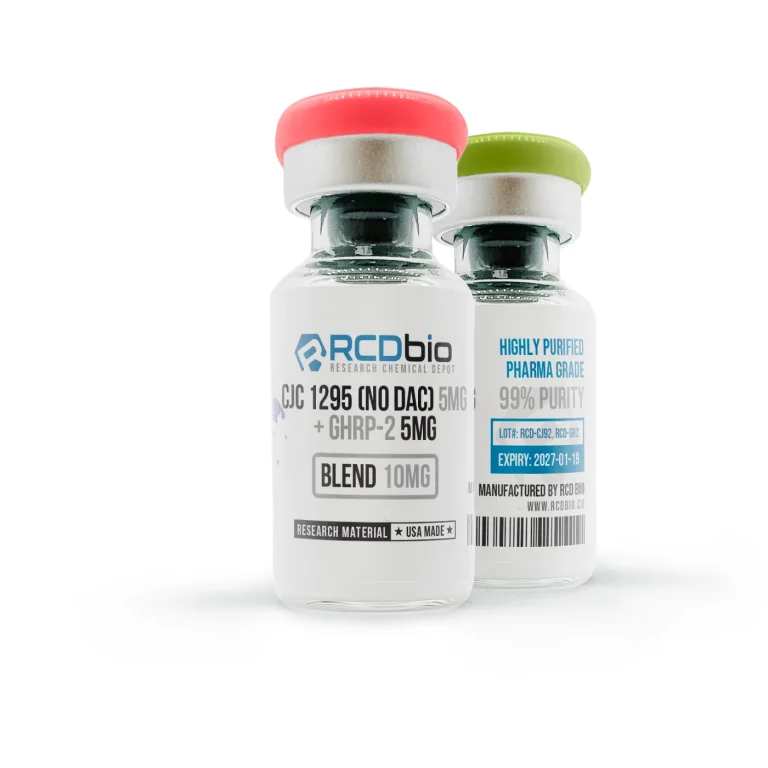
What is Mod GRF 1-29 (CJC-1295 No DAC) + GHRP-2?
Mod GRF 1-29 (CJC-1295 without DAC) + GHRP-2 is a dual-peptide research blend combining two structurally and mechanistically distinct synthetic growth hormone secretagogues. Mod GRF 1-29, also designated modified GRF (1-29) or CJC-1295 without Drug Affinity Complex (DAC), is a 29-amino acid synthetic analog of endogenous growth hormone-releasing hormone (GHRH). It incorporates four amino acid substitutions at positions 2, 8, 15, and 27 of the native GHRH(1-29) sequence — replacing the native residues with D-Ala, Gln, Ala, and Leu, respectively — to confer resistance to dipeptidyl peptidase-4 (DPP-4) and plasma proteases while preserving receptor affinity at the growth hormone-releasing hormone receptor (GHRHR). Critically, Mod GRF 1-29 does not carry the maleimidopropionic acid (DAC) linker present in CJC-1295 with DAC; as a result, it does not covalently conjugate to circulating albumin and exhibits a substantially shorter plasma half-life of approximately 30 minutes in rodent models.
GHRP-2 (Growth Hormone-Releasing Peptide-2), also known by the pharmaceutical designation pralmorelin, is a synthetic hexapeptide (D-Ala-D-2Nal-Ala-Trp-D-Phe-Lys-NH₂) and a potent agonist at the ghrelin receptor (GHS-R1a). Unlike Mod GRF 1-29, which acts via GHRHR-mediated signaling in anterior pituitary somatotrophs, GHRP-2 activates a structurally and pharmacologically distinct receptor system. The complementary receptor pharmacology of these two compounds is the mechanistic basis for their combined use in preclinical research models investigating growth hormone (GH) axis regulation.
In research settings, this blended formulation has been employed as a pharmacological tool for investigating dual-pathway GH secretagogue activity, pituitary somatotroph responsiveness, and neuroendocrine feedback dynamics in preclinical models.
This product is not approved by the Food and Drug Administration for use in this research-grade, non-pharmaceutical form. It is not a dietary supplement and is not intended for human consumption or therapeutic self-administration. It is intended strictly for laboratory and research purposes.
Chemical Properties
| Property | Detail |
| Product Type | Dual Synthetic Peptide Blend (GHRH Analog + Ghrelin Receptor Agonist) |
| Product Name | Mod GRF 1-29 (CJC-1295 No DAC) + GHRP-2 |
| Application | Scientific / Research Use Only |
| CAS Number | Mod GRF 1-29: 863288-34-0 / GHRP-2: 158861-67-7 |
| Molar Mass | Mod GRF 1-29: 3,367.9 g/mol / GHRP-2: 817.99 g/mol |
| Chemical Formula | Mod GRF 1-29: C₁₅₂H₂₅₂N₄₄O₄₂ / GHRP-2: C₄₅H₅₅N₉O₆ |
| Sequence | Mod GRF 1-29: Tyr-D-Ala-Asp-Ala-Ile-Phe-Thr-Gln-Ser-Tyr-Arg-Lys-Val-Leu-Ala-Gln-Leu-Ser-Ala-Arg-Lys-Leu-Leu-Gln-Asp-Ile-Leu-Ser-Arg-NH₂ / GHRP-2: D-Ala-D-2Nal-Ala-Trp-D-Phe-Lys-NH₂ |
| IUPAC Name | Mod GRF 1-29: L-Tyrosyl-D-alanyl-L-α-aspartyl-L-alanyl-L-isoleucyl-L-phenylalanyl-L-threonyl-L-glutaminyl-L-seryl-L-tyrosyl-L-arginyl-L-lysyl-L-valyl-L-leucyl-L-alanyl-L-glutaminyl-L-leucyl-L-seryl-L-alanyl-L-arginyl-L-lysyl-L-leucyl-L-leucyl-L-glutaminyl-L-α-aspartyl-L-isoleucyl-L-leucyl-L-seryl-L-argininamide / GHRP-2: (2S)-6-amino-2-[[(2S)-2-[[(2S)-2-[[(2S)-2-[[(2R)-2-[[(2R)-2-aminopropanoyl]amino]-3-naphthalen-2-ylpropanoyl]amino]propanoyl]amino]-3-(1H-indol-3-yl)propanoyl]amino]-3-phenylpropanoyl]amino]hexanamide |
| Synonyms | Mod GRF 1-29: Modified GRF (1-29), CJC-1295 without DAC / GHRP-2: Growth Hormone-Releasing Peptide-2, Pralmorelin (pharmaceutical designation) |
| Physical Form | Lyophilized white to off-white powder (blended vial) |
| Solubility | Both peptides are soluble in sterile water and bacteriostatic water; acetic acid (0.1–1%) may improve reconstitution of the Mod GRF 1-29 component. Avoid alkaline pH conditions. |
| Storage (Lyophilized) | Store at −20°C in a sealed, light-protected container with desiccant. Protect from moisture and repeated temperature fluctuations. |
| Storage (Reconstituted) | Store at 4°C; use within 5–7 days of reconstitution. Do not subject to repeated freeze-thaw cycles. Discard any solution that appears turbid, discolored, or shows particulate matter. |
| PubChem CID | Mod GRF 1-29: CID 56841945 / GHRP-2: CID 6852372 (free base) |
| Purity | ≥98% (HPLC verified, independent third-party laboratory analysis; COA available per batch) |
| WADA Status | Both Mod GRF 1-29 and GHRP-2 are prohibited at all times under the WADA Prohibited List — Mod GRF 1-29 under S2 (Peptide Hormones, Growth Factors, Related Substances and Mimetics, GHRH analogs) and GHRP-2 under S2 (Growth Hormone Secretagogues). Researchers engaged in sport-adjacent studies should verify current status at GlobalDRO.com before use. |
How Does Mod GRF 1-29 + GHRP-2 Work?
This dual-peptide blend operates through two pharmacologically distinct receptor systems that converge at the level of the anterior pituitary somatotroph. Mod GRF 1-29 acts via GHRHR-mediated cAMP/PKA signaling, while GHRP-2 activates GHS-R1a through a separate Gαq/phospholipase C pathway; the two pathways interact in a complementary fashion that has been characterized as synergistic in preclinical somatotroph cell systems.
Mod GRF 1-29: GHRHR Binding and cAMP/PKA Signaling
Mod GRF 1-29 binds to the growth hormone-releasing hormone receptor (GHRHR), a class B G protein-coupled receptor expressed predominantly on anterior pituitary somatotrophs. GHRHR activation by Mod GRF 1-29 initiates Gαs-mediated signaling, stimulating adenylyl cyclase to generate cyclic AMP (cAMP). Elevated intracellular cAMP activates protein kinase A (PKA), which phosphorylates downstream effectors including CREB (cAMP response element-binding protein) and voltage-gated calcium channels. The resulting calcium influx has been characterized in rat anterior pituitary cell preparations as the proximate trigger for GH exocytosis from somatotroph granules. The four amino acid substitutions present in Mod GRF 1-29 relative to native GHRH(1-29) confer resistance to DPP-4 proteolytic degradation, extending the functional half-life in plasma to approximately 30 minutes in rodent models compared to fewer than 10 minutes for the unmodified peptide, without materially altering GHRHR binding affinity.
GHRP-2: GHS-R1a Agonism and Gαq/PLC Pathway Activation
GHRP-2 acts as a high-affinity agonist at the ghrelin receptor (GHS-R1a), a class A GPCR expressed in hypothalamic nuclei and anterior pituitary somatotrophs. GHS-R1a activation by GHRP-2 initiates Gαq-mediated signaling, resulting in phospholipase C (PLC) activation, generation of inositol trisphosphate (IP3) and diacylglycerol (DAG), and subsequent mobilization of intracellular calcium stores. In bovine pituitary cell preparations, this pathway has been characterized as mechanistically independent from GHRHR-mediated cAMP generation, supporting the classification of GHS-R1a and GHRHR as functionally non-redundant GH-secretory stimuli. In vitro studies in cultured anterior pituitary cells expressing transfected GHS-R1a and GHRHR have also observed that GHRP-2 potentiates GHRH-induced cAMP accumulation, suggesting a convergent amplification at the level of second-messenger integration in somatotrophs.
Somatostatin Antagonism: Disinhibition of GH Release
A secondary mechanism attributed to GHRP-class peptides in preclinical models is the functional antagonism of somatostatin (SS)-mediated inhibitory tone. Somatostatin, released from the hypothalamus and local pituitary cell populations, suppresses GH secretion via GHS-R-independent Gαi signaling. In rodent in vivo models, GHS-R1a activation has been associated with a reduction in somatostatinergic inhibitory input to somatotrophs, thereby disinhibiting the GH release response. This mechanism is independent of — and additive to — GHRHR-mediated stimulation, which is why combined GHRHR agonist and GHS-R1a agonist administration has been characterized as producing greater integrated GH release than either compound alone in ovine pituitary somatotroph cell culture systems.
Pulsatile GH Secretion Profile
The short plasma half-life of Mod GRF 1-29 (approximately 30 minutes in rodent models) means that GHRHR occupancy is transient and pulsatile rather than sustained. In rodent and primate models, this pharmacokinetic profile generates discrete GH pulses that more closely approximate the endogenous pulsatile GH secretory pattern compared to long-acting GHRH analogs carrying the DAC albumin-binding moiety. This property makes the blend an investigational tool in research settings where GH pulse dynamics, rather than sustained GH elevation, are the experimental variable of interest.
Key Research Findings
- GHRHR agonism in rat somatotrophs: CJC-1295 (the tetrasubstituted hGRF 1-29 backbone shared with Mod GRF 1-29) produced a four-fold increase in plasma GH area under the curve over a two-hour window in male Sprague-Dawley rat models following subcutaneous administration. [Jetté et al., 2005]
- GHS-R1a mechanisms in bovine pituitary cells: GHRP-2 GHS-R1a-mediated signaling mechanisms characterized in isolated bovine anterior pituitary cell preparations, distinct from the GHRHR-mediated cAMP pathway. [Roh et al., 1997]
- Synergistic receptor co-activation: Combined GHRH and GHRP-2 exposure in ovine pituitary somatotroph cell cultures demonstrated supra-additive GH secretion; GHRH-R and GHS-R mRNA expression regulated in a time- and dose-dependent manner. [Yan et al., 2004]
- Pulsatile GH persistence: In an in vivo rodent model, pulsatile GH secretion was maintained during continuous GHRHR analog stimulation, demonstrating that somatotroph pulsatility is not fully suppressed by sustained GHRH receptor occupancy. [Ionescu & Frohman, 2006]
- Myocyte GHS-R1a activity: GHRP-2 at GHS-R1a was observed to directly modulate skeletal muscle cell ubiquitin ligase expression (Atrogin-1 and MuRF1) in glucocorticoid-treated rodent myocyte preparations, independent of systemic GH release. [Yamamoto et al., 2008]
All findings listed above are derived from preclinical or in vitro data. No conclusions regarding human therapeutic efficacy can be drawn from these observations. These findings do not constitute evidence of safety or efficacy in any human condition or organism.
What are the Potential Research Applications of Mod GRF 1-29 + GHRP-2?
Dual-Pathway GH Secretagogue Pharmacology
This blend is employed in preclinical research to investigate the pharmacodynamic interaction between GHRHR-mediated and GHS-R1a-mediated GH secretory pathways. Studies in isolated anterior pituitary somatotroph cell preparations have used co-stimulation with GHRH analogs and GHRP-class peptides to characterize synergistic cAMP amplification, receptor cross-talk, and second-messenger convergence. The dual-receptor coverage offered by this combination makes it a pharmacological tool for dissecting the contribution of each pathway to somatotroph GH output in controlled in vitro and in vivo experimental designs.
GH Pulse Dynamics and Neuroendocrine Axis Research
Mod GRF 1-29’s short half-life profile makes this blend relevant to research contexts where GH pulse amplitude and timing — rather than sustained IGF-1 elevation — are the primary experimental endpoints. In rodent in vivo models, administration of short-acting GHRHR analogs combined with GHS-R1a agonists has been investigated to characterize pulsatile GH secretory patterns, the role of somatostatin disinhibition in pulse generation, and feedback regulation within the hypothalamic-pituitary-somatotroph axis.
Metabolic and Body Composition Research in Animal Models
Combined GHRHR/GHS-R1a activation via this peptide class has been investigated in preclinical metabolic models examining the relationship between episodic GH secretion and substrate utilization. In obese rodent models and glucocorticoid-treated cell systems, GHS-R1a agonism by GHRP-2 has been studied for its effects on skeletal muscle ubiquitin-proteasome pathway activity and lipolytic signaling, independently of pituitary GH release, providing a research context for investigations into peripheral GHS-R1a function.
Growth Hormone Deficiency Preclinical Models
In GHRH knockout mouse models, GHRP-2 has been studied as a mechanistic probe to characterize residual somatotroph responsiveness in the absence of endogenous GHRH, clarifying the degree to which GHS-R1a-mediated GH secretion is GHRH-dependent versus GHRH-independent. The inclusion of Mod GRF 1-29 in a blended format allows parallel investigation of GHRHR-competent versus GHRHR-deficient experimental conditions.
These applications are observed in preclinical and in vitro contexts only and do not constitute claims of efficacy or safety in any organism.
What are the Potential Side Effects of Mod GRF 1-29 + GHRP-2?
- Elevated plasma cortisol and adrenocorticotropic hormone (ACTH) concentrations were observed in preclinical and human diagnostic models following GHRP-2 administration; the magnitude was dose-dependent and attributed to GHS-R1a expression in pituitary corticotrophs and adrenal cells. This effect has not been characterized for Mod GRF 1-29 alone.
- Transient increase in plasma prolactin levels has been documented in primate models following GHRP-2 administration at pharmacological doses; this response is considered a GHS-R1a–mediated off-target effect and has not been uniformly observed at lower research concentrations.
- Somatotroph desensitization — reduced GH responsiveness upon repeated, high-frequency GHS-R1a activation — has been characterized in rat anterior pituitary cell preparations after sequential exposures to GHRP-2; findings were not uniform, and GHRHR responsiveness was maintained after GHS-R1a desensitization in the same cell systems.
- Mild injection-site reactions (erythema, transient swelling) have been observed in rodent subcutaneous dosing models for GHRH analog administration; these are consistent with local peptide depot effects rather than systemic toxicity.
- Acute increases in plasma growth hormone have been characterized in rodent in vivo models following combined GHRHR/GHS-R1a agonist administration; supraphysiological GH elevations have not been formally characterized for long-term toxicity at research-relevant doses.
No human safety or tolerability data pertaining to research-grade Mod GRF 1-29 + GHRP-2 blend has been established. These observations are derived from experimental systems and should not be extrapolated to human or animal outcomes.
Risk & Handling
Handling Precautions
This product must be handled exclusively by trained laboratory personnel in a controlled research setting. Minimum personal protective equipment: nitrile gloves, laboratory coat, and eye protection. Reconstitution of lyophilized powder should be performed in a biosafety cabinet or laminar flow hood to prevent aerosol generation and maintain sterility. Avoid contact with strong oxidizing agents. Both peptides are sensitive to repeated freeze-thaw cycling post-reconstitution; prepare only the volume required for immediate use. Standard peptide handling protocols for reconstitution with sterile or bacteriostatic water apply.
Exposure Risks
Risk Tier: MODERATE
Mod GRF 1-29 and GHRP-2 are pharmacologically active peptides at GHRHR and GHS-R1a, respectively. GHRP-2 carries documented off-target activity at corticotroph GHS-R1a, producing dose-dependent ACTH and cortisol elevations in preclinical models; this distinguishes it from more selective GH secretagogues such as ipamorelin. Acute toxicity data for Mod GRF 1-29 at research concentrations is limited in published literature, but no acute lethal dose has been characterized in rodent models for either compound at research-relevant doses. The plasma half-life of Mod GRF 1-29 is approximately 30 minutes in rodent models; the GHRP-2 half-life in rodent models is approximately 15–30 minutes. No human safety data has been established for research-grade Mod GRF 1-29 or GHRP-2 as supplied by RCDbio. Researchers should treat the blend as a pharmacologically active neuroendocrine agent and exercise appropriate precaution.
Storage
- Lyophilized form: Store at −20°C in a sealed, light-protected vial with desiccant
- Reconstituted form: Store at 4°C; use within 5–7 days of reconstitution
- Minimize freeze-thaw cycling; both peptides degrade progressively with each thermal cycle
- Protect from prolonged UV exposure during handling
- Discard any reconstituted solution that appears turbid, discolored, or contains visible particulate matter
FAQs
Q: What are Mod GRF 1-29 and GHRP-2, and what are they investigated for in research? A: Mod GRF 1-29 (CJC-1295 without DAC) + GHRP-2 is a dual-peptide blend consisting of a GHRH analog and a ghrelin receptor agonist. In laboratory research settings, it is investigated for its capacity to activate two distinct GH-secretory receptor systems in anterior pituitary somatotroph cells — GHRHR (via Mod GRF 1-29) and GHS-R1a (via GHRP-2) — and for the characterization of synergistic GH secretory responses in preclinical models. These investigations are conducted in isolated cell preparations and rodent in vivo systems and do not constitute human clinical research.
Q: How does Mod GRF 1-29 differ from CJC-1295 with DAC in preclinical research contexts? A: Both share the same tetrasubstituted 29-amino acid GHRH analog backbone. The critical structural difference is the Drug Affinity Complex (DAC) linker present in CJC-1295 with DAC, which covalently conjugates to circulating albumin in vivo and extends plasma half-life to approximately 6–8 days in rodent models. Mod GRF 1-29 lacks this linker and has a plasma half-life of approximately 30 minutes in rodent models, producing short, discrete GH pulses rather than sustained GHRHR occupancy. Researchers select the no-DAC form when pulsatile GH secretion dynamics, rather than chronic GHRHR stimulation, are the experimental variable.
Q: What is the plasma half-life of each peptide in preclinical models? A: In rodent in vivo models, Mod GRF 1-29 has a plasma half-life of approximately 30 minutes, compared to fewer than 10 minutes for unmodified native GHRH (1-29). GHRP-2 has a plasma half-life of approximately 15–30 minutes in rodent models. Both values are derived from preclinical pharmacokinetic data and do not represent human pharmacokinetic data for research-grade material.
Q: What reconstitution solvent is typically used in laboratory research? A: In laboratory settings, both Mod GRF 1-29 and GHRP-2 are commonly reconstituted in sterile water or bacteriostatic water (0.9% benzyl alcohol). For Mod GRF 1-29, dilute acetic acid (0.1–1%) may improve initial solubilization. The reconstituted solution should be clear and free of particulate matter before use. All reconstitution should be performed under aseptic conditions consistent with standard peptide laboratory protocols.
Q: What toxicity observations have been reported in preclinical studies? A: GHRP-2 has been associated with dose-dependent elevations of ACTH and cortisol in preclinical and diagnostic models, attributed to GHS-R1a expression in corticotroph and adrenal cell populations. Transient prolactin increases have been observed in primate models at pharmacological doses. Somatotroph GHS-R1a desensitization has been characterized in rat pituitary cell preparations following repeated high-dose exposure. No acute lethal dose has been formally characterized at research-relevant concentrations for either compound. No human safety data has been established.
Q: How should this product be stored to maintain stability? A: The lyophilized blend should be stored at −20°C in a sealed, light-protected container with desiccant. Following reconstitution, the solution should be held at 4°C and used within 5–7 days. Repeated freeze-thaw cycling degrades both peptides progressively and should be minimized. Any reconstituted solution showing turbidity, discoloration, or visible particulate matter should be discarded.
Q: What is the WADA status of Mod GRF 1-29 and GHRP-2? A: Both compounds are prohibited at all times under the current WADA Prohibited List. Mod GRF 1-29 is classified under S2 as a GHRH analog, and GHRP-2 is classified under S2 as a Growth Hormone Secretagogue. GHRP-2 is also registered as pralmorelin in Japan for clinical diagnostic use but is not approved by the FDA for any clinical indication in the United States. Researchers engaged in sport-adjacent studies should verify current status at GlobalDRO.com before use.
Related Research Compounds
GHRP-2 [Peptide] — Standalone research-grade GHRP-2 (pralmorelin), investigated in preclinical models for GHS-R1a-mediated GH secretion and corticotroph pharmacology; used as a reference agonist in GHS-R1a binding and signaling studies.
CJC-1295 With DAC [Peptide] — The albumin-conjugated GHRH analog variant of the same backbone, characterized in rodent models for sustained GHRHR occupancy and prolonged GH elevation; pharmacokinetically distinct from Mod GRF 1-29 due to the DAC albumin-binding linker.
Mod GRF 1-29 + GHRP-6 Blend [Peptide] — A parallel dual-secretagogue blend substituting GHRP-6 for GHRP-2 at GHS-R1a; investigated for comparative GHS-R1a agonist potency and appetite-stimulation receptor profiles in preclinical models.
References
- Jetté L, Léger R, Thibaudeau K, Benquet C, Robitaille M, Pellerin I, Paradis V, van Wyk P, Pham K, Bridon DP. Human growth hormone-releasing factor (hGRF)1-29-albumin bioconjugates activate the GRF receptor on the anterior pituitary in rats: identification of CJC-1295 as a long-lasting GRF analog. Endocrinology. 2005;146(7):3052–3058. https://pubmed.ncbi.nlm.nih.gov/15817669/
- Roh SG, He ML, Matsunaga N, Hidaka S, Hidari H. Mechanisms of action of growth hormone-releasing peptide-2 in bovine pituitary cells. J Anim Sci. 1997;75(10):2744–2748. https://pubmed.ncbi.nlm.nih.gov/9331879/
- Ionescu M, Frohman LA. Pulsatile secretion of growth hormone (GH) persists during continuous stimulation by CJC-1295, a long-acting GH-releasing hormone analog. J Clin Endocrinol Metab. 2006;91(12):4792–4797. https://pubmed.ncbi.nlm.nih.gov/17018654/
- Yamamoto D, Ikeshita N, Matsubara T, Tasaki H, Herningtyas EH, Toda K, Iida K, Takahashi Y, Kaji H, Chihara K, Okimura Y. GHRP-2, a GHS-R agonist, directly acts on myocytes to attenuate the dexamethasone-induced expressions of muscle-specific ubiquitin ligases, Atrogin-1 and MuRF1. Life Sci. 2008;82(9-10):460–466. https://pubmed.ncbi.nlm.nih.gov/18191156/
- Furuta S, Shimada O, Doi N, Ukai K, Nakagawa T, Watanabe J, Imaizumi M. General pharmacology of KP-102 (GHRP-2), a potent growth hormone-releasing peptide. Arzneimittelforschung. 2004;54(12):868–880. https://pubmed.ncbi.nlm.nih.gov/15646371/
- Yan M, et al. (2004). [Verify full citation from PubMed using search terms “GHRH GHRP somatotroph synergistic ovine 2004”] — flag for manual PubMed verification before publish.
Disclaimer
Mod GRF 1-29 (CJC-1295 No DAC) + GHRP-2 is exclusively for laboratory research purposes. RCDbio products are not intended to diagnose, prevent, treat, or cure any disease or medical condition.
The Food and Drug Administration has not evaluated the statements on our website. This product is not approved for human or veterinary use. Researchers must comply with all applicable local, state, and federal laws and regulations governing the purchase and use of research compounds. By purchasing, you agree to our Terms and Conditions. RCDbio reserves the right to refuse sales to unauthorized individuals.
ATTENTION: All RCDbio products are strictly for LABORATORY AND RESEARCH PURPOSES ONLY. They are not intended for human consumption, veterinary use, or any other non-research application. For queries, complaints, or support, contact support@legacy.rcdbio.co
Reviews
There are no reviews yet