

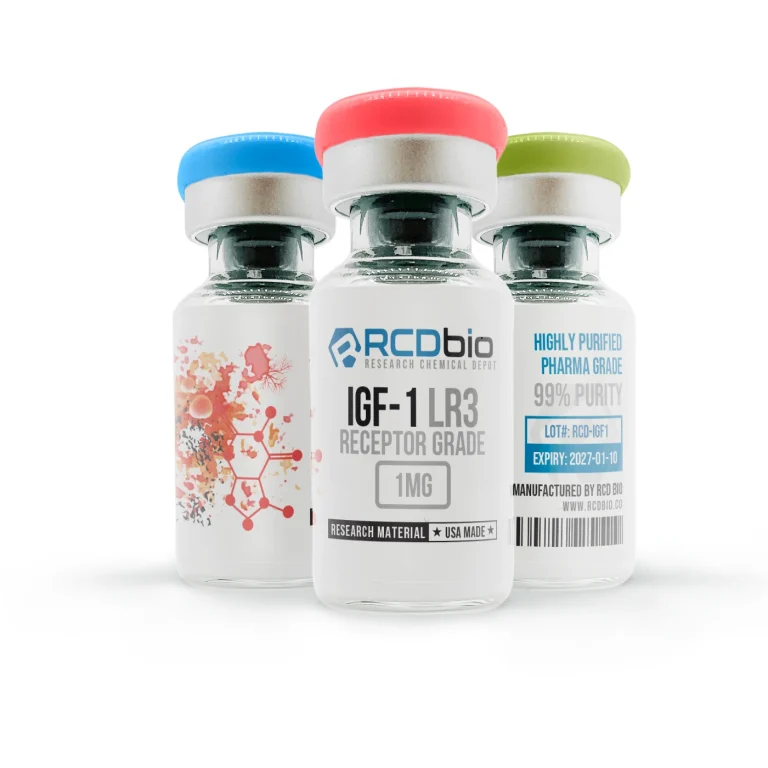
Description
What is IGF-1 LR3?
IGF-1 LR3 (Long Arginine 3 — Insulin-like Growth Factor 1) is a synthetic 83-amino acid analog of endogenous human IGF-1, engineered with two deliberate structural modifications that substantially alter its pharmacokinetic profile in laboratory and preclinical settings. First, the native glutamic acid residue at position 3 is replaced by arginine — the “R3” substitution — which is primarily responsible for reducing the molecule’s binding affinity for insulin-like growth factor binding proteins (IGFBPs). Second, an additional 13-amino acid sequence is appended to the N-terminus, extending the total chain length from the 70 residues found in native IGF-1 to 83. Together, these modifications reduce IGFBP binding affinity by approximately 1,000-fold relative to native IGF-1, as characterized in radioligand displacement assays, while preserving full binding activity at the IGF-1 receptor (IGF1R). The practical consequence in preclinical models is a substantially extended circulating half-life of approximately 20–30 hours, compared to the minutes-range clearance observed for unmodified IGF-1 in rodent in vivo models.
In research settings, IGF-1 LR3 is employed as a pharmacological tool to investigate IGF1R-mediated intracellular signaling in the absence of the confounding regulatory influence of IGFBPs. It has been studied in preclinical rodent models and in vitro cell systems for its role in IGF1R activation, downstream PI3K/Akt/mTOR and MAPK/ERK signaling cascades, satellite cell biology, and cellular anabolic responses under various metabolic conditions.
IGF-1 LR3 supplied by RCDbio is intended strictly for laboratory and research purposes. It is not approved by the Food and Drug Administration for use in this research-grade, non-pharmaceutical form. It is not a dietary supplement and is not intended for human consumption or therapeutic self-administration.
Chemical Properties
| Property | Detail |
| Product Type | Synthetic Long-Chain Peptide Analog (83 amino acids) |
| Product Name | IGF-1 LR3 (Long Arginine 3 — Insulin-like Growth Factor 1) |
| Application | Scientific / Research Use Only |
| CAS Number | 946870-92-4 (research-grade lyophilized form); 143045-27-6 (free form) |
| Molar Mass | 9117.60 g/mol |
| Chemical Formula | C400H625N111O115S9 |
| Sequence | Met–Phe–Pro–Ala–Met–Pro–Leu–Ser–Ser–Leu–Phe–Val–Asn–Gly–Pro–Arg–Thr–Leu–Cys–Gly–Ala–Glu–Leu–Val–Asp–Ala–Leu–Gln–Phe–Val–Cys–Gly–Asp–Arg–Gly–Phe–Tyr–Phe–Asn–Lys–Pro–Thr–Gly–Tyr–Gly–Ser–Ser–Ser–Arg–Arg–Ala–Pro–Gln–Thr–Gly–Ile–Val–Asp–Glu–Cys–Cys–Phe–Arg–Ser–Cys–Asp–Leu–Arg–Arg–Leu–Glu–Met–Tyr–Cys–Ala–Pro–Leu–Lys–Pro–Ala–Lys–Ser–Ala (83 residues; Arg³ substitution replacing Glu at position 3; 13-residue N-terminal extension) |
| IUPAC Name | Insulin-like growth factor-1 (human), N-(N-(N-glycyl-L-prolyl)-L-glutamyl)-[Arg3]- — long arginine 3 analogue |
| Synonyms | Long R3-IGF-1; LR3-IGF-1; Long Arginine 3 IGF-1 |
| Physical Form | Lyophilized white to off-white powder; TFA salt form (residual trifluoroacetate typically ≤10% w/w) |
| Solubility | Reconstitutes in sterile distilled water or sterile phosphate-buffered saline; small volumes of DMSO or TFA (≤0.1%) may be used to improve initial solubility in laboratory settings; avoid high-temperature dissolution |
| Storage (Lyophilized) | Store at −20°C in a sealed, light-protected container with desiccant; avoid temperature cycling prior to reconstitution |
| Storage (Reconstituted) | Store at 4°C; use within 48–72 hours; avoid repeated freeze-thaw cycles; discard any solution that appears turbid, discolored, or contains visible particulate matter |
| PubChem CID | 381123731 |
| Purity | ≥98% (HPLC verified, independent third-party laboratory analysis; COA available per batch) |
| WADA Status | IGF-1 LR3 is a synthetic analog of IGF-1 and falls under Section S2 (Peptide Hormones, Growth Factors, Related Substances and Mimetics) of the current WADA Prohibited List. It is prohibited both in-competition and out-of-competition. Researchers engaged in sport-adjacent studies should verify the current status at GlobalDRO.com before use. |
How Does IGF-1 LR3 Work?
IGF-1 LR3 exerts its effects in experimental systems primarily through high-affinity binding to the IGF-1 receptor (IGF1R), a transmembrane receptor tyrosine kinase expressed in skeletal muscle cell cultures, adipocyte preparations, osteoblast cultures, and a broad range of other cell systems investigated in vitro. Upon binding, IGF1R undergoes ligand-induced conformational rearrangement resulting in autophosphorylation of specific tyrosine residues within the intracellular kinase domain. Downstream, two principal signaling branches have been characterized in cell-based research systems.
PI3K/Akt/mTOR Pathway In skeletal muscle cell preparations and isolated myoblast culture systems, IGF1R activation by the LR3 analog has been observed to recruit insulin receptor substrate-1 (IRS-1) to the activated receptor complex, initiating phosphoinositide 3-kinase (PI3K)-mediated generation of phosphatidylinositol (3,4,5)-trisphosphate (PIP3). PIP3 accumulation promotes membrane recruitment and phosphorylation of Akt (protein kinase B) at Thr308 and Ser473. Akt-mediated phosphorylation subsequently activates the mechanistic target of rapamycin complex 1 (mTORC1), which has been characterized in isolated cell systems as a central regulator of ribosomal protein S6 kinase 1 (S6K1) activation and eukaryotic translation initiation factor 4E-binding protein 1 (4E-BP1) phosphorylation — events associated with upstream regulation of protein synthesis in these experimental models. Akt-dependent phosphorylation and cytoplasmic sequestration of FOXO transcription factors has also been characterized in myotube preparations as a mechanism associated with reduced expression of atrophy-related ubiquitin ligases MAFbx and MuRF1.
MAPK/ERK Pathway In fibroblast and satellite cell preparations, IGF1R engagement also recruits the adapter protein Shc, which bridges to Grb2-SOS complex formation and subsequent Ras activation. The downstream Raf–MEK–ERK1/2 phosphorylation cascade has been characterized in multiple in vitro cell systems as mechanistically involved in cell cycle progression and mitogenic responses. In rodent-derived myoblast preparations, ERK1/2 activation by IGF-1 analogs has been investigated in the context of satellite cell activation and differentiation toward a committed myogenic phenotype, although the relative contributions of the PI3K and MAPK branches vary across cell type and experimental context.
IGFBP Independence as a Research Tool Property A defining pharmacological characteristic of IGF-1 LR3 relative to native IGF-1 is its approximately 1,000-fold reduction in binding affinity for IGF binding proteins (IGFBP-1 through IGFBP-6), as established in radioligand competition assay systems. Since IGFBPs sequester native IGF-1 in the extracellular compartment and substantially limit its receptor-accessible fraction, the LR3 modification renders the analog a valuable pharmacological tool for investigating direct IGF1R-mediated signaling in cell culture systems without the confounding attenuation introduced by endogenous IGFBP expression. This property is specifically exploited in serum-free cell culture protocols where accurate dose-response characterization of IGF1R activity is required.
Glucose Transporter Regulation In isolated 3T3-L1 adipocyte preparations, IGF1R activation by IGF-1 analogs has been characterized as promoting translocation of glucose transporter type 4 (GLUT4) to the plasma membrane in an Akt-dependent manner, resulting in measurable increases in glucose uptake in vitro. This pathway overlaps mechanistically with insulin receptor signaling and has been investigated in cell-based models as context for understanding the cross-reactivity between the IGF and insulin receptor systems under metabolic research conditions.
Key Research Findings
- IGFBP-independent potency: LR3 IGF-I demonstrated 1.5- to 2-fold greater potency than native IGF-I in promoting body weight gain and reversing dexamethasone-induced catabolism in rat in vivo models under continuous infusion conditions, attributed to its negligible IGFBP affinity. [Tomas et al., 1996]
- Anabolic activity in catabolic rodent models: LR3 IGF-I and related IGF-I variants produced significantly greater nitrogen retention and muscle protein synthesis than native IGF-I in dexamethasone-treated rat models, characterizing the structural R3 modification as conferring enhanced receptor-available bioactivity. [Tomas et al., 1992]
- IGFBP-3 interaction context: LR3-IGF-1’s negligible IGFBP-3 affinity has been employed in breast epithelial cell preparations to isolate IGFBP-3 co-activating effects on IGF1R from direct IGF1R ligand effects, demonstrating utility as a mechanistic disambiguation tool in receptor signaling studies. [Baxter, 2023]
- IGF1R tyrosine kinase autophosphorylation: Structural studies of the IGF1R have characterized receptor activation as proceeding through ligand-induced conformational change, transautophosphorylation of intracellular tyrosine residues, and downstream IRS-1 and Shc substrate engagement in isolated receptor preparations and transfected cell systems. [Zha & Bhatt, 2022]
- Organ growth responses: Long R3 IGF-I infusion in guinea pig models was associated with organ-specific growth responses accompanied by reductions in circulating endogenous IGF-I and IGFBPs, reflecting receptor-mediated feedback regulation of the somatotropic axis in vivo. [Conlon et al., 1995]
All findings listed above are derived from preclinical or in vitro data. No conclusions regarding human therapeutic efficacy can be drawn from these observations. These findings do not constitute evidence of safety or efficacy in any human condition or organism.
What are the Potential Research Applications of IGF-1 LR3?
IGF1R Signal Transduction Studies IGF-1 LR3 is employed as a reference agonist in investigations of IGF1R receptor activation kinetics, autophosphorylation stoichiometry, and G protein-independent signaling branch selectivity. Its negligible IGFBP affinity makes it particularly useful in serum-containing cell culture systems and in studies where endogenous IGFBP expression would otherwise confound dose-response characterization. In isolated cell preparations and reconstituted signaling systems, it is used as a pharmacological tool to selectively activate IGF1R without concurrent insulin receptor cross-activation at research-relevant concentrations.
Skeletal Muscle Cell Biology and Satellite Cell Research In vitro preparations of primary myoblasts and satellite cell-derived cultures have employed IGF-1 LR3 to investigate signaling events associated with myogenic differentiation, hypertrophy-related protein synthesis responses, and expression of myogenic regulatory factors including MyoD and myogenin. In rodent in vivo models, IGF-1 analogs have been investigated in the context of experimental muscle atrophy paradigms — including denervation and glucocorticoid-induced catabolic states — to characterize the mechanistic relationship between IGF1R signaling and fiber-level anabolic responses.
Metabolic and Glucose Uptake Research IGF-1 LR3 is investigated in isolated adipocyte and hepatocyte preparations for its capacity to engage insulin receptor substrate proteins and modulate GLUT4 trafficking. In cell culture models of insulin resistance and hyperglycemia, the analog is used to interrogate the functional overlap and divergence between IGF1R and insulin receptor signaling at shared downstream effectors, including IRS-1, PI3K, and Akt.
Cell Culture and Bioreactor Applications IGF-1 LR3 is extensively employed as a serum-free culture supplement in biopharmaceutical manufacturing cell lines, including CHO, HEK293, and hybridoma preparations, where it serves as a defined growth factor replacement supporting proliferation and viability in the absence of serum-derived IGFs. In this context, the extended half-life and IGFBP independence of the LR3 form are specifically advantageous for maintaining consistent receptor stimulus across extended culture periods.
Cancer Biology and IGF1R Pathway Research The IGF1R/PI3K/Akt axis has been extensively investigated in oncological research contexts for its role in tumor cell proliferation, survival, and resistance to apoptotic signaling. IGF-1 LR3 is used in cell-based assays to characterize IGF1R-dependent oncogenic signaling in tumor-derived cell lines, to establish IGF1R pathway activity benchmarks for receptor antagonist and inhibitor studies, and to investigate crosstalk between the IGF axis and other growth factor receptor systems.
These are observed in preclinical and in vitro contexts only and do not constitute claims of efficacy or safety in any organism.
What are the Potential Side Effects of IGF-1 LR3?
- Hypoglycemia-like responses (reduced glucose availability in medium) observed in serum-free cell culture systems at high IGF-1 LR3 concentrations, consistent with GLUT4 upregulation and increased glucose consumption by cells; not a direct cellular toxicity observation
- Dose-dependent suppression of endogenous IGF-I and IGF binding protein-3 plasma concentrations observed in guinea pig and porcine in vivo models following prolonged LR3 IGF-I infusion, reflecting somatotropic axis feedback regulation
- Visceral organ hypertrophy (including liver and kidney weight increases) observed in rodent in vivo studies at pharmacological doses during sustained infusion protocols; consistent with systemic IGF1R activation and not uniquely attributable to the LR3 modification
- Insulin receptor cross-activation observed at supraphysiological concentrations in cell-based assays, reflecting structural homology between the IGF and insulin receptor systems; may confound experimental interpretation at non-physiological dose ranges
- Off-target growth factor receptor binding at elevated concentrations reported in in vitro systems, consistent with the structural relatedness of receptor tyrosine kinases in the insulin superfamily
- Satellite cell over-activation and altered differentiation kinetics observed in prolonged in vitro myoblast culture preparations at sustained high concentrations, suggesting non-physiological mitogenic pressure at doses beyond standard research concentrations
No human safety or tolerability data pertaining to research-grade IGF-1 LR3 has been established. These observations are derived from experimental systems and should not be extrapolated to human or animal outcomes.
Risk & Handling
Handling Precautions
IGF-1 LR3 is a high-molecular-weight biologically active peptide that must be handled exclusively by trained laboratory personnel in an appropriately equipped research facility. Minimum personal protective equipment includes nitrile gloves, a laboratory coat, and chemical splash-resistant eye protection. Reconstitution of lyophilized material should be performed in a laminar flow biosafety cabinet or equivalent controlled environment to minimize aerosol generation and contamination risk. Avoid generating aerosols during reconstitution or transfer steps.
Researchers should use low-binding polypropylene or borosilicate glass laboratory vessels during reconstitution and storage; polystyrene and standard laboratory-grade plastic containers are not recommended due to peptide adsorption losses. Amber or opaque containers are not appropriate for this compound; transparent vessels facilitate visual inspection for particulates and turbidity.
IGF-1 LR3 contains internal cysteine residues forming disulfide bridges critical to its three-dimensional structure and receptor binding activity. Exposure to reducing agents — including dithiothreitol (DTT), β-mercaptoethanol, or tris(2-carboxyethyl)phosphine (TCEP) — will disrupt disulfide bond integrity and inactivate the compound. Ensure all reconstitution buffers and culture media are free of reducing agents before use with this analog.
Exposure Risks
Risk Tier: MODERATE
IGF-1 LR3 is a potent agonist at IGF1R, a receptor tyrosine kinase with broad tissue expression and established roles in proliferative and anabolic signaling cascades. At research-relevant concentrations, it is not acutely cytotoxic in standard preclinical cell systems; however, its extended half-life (approximately 20–30 hours in preclinical models) compared to native IGF-1 amplifies the duration of receptor occupancy and downstream pathway activation per dose. Dose-dependent organ weight increases and suppression of the somatotropic axis have been documented in rodent and porcine in vivo models at pharmacological doses. Insulin receptor cross-reactivity at supraphysiological concentrations introduces risk of confounding glycemic effects in whole-animal models. The structural overlap between IGF1R and proliferative oncogenic signaling pathways warrants appropriate precaution in experimental design.
No human safety data has been established for research-grade IGF-1 LR3. Researchers should exercise caution appropriate to handling a potent biologically active peptide with growth factor activity.
Storage
- Lyophilized form: Store at −20°C in a sealed, light-protected container with desiccant; verify container integrity before use
- Reconstituted form: Store at 4°C; use within 48–72 hours of reconstitution
- Do not subject reconstituted solutions to repeated freeze-thaw cycles; each cycle degrades structural integrity and risks disulfide bridge oxidative damage
- Do not reconstitute or store in the presence of reducing agents (DTT, β-mercaptoethanol, TCEP); these will disrupt internal disulfide bonds and abolish receptor binding activity
- Discard any reconstituted solution that appears turbid, visibly discolored, or contains particulate matter
- Avoid sustained exposure to temperatures above ambient (>25°C) even in lyophilized form
FAQs
Q: What is IGF-1 LR3 and what is it investigated for in research? A: IGF-1 LR3 is a synthetic 83-amino acid analog of human IGF-1 distinguished by an arginine substitution at position 3 and a 13-residue N-terminal extension. It is investigated in preclinical and in vitro research systems for its role as a pharmacological tool at the IGF-1 receptor (IGF1R), enabling study of IGF1R-mediated PI3K/Akt/mTOR and MAPK/ERK signaling without the confounding attenuation of IGF binding proteins. Research applications include skeletal muscle cell biology, metabolic signaling studies, cancer biology, and serum-free cell culture applications.
Q: What is the half-life of IGF-1 LR3 in preclinical models? A: The circulating half-life of IGF-1 LR3 in preclinical rodent in vivo models is approximately 20–30 hours, compared to the minutes-range clearance observed for native IGF-1. This extended half-life is a direct consequence of the R3 modification, which reduces IGFBP binding affinity by approximately 1,000-fold, substantially decreasing the rate at which the analog is sequestered from the receptor-accessible free fraction. These figures are derived from preclinical pharmacokinetic studies and do not represent human pharmacokinetic data for research-grade material.
Q: How should IGF-1 LR3 be stored to maintain stability? A: Lyophilized IGF-1 LR3 should be stored at −20°C in a sealed, desiccant-protected, light-resistant container. Reconstituted solutions should be maintained at 4°C and used within 48–72 hours. Repeated freeze-thaw cycles should be avoided, as each cycle introduces risk of disulfide bond oxidative degradation and irreversible loss of structural integrity. Reducing agents (DTT, β-mercaptoethanol, TCEP) must be excluded from all reconstitution buffers and storage vessels, as they disrupt the internal disulfide bonds required for native receptor binding conformation.
Q: What toxicity observations have been reported in preclinical studies? A: In rodent and porcine in vivo pharmacological models, prolonged infusion of LR3 IGF-I at pharmacological doses has been associated with visceral organ weight increases (including liver and kidney hypertrophy), suppression of endogenous IGF-I and IGF binding protein-3 concentrations, and alterations in somatotropic axis regulation. Insulin receptor cross-activation at supraphysiological in vitro concentrations introduces potential for confounded glycemic signaling in whole-animal experimental designs. Acute cytotoxicity has not been characterized as a primary finding at research-relevant concentrations in standard cell culture systems. No human safety or tolerability data has been established for this compound.
Q: What is IGF-1 LR3 typically reconstituted with in laboratory research? A: In research settings, IGF-1 LR3 is most commonly reconstituted in sterile distilled water or sterile phosphate-buffered saline (PBS, pH 7.4). For applications requiring high initial concentration, a small volume of DMSO or TFA (≤0.1% of final volume) may be used to improve solubility prior to dilution into aqueous buffer. The reconstituted compound should be gently mixed by inversion or slow rotation rather than vortexing to minimize shear-induced aggregation of this high-molecular-weight peptide.
Q: How does IGF-1 LR3 differ structurally and pharmacologically from native IGF-1? A: Native IGF-1 is a 70-amino acid endogenous growth factor with high binding affinity for all six IGF binding proteins (IGFBPs), which regulate its bioavailability in the extracellular compartment. IGF-1 LR3 incorporates two engineering modifications: an arginine substitution at position 3 (replacing the native glutamic acid) and a 13-residue N-terminal extension. These changes reduce IGFBP binding affinity by approximately 1,000-fold while preserving full IGF1R agonist activity. The practical consequence in preclinical models is a half-life of approximately 20–30 hours versus the minutes observed for native IGF-1. For cell culture research applications, this means greater receptor-accessible fraction per unit concentration and reduced variability introduced by variable endogenous IGFBP expression across different cell lines.
Q: What is the significance of the TFA salt form in which IGF-1 LR3 is supplied? A: IGF-1 LR3 is supplied as a lyophilized trifluoroacetate (TFA) salt, which is the standard residual counterion form resulting from reversed-phase HPLC purification procedures used in peptide manufacturing. Residual trifluoroacetate content is typically ≤10% w/w in this material. In standard aqueous reconstitution buffers at the volumes used in cell culture research, residual TFA at these concentrations is generally not a source of confounding biological activity; however, researchers requiring TFA-free preparations for sensitive cell-based assays may exchange the counterion using ion exchange procedures prior to use. Exact TFA content is confirmed on batch-specific Certificates of Analysis available from RCDbio.
Related Research Compounds
IGF-1 DES(1-3) Peptide — A truncated N-terminal IGF-1 variant that also exhibits markedly reduced IGFBP binding affinity through deletion of the first three amino acid residues; employed in research contexts where the extended half-life of the LR3 form is not required and acute receptor activation followed by rapid clearance is the experimental design objective.
Sermorelin Peptide — A synthetic 29-amino acid analog of growth hormone-releasing hormone (GHRH) that acts upstream of the IGF axis at the GHRH receptor (GHRHR) in somatotroph cell preparations; investigated in preclinical models as a tool to study pituitary GH release and the consequent hepatic stimulation of endogenous IGF-1 production through a distinct proximal mechanism.
GHRP-6 Peptide — A synthetic hexapeptide that activates the ghrelin receptor (GHSR) in pituitary and hypothalamic cell preparations, characterized in rodent in vivo models for its role in promoting pulsatile GH secretion and the associated downstream IGF-1 axis stimulation; used in combination with GHRH analogs to investigate the synergistic regulation of somatotropic signaling in preclinical research designs.
References
- Tomas FM, Lemmey AB, Read LC, Ballard FJ. (1996). Superior potency of infused IGF-I analogues which bind poorly to IGF-binding proteins is maintained when administered by injection. Journal of Endocrinology, 150(1):77–84. https://pubmed.ncbi.nlm.nih.gov/8708565/
- Tomas FM, Knowles SE, Owens PC, Chandler CS, Francis GL, Read LC, Ballard FJ. (1992). Insulin-like growth factor-I (IGF-I) and especially IGF-I variants are anabolic in dexamethasone-treated rats. Biochemical Journal, 282(Pt 1):91–97. https://pubmed.ncbi.nlm.nih.gov/1371669/
- Mohan S, Baylink DJ. (2002). IGF-binding proteins are multifunctional and act via IGF-dependent and -independent mechanisms. Journal of Endocrinology, 175(1):19–31. https://pubmed.ncbi.nlm.nih.gov/12379487/
- Francis GL, Ross M, Ballard FJ, et al. (1992). Novel recombinant fusion protein analogues of insulin-like growth factor (IGF)-I indicate the relative importance of IGF-binding protein and receptor binding for enhanced biological potency. Journal of Molecular Endocrinology, 8(3):213–223. https://pubmed.ncbi.nlm.nih.gov/1378742/
- Conlon MA, Tomas FM, Owens PC, et al. (1995). Long R3 insulin-like growth factor-I (IGF-I) infusion stimulates organ growth but reduces plasma IGF-I, IGF-II and IGF binding protein concentrations in the guinea pig. Journal of Endocrinology, 146(3):247–253. https://pubmed.ncbi.nlm.nih.gov/7561636/
Disclaimer
IGF-1 LR3 Peptide is exclusively for laboratory research purposes. RCDbio products are not intended to diagnose, prevent, treat, or cure any disease or medical condition.
The Food and Drug Administration has not evaluated the statements on our website. This product is not approved for human or veterinary use. Researchers must comply with all applicable local, state, and federal laws and regulations governing the purchase and use of research compounds. By purchasing, you agree to our Terms and Conditions. RCDbio reserves the right to refuse sales to unauthorized individuals.
ATTENTION: All RCDbio products are strictly for LABORATORY AND RESEARCH PURPOSES ONLY. They are not intended for human consumption, veterinary use, or any other non-research application. For queries, complaints, or support, contact support@legacy.rcdbio.co
Reviews
There are no reviews yet