

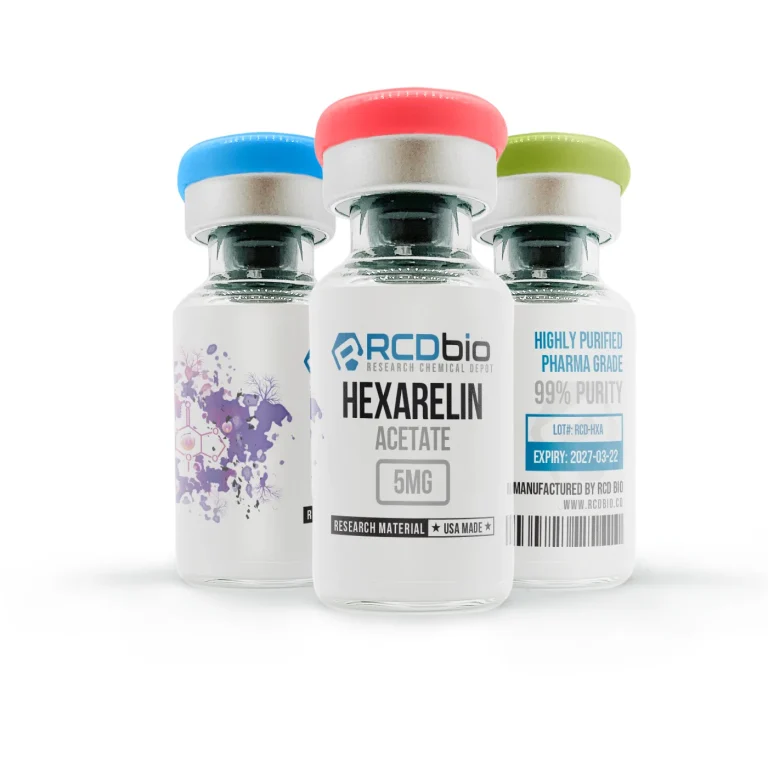
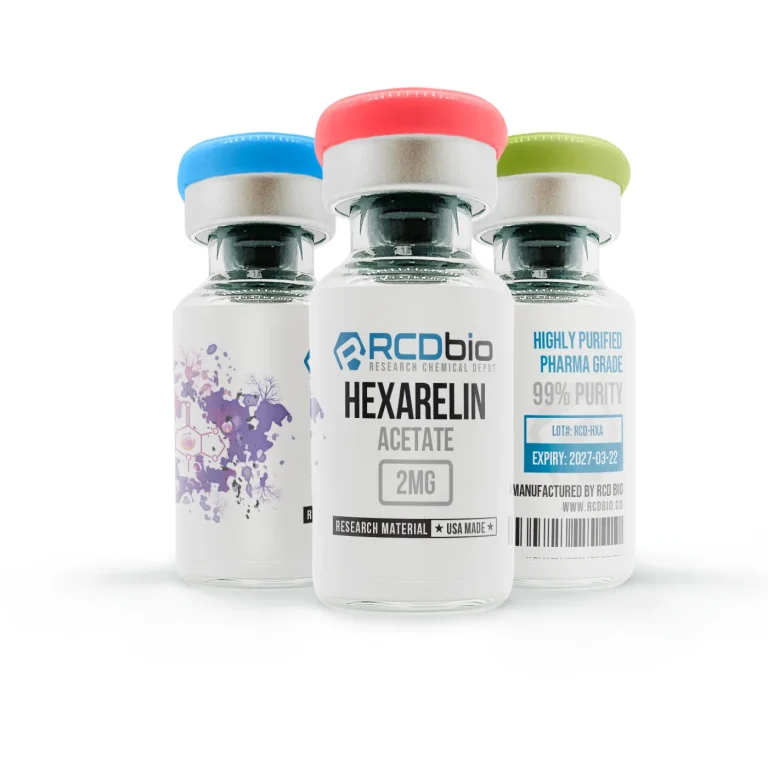
Description
What is Hexarelin Acetate?
Hexarelin acetate, assigned the International Nonproprietary Name examorelin and bearing the developmental code EP-23905, is a synthetic hexapeptide growth hormone secretagogue (GHS) with the sequence His-D-2-methyl-Trp-Ala-Trp-D-Phe-Lys-NH₂. It was developed in the early 1990s by Romano Deghenghi and colleagues at Europeptides as a structural analog of GHRP-6, incorporating a D-2-methyltryptophan substitution at position 2 and a D-phenylalanine at position 5 to confer enhanced metabolic stability and increased receptor binding potency relative to the parent sequence. The compound is supplied by RCDbio as the acetate salt in lyophilized powder form.
In research settings, hexarelin acetate is investigated as a dual-receptor tool compound with activity at two pharmacologically distinct binding sites. The primary site is the growth hormone secretagogue receptor type 1a (GHS-R1a), a Gαq/11-coupled seven-transmembrane receptor expressed in the pituitary, hypothalamus, and peripheral tissues, through which hexarelin mediates growth hormone (GH) release. The secondary and mechanistically distinct site is the CD36 scavenger receptor, a multifunctional transmembrane glycoprotein expressed on cardiomyocytes, microvascular endothelial cells, platelets, macrophages, and adipocytes. Hexarelin’s binding to CD36 has been characterized in isolated cardiac membrane preparations as the molecular basis for its GH-independent cardioprotective activity — a property that distinguishes it from most other members of the GHRP class.
RCDbio synthetic hexarelin acetate is intended strictly for laboratory and research purposes. It is not approved by the Food and Drug Administration for use in this research-grade, non-pharmaceutical form. It is not a dietary supplement and is not intended for human consumption or therapeutic self-administration.
Chemical Properties
| Property | Detail |
| Product Type | Synthetic Hexapeptide Growth Hormone Secretagogue (GHS); Acetate Salt |
| Product Name | Hexarelin Acetate (Examorelin) |
| Application | Scientific / Research Use Only |
| CAS Number | 140703-51-1 (free base); 208251-52-9 (acetate salt) |
| Molar Mass | 887.06 g/mol (free base, C₄₇H₅₈N₁₂O₆); acetate salt: 887.06 g/mol free base + xCH₃COOH adduct (variable stoichiometry) |
| Chemical Formula | C₄₇H₅₈N₁₂O₆ (free base); C₄₇H₅₈N₁₂O₆ · xC₂H₄O₂ (acetate salt) |
| Sequence | His-D-2-methyl-Trp-Ala-Trp-D-Phe-Lys-NH₂ (C-terminal primary amide; D-stereochemistry at positions 2 and 5; 2-methyl substitution on indole nitrogen of Trp at position 2) |
| IUPAC Name | (2S)-6-amino-2-[[(2R)-2-[[(2S)-2-[[(2S)-2-[[(2R)-2-[[(2S)-2-amino-3-(1H-imidazol-5-yl)propanoyl]amino]-3-(2-methyl-1H-indol-3-yl)propanoyl]amino]propanoyl]amino]-3-(1H-indol-3-yl)propanoyl]amino]-3-phenylpropanoyl]amino]hexanamide (free base); acetate salt IUPAC: acetic acid; (2S)-6-amino-2-[[(2R)-2-[[(2S)-2-[[(2S)-2-[[(2R)-2-[[(2S)-2-amino-3-(1H-imidazol-5-yl)propanoyl]amino]-3-(2-methyl-1H-indol-3-yl)propanoyl]amino]propanoyl]amino]-3-(1H-indol-3-yl)propanoyl]amino]-3-phenylpropanoyl]amino]hexanamide |
| Synonyms | Examorelin (INN); EP-23905 (developmental code); MF-6003; GHRP hexapeptide; His-D-2-Me-Trp-Ala-Trp-D-Phe-Lys-NH₂ |
| Physical Form | Lyophilized white to off-white powder |
| Solubility | Soluble in sterile water for injection, bacteriostatic water (0.9% benzyl alcohol), or dilute aqueous acetic acid (0.1–1% v/v); also soluble in PBS at research concentrations. No disulfide bridge; reducing agents do not affect structural integrity. |
| Storage (Lyophilized) | Store at −20°C in a sealed, light-protected container with desiccant; protect from moisture and repeated temperature fluctuations |
| Storage (Reconstituted) | Store at 4°C; use within 7–14 days of reconstitution; avoid repeated freeze-thaw cycles; discard any solution appearing turbid, discolored, or showing particulate matter |
| PubChem CID | 6918297 (free base, examorelin); 21885907 (hexarelin acetate) |
| Purity | ≥98% (HPLC verified, independent third-party laboratory analysis; COA available per batch) |
| WADA Status | Hexarelin (examorelin) is prohibited under S2.2.4 of the 2026 WADA Prohibited List (Growth Hormone Releasing Factors – GH-releasing peptides), where examorelin (hexarelin) is explicitly named. Prohibition applies in and out of competition. Verify at GlobalDRO.com. It is prohibited in-competition and out-of-competition. Researchers engaged in sport-adjacent studies should verify the current status at GlobalDRO.com before use. |
How Does Hexarelin Acetate Work?
Hexarelin acetate exerts its characterized laboratory effects through two pharmacologically distinct receptor systems that operate independently of one another, distinguishing it from other members of the GHRP class.
GHS-R1a Agonism and Pituitary GH Release
At the GHS-R1a receptor a Gαq/11-coupled seven-transmembrane G protein-coupled receptor (GPCR) expressed in somatotroph cells of the anterior pituitary, arcuate nucleus neurons, and peripheral tissues — hexarelin binding initiates phospholipase C (PLC)-mediated hydrolysis of phosphatidylinositol 4,5-bisphosphate (PIP₂), generating inositol trisphosphate (IP₃) and diacylglycerol (DAG). IP₃-mediated calcium mobilization from intracellular stores and PKC activation have been characterized in pituitary somatotroph cell preparations as the primary intracellular mechanism driving GH exocytosis. In parallel, hexarelin has been observed to suppress somatostatin tone at the hypothalamic level in rodent in vivo models — an additional mechanism contributing to the magnitude of observed GH release. Among synthetic GHRPs, hexarelin is characterized as the most potent acute GH secretagogue in both rodent and human study models, producing peak GH responses at doses investigated in early clinical pharmacology settings.
GHS-R1a-Independent CD36 Binding and Cardiac Signaling
In isolated rat cardiac membrane preparations, a hexarelin-binding protein of approximately 84 kDa was identified using a radioactive photoactivatable hexarelin derivative and characterized by N-terminal sequence determination as CD36 — a multifunctional scavenger glycoprotein (also known as scavenger receptor B2) expressed on cardiomyocytes and microvascular endothelial cells. Activation of CD36 by hexarelin in isolated perfused heart preparations was observed to modulate coronary perfusion pressure in a dose-dependent manner. Critically, this cardiac receptor activity is characterized as GH-independent: cardioprotective effects observed in GH-deficient rodent models and GH-deficient human subject studies confirm that hexarelin’s cardiac actions do not require downstream GH or IGF-1 signaling. CD36-mediated signaling by hexarelin has been associated with downstream PI3K/Akt/mTOR pathway activation in cardiomyocyte preparations, PTEN suppression, and modulation of matrix metalloproteinase (MMP-2, MMP-9) activity in cardiac fibrosis models.
HPA Axis Co-Stimulation
In addition to GHS-R1a-mediated somatotroph activation, hexarelin has been characterized in rodent and human study designs to co-stimulate the hypothalamic-pituitary-adrenal (HPA) axis, with observed increases in ACTH and cortisol secretion. This effect distinguishes hexarelin from more receptor-selective GHRPs such as ipamorelin, which do not elicit significant ACTH or cortisol responses at GH-releasing doses. HPA co-stimulation has been attributed to hypothalamic arginine vasopressin (AVP) release in preclinical model preparations.
GHS-R1a Desensitization with Repeated Exposure
In rodent in vivo models and human study designs, repeated administration of hexarelin has been observed to attenuate the GH response a receptor desensitization phenomenon attributed to GHS-R1a downregulation or functional uncoupling. This desensitization is more pronounced with hexarelin than with other GHRPs at equivalent dosing frequencies and has been characterized in both short-term and extended preclinical dosing protocols.
Key Research Findings
- GHS-R1a potency characterization: Hexarelin elicited the highest peak GH responses among synthetic GHRPs evaluated via intravenous, subcutaneous, intranasal, and oral routes in healthy human volunteers; GH peak magnitude exceeded GHRH-stimulated responses at equivalent doses. [Ghigo et al., J Clin Endocrinol Metab, 1994]
- CD36 identification as cardiac receptor: A radioactive hexarelin derivative labeled a cardiac membrane glycoprotein of 84 kDa in isolated rat heart preparations; N-terminal sequencing confirmed CD36 identity; CD36-null murine hearts did not exhibit hexarelin-elicited coronary perfusion pressure changes, confirming CD36 as the mediating receptor. [Bodart et al., Circ Res, 2002]
- Cardiac fibrosis suppression: Chronic hexarelin administration significantly reduced interstitial and perivascular myocardial collagen deposition in spontaneously hypertensive rat (SHR) cardiac tissue; MMP-2 and MMP-9 activities were increased and collagen I and III mRNA expression was reduced compared to untreated controls. [Xu et al., Am J Physiol Heart Circ Physiol, 2012]
- Post-myocardial infarction cardiac function: Hexarelin treatment preserved left ventricular ejection fraction, reduced infarct zone fibrosis, and attenuated cardiac remodeling in murine coronary artery ligation models; effects were superior to ghrelin-treated controls in GH-deficient model variants, consistent with CD36-mediated GH-independent activity. [Mao et al., J Geriatr Cardiol, 2014]
- GH-deficiency pituitary reserve diagnostic: Hexarelin administration at 2 µg/kg i.v. was evaluated as a pituitary reserve diagnostic agent in subjects with hypothalamic-pituitary abnormalities; GH response magnitude correlated with residual pituitary stalk integrity on MRI, establishing mechanistic differentiation between hypothalamic and pituitary GH deficiency etiologies in a clinical study design. [Maghnie et al., J Clin Endocrinol Metab, 2001]
All findings listed above are derived from preclinical or in vitro data except where explicitly noted as human clinical study observations. No conclusions regarding human therapeutic efficacy can be drawn from these observations. These findings do not constitute evidence of safety or efficacy in any human condition or organism.
What are the Potential Research Applications of Hexarelin Acetate?
GHS-R1a Receptor Pharmacology and GPCR Signaling
Hexarelin acetate is employed in laboratory investigations characterizing GHS-R1a signal transduction in pituitary somatotroph cell preparations, heterologous expression systems, and primary neuronal cultures. Its well-defined receptor selectivity profile and high binding affinity (Kd approximately 0.7 nM at GHS-R1a) make it a standard reference compound in radioligand binding assays, calcium mobilization experiments, and PLC pathway reporter systems. It is used to probe the molecular pharmacology of ghrelin-receptor interactions, somatostatin-GHRP antagonism, and hypothalamic GH axis regulation in rodent in vivo models.
Cardiovascular and Cardiac Biology Research
The identification of CD36 as a hexarelin-binding cardiac receptor has established hexarelin as a unique probe for studying GH-independent cardioprotective signaling. In isolated cardiomyocyte preparations, ischemia-reperfusion injury models, coronary artery ligation rodent models, and cardiac fibrosis preparations, hexarelin is investigated for its effects on PI3K/Akt/mTOR pathway activation, MMP-mediated collagen remodeling, left ventricular function preservation, and cardiomyocyte apoptosis inhibition. Its greater chemical stability relative to ghrelin makes it the preferred GHS tool compound in cardiac biology research contexts.
Growth Hormone Axis and Neuroendocrine Research
In neuroendocrine research contexts, hexarelin acetate is utilized as a maximally efficacious GHS-R1a agonist to investigate somatotroph secretory capacity, hypothalamic regulatory circuits, and pituitary reserve testing paradigms in preclinical and early-phase clinical study models. It is used alongside GHRH in combination protocols to probe the synergistic versus independent contributions of the two pathways to GH secretory dynamics in rodent and primate model systems.
Metabolic Biology and Body Composition Research
In preclinical metabolic models — including diet-induced obesity rodent preparations, GH-deficient rat models, and diabetic rodent systems — hexarelin acetate is investigated for its effects on GH/IGF-1 axis-mediated metabolic parameters, including lean mass preservation, visceral adipose tissue distribution, and glucose homeostasis biomarkers. CD36’s role in fatty acid uptake and lipid metabolism is an additional area of research interest in models employing hexarelin as a CD36 agonist probe.
Receptor Desensitization and Tachyphylaxis Research
Hexarelin’s well-characterized GHS-R1a desensitization profile following repeated administration makes it a useful experimental model for investigating GPCR downregulation mechanisms, agonist-induced receptor internalization, and recovery kinetics in pituitary cell preparations and in vivo rodent models.
These are observed in preclinical and in vitro contexts only and do not constitute claims of efficacy or safety in any organism.
What are the Potential Side Effects of Hexarelin Acetate?
- Cortisol and prolactin co-elevation observed in human clinical pharmacology study designs at GH-releasing doses (1–2 µg/kg i.v.); distinguishes hexarelin from receptor-selective GHRPs such as ipamorelin; magnitude is dose-dependent and was not characterized as dose-limiting in short-duration studies
- GHS-R1a receptor desensitization with attenuation of GH response observed in both rodent in vivo models and human study designs following repeated hexarelin administration; effect is more pronounced than with other GHRPs at comparable dosing frequencies; receptor recovery characterized over multi-day wash-out periods in rodent models
- Transient coronary vasoconstriction observed in isolated perfused rat heart preparations at high hexarelin concentrations via CD36 activation; effect is concentration-dependent and not observed in CD36-null murine hearts; not consistently characterized in intact in vivo models at research-relevant doses
- Water retention and joint-associated discomfort have been noted in investigational human use contexts, consistent with GH-mediated effects observed with other secretagogues; these observations are not from controlled preclinical toxicology studies
- No acute hepatotoxicity or nephrotoxicity has been characterized in published preclinical data at research-relevant concentrations; long-term organ-level toxicity data for chronic hexarelin exposure in animal models is limited in the published literature
No human safety or tolerability data pertaining to research-grade hexarelin acetate supplied in lyophilized powder form has been established. Observations from clinical pharmacology study designs referenced herein reflect pharmaceutical-grade, controlled-trial formulations and should not be extrapolated to research-grade material. These observations are derived from experimental systems and should not be extrapolated to human or animal outcomes.
Risk & Handling
Handling Precautions
Hexarelin acetate lyophilized powder should be handled by trained laboratory personnel only. Standard peptide handling precautions apply: nitrile gloves, laboratory coat, and eye protection at minimum. Reconstitution of lyophilized material should avoid aerosol generation; use of a biosafety cabinet is recommended when handling powdered peptide material. Hexarelin acetate does not contain a disulfide bridge and is not sensitive to reducing agents. All reconstitution and aliquoting operations should follow institutional SOPs for bioactive peptide handling. Avoid repeated freeze-thaw cycling of reconstituted solutions.
Exposure Risks
Risk Tier: MODERATE
Hexarelin acetate is a pharmacologically active peptide with characterized receptor-level activity at GHS-R1a and CD36. At doses investigated in short-duration human clinical pharmacology studies (1–2 µg/kg i.v.), no serious adverse events or dose-limiting toxicity were documented; however, ACTH, cortisol, and prolactin co-elevation was observed alongside GH responses. The plasma half-life of hexarelin in rodent models is approximately 55 minutes — longer than many other short peptides, reflecting the metabolic stability conferred by the D-amino acid substitutions. This extended half-life should be considered when designing exposure risk assessments for laboratory personnel. No human safety data has been established for research-grade lyophilized hexarelin acetate supplied in non-pharmaceutical form. Researchers should exercise caution appropriate to handling a potent, biologically active GPCR agonist with neuroendocrine and cardiovascular receptor activity.
Storage
- Lyophilized form: Store at −20°C in a sealed, light-protected container with desiccant; minimize exposure to ambient humidity
- Reconstituted form: Store at 4°C; use within 7–14 days of reconstitution; label reconstitution date and time on each vial
- Avoid repeated freeze-thaw cycles; each cycle risks progressive loss of peptide activity
- No reducing agent sensitivity (no disulfide bridge); however, avoid prolonged exposure to strongly oxidizing conditions
- Discard any reconstituted solution that appears turbid, discolored, or shows visible particulate matter
FAQs
Q: What is hexarelin acetate and what is it investigated for in research settings? A: Hexarelin acetate (examorelin) is a synthetic hexapeptide growth hormone secretagogue with the sequence His-D-2-methyl-Trp-Ala-Trp-D-Phe-Lys-NH₂. In laboratory settings, it is investigated as a dual-receptor tool compound: as a high-affinity GHS-R1a agonist mediating GH release from pituitary somatotroph cell preparations, and as a CD36 scavenger receptor ligand mediating GH-independent cardioprotective signaling in isolated cardiac tissue preparations. It is not approved for human use and is supplied by RCDbio strictly for laboratory and research purposes.
Q: What is the plasma half-life of hexarelin acetate in preclinical models? A: The plasma half-life of hexarelin in rodent preclinical models is approximately 55 minutes — substantially longer than most other synthetic GHRPs. The extended metabolic stability is attributed to the D-amino acid substitutions at positions 2 (D-2-methyltryptophan) and 5 (D-phenylalanine), which reduce susceptibility to endopeptidase degradation. These figures are derived from rodent pharmacokinetic models and do not represent human pharmacokinetic data for research-grade material.
Q: How should hexarelin acetate be stored to maintain stability? A: Lyophilized hexarelin acetate should be stored at −20°C in a sealed, desiccated, light-protected container. Reconstituted solutions should be stored at 4°C and used within 7–14 days. Repeated freeze-thaw cycles should be avoided. The compound does not contain a disulfide bridge and is not sensitive to reducing agents. Turbid or discolored solutions should be discarded.
Q: What toxicity observations have been reported in preclinical studies of hexarelin? A: In published preclinical rodent model data, hexarelin has not been characterized as acutely toxic at research-relevant concentrations. No dose-limiting hepatotoxicity or nephrotoxicity has been reported. Receptor desensitization with attenuation of GH secretory responses is well-documented in repeated-dose rodent models and short-term human study designs. Transient coronary vasoconstriction was observed in isolated perfused rat heart preparations at high concentrations via CD36 activation; this effect was not characterized in intact in vivo models at research doses. Long-term chronic toxicity data in animal models is limited in the published literature.
Q: What is hexarelin acetate typically reconstituted with in laboratory research? A: In laboratory research, hexarelin acetate lyophilized powder is typically reconstituted with sterile water for injection, bacteriostatic water (0.9% benzyl alcohol), or 0.1–1% aqueous acetic acid. The choice of diluent depends on the experimental system and downstream application (e.g., cell culture vs. in vivo rodent administration). The compound does not require reducing agent-free conditions. Researchers should consult institutional protocols and COA documentation for guidance specific to the supplied batch.
Q: How does hexarelin acetate differ from GHRP-6 in its receptor profile? A: Hexarelin and GHRP-6 share the GHS-R1a receptor as their primary pharmacological target and both produce robust GH secretion in pituitary somatotroph preparations. Hexarelin is distinguished by three key features: (1) a D-2-methyltryptophan substitution at position 2 that confers greater metabolic stability and higher GHS-R1a binding affinity compared to GHRP-6; (2) secondary binding activity at the CD36 scavenger receptor on cardiomyocytes, which mediates GH-independent cardioprotective effects not observed with GHRP-6; and (3) more pronounced HPA axis co-stimulation (cortisol and ACTH elevation) at GH-releasing doses. These differences have been characterized in direct head-to-head preclinical and human pharmacology study designs.
Q: Is hexarelin acetate subject to WADA prohibition? A: Yes. Examorelin (hexarelin) is explicitly named under S2.2.4 (Growth Hormone Releasing Factors — GH-releasing peptides) of the 2026 WADA Prohibited List. It is prohibited in-competition and out-of-competition. Researchers engaged in any study design adjacent to competitive sport or anti-doping research should verify the current regulatory status at GlobalDRO.com before initiating use.
Related Research Compounds
GHRP-6 [Peptide] — The parent hexapeptide from which hexarelin was structurally derived; investigated in preclinical models as a GHS-R1a agonist for GH secretagogue pharmacology research; used in comparative receptor binding and GH secretory dynamics studies alongside hexarelin in rodent pituitary preparations.
Sermorelin [Peptide] — A synthetic 29-amino acid peptide corresponding to the biologically active N-terminal fragment of endogenous growth hormone-releasing hormone (GHRH); investigated in GH axis research as a GHRH receptor agonist complementary to GHS-R1a agonists such as hexarelin, particularly in synergistic GH secretion models where GHRH and GHRP pathways are studied in combination.
GHRP-2 [Peptide] — A synthetic hexapeptide GHS-R1a agonist structurally related to hexarelin; investigated in parallel preclinical studies for comparative GH secretagogue potency, HPA axis co-stimulation profiles, and receptor desensitization kinetics in pituitary and hypothalamic model preparations.
References
- Ghigo E, Arvat E, Gianotti L, Imbimbo BP, Lenaerts V, Deghenghi R, Camanni F. Growth hormone-releasing activity of hexarelin, a new synthetic hexapeptide, after intravenous, subcutaneous, intranasal, and oral administration in man. J Clin Endocrinol Metab. 1994;78(3):693–698. https://pubmed.ncbi.nlm.nih.gov/8126144/
- Arvat E, Gianotti L, Di Vito L, Imbimbo BP, Lenaerts V, Deghenghi R, Camanni F, Ghigo E. Modulation of growth hormone-releasing activity of hexarelin in man. Neuroendocrinology. 1995;61(1):51–56. https://pubmed.ncbi.nlm.nih.gov/7731498/
- Bodart V, Febbraio M, Demers A, McNicoll N, Pohankova P, Perreault A, Sejlitz T, Escher E, Silverstein RL, Lamontagne D, Ong H. CD36 mediates the cardiovascular action of growth hormone-releasing peptides in the heart. Circ Res. 2002;90(8):844–849. https://pubmed.ncbi.nlm.nih.gov/11988484/
- Xu X, Ding F, Pang J, Gao X, Xu RK, Hao W, Cao JM, Geng W. Chronic administration of hexarelin attenuates cardiac fibrosis in the spontaneously hypertensive rat. Am J Physiol Heart Circ Physiol. 2012;303(6):H703–H711. https://pubmed.ncbi.nlm.nih.gov/22842067/
- Mao Y, Tokudome T, Kishimoto I. The cardiovascular action of hexarelin. J Geriatr Cardiol. 2014;11(3):253–258. https://pubmed.ncbi.nlm.nih.gov/25278975/
Disclaimer
Hexarelin acetate is exclusively for laboratory research purposes. RCDbio products are not intended to diagnose, prevent, treat, or cure any disease or medical condition.
The Food and Drug Administration has not evaluated the statements on our website. This product is not approved for human or veterinary use. Researchers must comply with all applicable local, state, and federal laws and regulations governing the purchase and use of research compounds. By purchasing, you agree to our Terms and Conditions. RCDbio reserves the right to refuse sales to unauthorized individuals.
ATTENTION: All RCDbio products are strictly for LABORATORY AND RESEARCH PURPOSES ONLY. They are not intended for human consumption, veterinary use, or any other non-research application. For queries, complaints, or support, contact support@legacy.rcdbio.co
Reviews
There are no reviews yet