

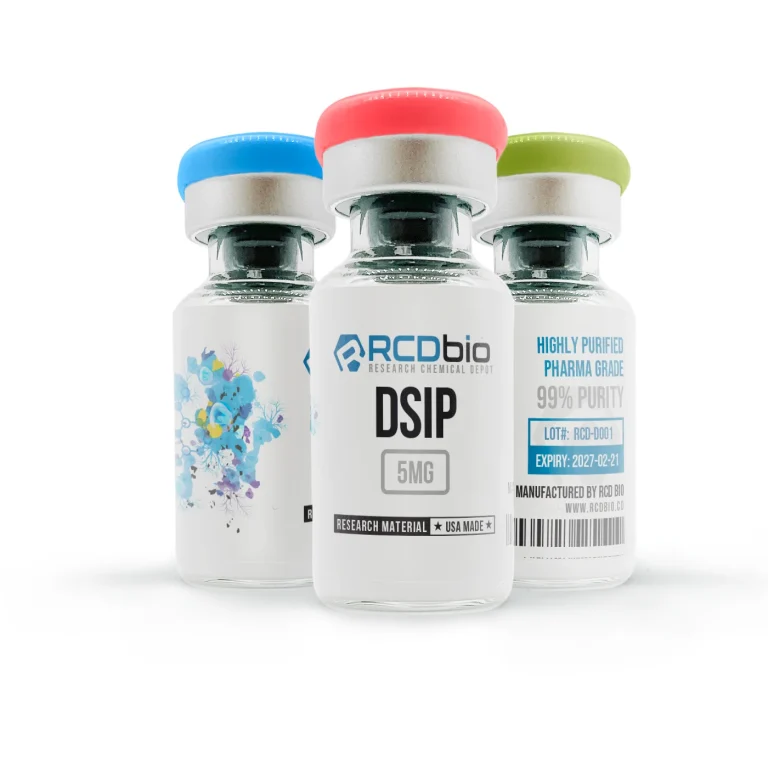
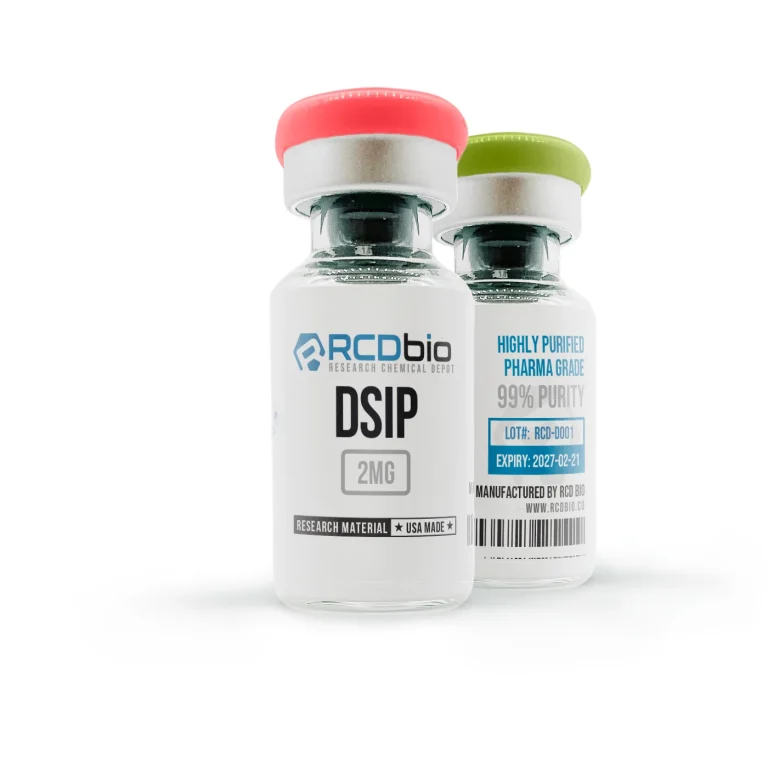
Description
What is DSIP?
Delta sleep-inducing peptide (DSIP) is a synthetic nonapeptide consisting of nine amino acids — tryptophan, alanine, glycine, glycine, aspartic acid, alanine, serine, glycine, and glutamic acid — with the sequence Trp-Ala-Gly-Gly-Asp-Ala-Ser-Gly-Glu (WAGGDASGE). It was first isolated from cerebral venous blood of sleeping rabbits by Schoenenberger and Monnier at the University of Basel, Switzerland, in 1974, with the structural characterisation and activity verification published in the Proceedings of the National Academy of Sciences in 1977. Amino acid sequencing, complete synthesis, and activity verification of the nonapeptide were subsequently confirmed in 1978.
DSIP is an amphiphilic peptide detectable in both free and bound forms across multiple tissue compartments in mammalian systems, including the hypothalamus, limbic system, pituitary gland, gut secretory cells, pancreas, and various peripheral organs and body fluids. In the pituitary, it co-localises with corticotropin-like intermediate peptide (CLIP), adrenocorticotropic hormone (ACTH), melanocyte-stimulating hormone (MSH), thyroid-stimulating hormone (TSH), and melanin-concentrating hormone (MCH), suggesting a role in broader neuroendocrine regulation beyond its originally characterised sleep-promoting activity. DSIP-like immunoreactivity has also been detected in human breast milk. Despite decades of investigation, no DSIP gene, receptor protein, or biosynthetic precursor has been identified in mammalian systems, and its natural occurrence and mechanism of action remain incompletely characterised in the published literature.
DSIP is classified as a research-grade synthetic neuropeptide. It is not approved by the Food and Drug Administration for human or veterinary use. It is not a dietary supplement and is not intended for human consumption or therapeutic self-administration. All RCDbio research compounds are supplied strictly for laboratory and research purposes only.
Chemical Properties
| Property | Detail |
| Product Type | Synthetic Nonapeptide / Neuropeptide Research Compound |
| Product Name | DSIP (Delta Sleep-Inducing Peptide) |
| Application | Scientific / Research Use Only |
| CAS Number | 62568-57-4 |
| Molar Mass | 848.81 g/mol |
| Chemical Formula | C35H48N10O15 |
| PubChem CID | 68816 |
| IUPAC Name | (2S)-2-[[(2S)-2-[[2-[[(2S)-2-[[2-[[2-[[(2S)-2-[[(2S)-2-amino-3-(1H-indol-3-yl)propanoyl]amino]propanoyl]amino]acetyl]amino]acetyl]amino]-3-carboxypropanoyl]amino]propanoyl]amino]-3-hydroxypropanoyl]amino]acetyl]amino]pentanedioic acid |
| Amino Acid Sequence | Trp-Ala-Gly-Gly-Asp-Ala-Ser-Gly-Glu (WAGGDASGE); 9 amino acids |
| Synonyms | Emideltide; Deltaran; DSIP nonapeptide; Delta sleep-inducing peptide; Sleep-promoting peptide |
| Physical Form | Lyophilized white to off-white powder |
| Solubility | Freely soluble in water; soluble in PBS and standard aqueous buffers |
| Storage (Lyophilized) | −20°C; sealed container; protected from light and moisture |
| Storage (Reconstituted) | 4°C; use within 48–72 hours; avoid repeated freeze-thaw cycles |
| Purity | ≥98% (HPLC verified, independent third-party laboratory analysis) |
| WADA Status | Not explicitly named on the 2026 WADA Prohibited List. As a non-approved research-grade neuropeptide with neuroendocrine activity, S0 (Non-Approved Substances) provisions may apply in sport-adjacent research contexts. Verify current status at GlobalDRO.com before use. |
How Does DSIP Work?
DSIP’s mechanism of action remains incompletely characterised in the published literature. No specific receptor has been identified for DSIP, and no DSIP gene or biosynthetic precursor has been found in mammalian systems. Despite this, multiple interactions with established neuroendocrine and neurochemical systems have been characterised in preclinical preparations, suggesting DSIP acts through indirect or modulatory mechanisms rather than through a dedicated high-affinity receptor system.
Hypothalamic-Pituitary-Adrenal (HPA) Axis Modulation
In preclinical models and human studies, DSIP has been investigated for its modulation of HPA axis activity. Administration of DSIP in rodent and human preparations has been associated with altered secretion patterns of corticotrophin (ACTH), luteinising hormone (LH), and growth hormone (GH). In the context of elevated basal cortisol — as observed under stress or in insomnia-associated HPA hyperactivation — DSIP has been investigated for attenuating cortisol secretion and normalising ACTH pulsatility patterns in preclinical and limited clinical research preparations [Graf & Kastin, 1984].
GABAergic and EEG Delta Activity Modulation
Preclinical electrophysiological studies in rodent and rabbit preparations have characterised DSIP-mediated enhancement of delta-wave EEG activity following intraventricular infusion. A mean increase of 35% in neocortical and limbic cortical EEG delta activity was observed in preclinical rabbit models compared to control animals receiving CSF-like solution [Schoenenberger & Monnier, 1977; Schoenenberger et al., 1978]. The receptor pathway underlying this EEG modulation has not been definitively established; interactions with GABAergic inhibitory systems and NMDA receptor pathways have been proposed in preclinical preparations but not definitively confirmed [Mendelson, 2001].
ACTH and LH Secretion Pathway Interactions
In rodent and human preparations, DSIP has been investigated for its influence on ACTH and LH secretion patterns. Studies measuring plasma DSIP-like immunoreactivity in humans identified a correlation between DSIP plasma concentrations and circadian rhythmicity, with DSIP levels decreasing at the transition from wakefulness to sleep in both evening sleep and morning recovery sleep conditions, suggesting involvement in sleep initiation rather than sleep maintenance signalling.
Antioxidant and Cytoprotective Activity
In isolated cell preparations and preclinical models, DSIP has been investigated for antioxidant activity, including observed attenuation of lipid peroxidation and oxidative stress markers in rodent tissue preparations. These findings are early-stage and not consistent across all experimental systems.
Key Research Findings
In preclinical and in vitro research contexts, DSIP has been associated with the following observations:
- EEG delta activity enhancement: 35% mean increase in neocortical and limbic EEG delta activity observed in rabbit preclinical models following intraventricular infusion; only the alpha-aspartyl form is active [Schoenenberger et al., 1978].
- HPA axis modulation: ACTH and LH secretion pattern alterations observed in rodent and human preparations; elevated cortisol attenuation investigated in stress-model systems [Graf & Kastin, 1984].
- Circadian correlation: Plasma DSIP-like immunoreactivity correlated with circadian rhythmicity in human studies; concentrations decreased at wakefulness-to-sleep transition.
- DSIP as unresolved riddle: Despite initial characterisation as a sleep-promoting factor, no DSIP gene, receptor, or precursor has been identified in mammals; the mechanism linking DSIP to sleep remains incompletely established in the peer-reviewed literature [Inoué, 2006].
- Antioxidant activity: Attenuation of lipid peroxidation markers observed in preclinical rodent tissue preparations; findings not replicated consistently across all experimental systems.
All findings listed above are derived from preclinical or in vitro data and limited early-phase clinical observations. No regulatory-grade human clinical trial data have been established for DSIP. These observations do not constitute evidence of efficacy or safety in any human condition or organism.
What are the Potential Research Applications of DSIP?
In controlled laboratory environments, DSIP has been investigated for the following research applications. These are observed in preclinical and in vitro contexts only and do not constitute claims of efficacy or safety in any organism.
Neuroendocrine Axis and HPA Pathway Research DSIP is employed in studies characterising hypothalamic-pituitary-adrenal axis interactions, including ACTH and cortisol secretion pattern modulation under stress conditions in rodent in vivo models. Research examines the relationship between DSIP administration and pulsatile hormone secretion profiles in preclinical and isolated tissue preparations.
EEG and Sleep Architecture Studies. In preclinical electrophysiological preparations, DSIP is investigated as a reference compound for studying delta-wave EEG enhancement in intraventricular infusion models. Research examines spectral EEG power changes in neocortical and limbic cortical tissue preparations following peptide exposure.
Circadian Rhythm Research DSIP’s correlation with circadian rhythmicity in plasma measurements makes it an investigational tool in circadian biology research, including studies examining the relationship between peptide hormones and sleep-wake cycle regulation in preclinical models.
Neuropeptide Pharmacology and BBB Transport Studies DSIP demonstrates blood-brain barrier penetration in preclinical models. Research investigates the mechanisms of DSIP transport across the BBB, its distribution patterns in CNS compartments, and the pharmacokinetics of intravenously and intracerebroventricularly administered DSIP in rodent preparations.
Opioid Withdrawal and Neuropharmacological Models. In rodent preclinical models, DSIP has been investigated for its effects in opioid withdrawal paradigms, including modulation of withdrawal-associated behavioural and neurochemical changes. These findings are early-stage and limited in the published literature.
What are the Potential Side Effects of DSIP?
Researchers in preclinical and in vitro settings have noted the following observations. Long-term safety profiles in humans have not been established.
- Generally low acute toxicity profile reported in preclinical rodent studies at doses used in sleep and neuroendocrine research; no significant adverse effects reported in published preclinical studies at research-relevant concentrations
- Tryptophan residue at position 1 renders DSIP susceptible to oxidative degradation under light or aerobic storage conditions; oxidised forms may have altered activity in experimental systems
- The alpha-aspartyl configuration at position 5 is critical for activity; the beta-Asp isomer has been confirmed inactive in preclinical preparations — structural integrity during storage is therefore experimentally relevant
- No human safety or tolerability data have been established for DSIP as a research compound. These observations are derived from experimental systems and should not be extrapolated to human or animal outcomes.
Risk & Handling
Handling Precautions
DSIP should only be handled by trained laboratory personnel. Appropriate personal protective equipment is required: nitrile gloves, a laboratory coat, and eye protection at a minimum. When working with lyophilized powder, use within a laminar flow cabinet or a clean area. Avoid aerosol generation during reconstitution. Protect from light exposure during handling — the tryptophan residue at position 1 is photosensitive and may undergo oxidative modification under UV or prolonged visible light exposure. Store in amber or opaque containers.
Exposure Risks
Risk Tier: LOW
DSIP has demonstrated a low acute toxicity profile in published preclinical rodent studies at research-relevant doses. No significant adverse effects have been reported in the published preclinical literature at concentrations used in neuroendocrine and EEG research. The compound’s neuroendocrine activity — HPA axis modulation, ACTH and cortisol secretion effects — means that accidental systemic exposure may produce hormonal effects in preclinical experimental systems. No human safety or tolerability data have been established for DSIP.
Storage
- Lyophilized form: Store at −20°C in original sealed, light-protected (amber or opaque) container with desiccant
- Reconstituted form: Store at 4°C; use within 48–72 hours of reconstitution
- Protect from light at all stages — tryptophan residue is photosensitive
- Do not subject to repeated freeze-thaw cycles; both the Trp residue and the alpha-Asp5 configuration may be compromised
- The alpha-aspartyl form at position 5 must be preserved — avoid conditions that promote aspartyl isomerisation (prolonged exposure to elevated temperature, extreme pH)
Frequently Asked Questions
Q: What is DSIP, and what is it investigated for in research? A: DSIP (Delta Sleep-Inducing Peptide) is a synthetic nonapeptide (WAGGDASGE) originally isolated from rabbit cerebral venous blood in 1977. It is investigated in preclinical research contexts for EEG delta activity modulation, HPA axis and neuroendocrine pathway interactions, circadian rhythm signalling, and neuropeptide BBB transport studies. Its mechanism of action remains incompletely characterised — no specific receptor has been identified. It is not approved by the FDA for human use and is intended strictly for laboratory and research purposes.
Q: Why has no DSIP receptor been identified despite decades of research? A: Despite extensive investigation since 1977, no DSIP gene, biosynthetic precursor, or dedicated high-affinity receptor has been isolated in mammalian systems. This is considered one of the major unresolved questions in neuropeptide biology. DSIP’s observed biological effects in preclinical models are attributed to indirect interactions with existing neuroendocrine and GABAergic pathways rather than a dedicated receptor, though this remains under investigation. The original DSIP characterisation paper itself acknowledged the compound’s “neurohumoral modulating and programming activity” as a proposed mechanism.
Q: What is the significance of the alpha-aspartyl configuration at position 5? A: The aspartic acid residue at position 5 of the DSIP sequence must be in the alpha-aspartyl (α-Asp) configuration for biological activity in preclinical preparations. The beta-Asp isomer (β-Asp5) was confirmed inactive in the original Schoenenberger et al. (1978) synthesis and activity characterisation study. This structural specificity is experimentally important: conditions that promote aspartyl isomerisation (elevated temperature, extreme pH, prolonged storage) may produce inactive material. Quality control verification of α-Asp5 configuration is recommended before use in biological assay systems.
Q: What is the plasma half-life of DSIP in preclinical models? A: DSIP demonstrates unusual stability for a short peptide. In human plasma studies, DSIP-like immunoreactivity persists for extended periods, with some reports citing stability over several hours — attributed to the compact WAGGDASGE sequence lacking exposed proteolytic cleavage sites common in longer peptides. However, the tryptophan residue at position 1 is susceptible to oxidative degradation. Precise standardised half-life data from peer-reviewed preclinical pharmacokinetic studies is limited in the published literature. These observations are from preclinical and limited human measurement studies.
Q: How should DSIP be stored to maintain activity? A: Lyophilized DSIP should be stored at −20°C in a sealed, light-protected container with desiccant. Once reconstituted, store at 4°C and use within 48–72 hours. Protect from light at all stages — the tryptophan residue at position 1 is photosensitive. Repeated freeze-thaw cycles are not recommended. Conditions promoting aspartyl isomerisation (extreme pH, elevated temperature, prolonged storage in solution) should be avoided to preserve the active alpha-Asp5 configuration.
Q: What were the original sleep-promoting findings for DSIP in preclinical models? A: In the 1977 Schoenenberger and Monnier study (PMID 265572), DSIP isolated from rabbit cerebral venous blood was infused intraventricularly into awake recipient rabbits, producing spindle and delta EEG activity. Subsequent synthesis and double-blind verification (Schoenenberger et al., 1978, PMID 568769) confirmed a 35% mean increase in neocortical and limbic EEG delta activity with synthetic DSIP compared to control animals. These effects were observed in rabbit intraventricular infusion models. Later studies in rodents and humans produced inconsistent results, and the sleep-promoting hypothesis remains weakly supported in the contemporary peer-reviewed literature.
Related Research Compounds
Researchers investigating DSIP may also be interested in the following compounds currently available for laboratory research at RCDbio:
- Epithalon — A synthetic tetrapeptide investigated in preclinical models for pineal gland biology, telomerase activity, and neuroendocrine pathway research; shares the neuroendocrine regulatory research context with DSIP.
- Selank — A synthetic GABAergic heptapeptide investigated in preclinical stress-response and HPA axis pathway research; shares the HPA modulation and neuroendocrine signalling research context with DSIP.
- Semax — A synthetic ACTH(4-7) analogue investigated in preclinical models for BDNF pathway modulation and neuroendocrine signalling; relevant to comparative neuropeptide HPA axis research alongside DSIP.
All products listed are for laboratory and research purposes only.
References
- Schoenenberger, G. A., & Monnier, M. (1977). Characterization of a delta-electroencephalogram (-sleep)-inducing peptide. Proceedings of the National Academy of Sciences USA, 74(3), 1282–1286. https://pubmed.ncbi.nlm.nih.gov/265572/
- Schoenenberger, G. A., Maier, P. F., Tobler, H. J., Wilson, K., & Monnier, M. (1978). The delta EEG (sleep)-inducing peptide (DSIP). XI. Amino-acid analysis, sequence, synthesis and activity of the nonapeptide. Pflügers Archiv: European Journal of Physiology, 376(2), 119–129. https://pubmed.ncbi.nlm.nih.gov/568769/
- Graf, M. V., & Kastin, A. J. (1984). Delta-sleep-inducing peptide (DSIP): a review. Neuroscience and Biobehavioral Reviews, 8(1), 83–93. https://pubmed.ncbi.nlm.nih.gov/6145137/
- Inoué, S. (2006). Delta sleep-inducing peptide (DSIP): a still unresolved riddle. Peptides, 27(2), 330–332. https://pubmed.ncbi.nlm.nih.gov/16539679/
Disclaimer
DSIP (Delta Sleep-Inducing Peptide) is exclusively for laboratory research purposes. RCDbio products are not intended to diagnose, prevent, treat, or cure any disease or medical condition.
The Food and Drug Administration has not evaluated the statements on our website. This product is not approved for human or veterinary use. Researchers must comply with all applicable local, state, and federal laws and regulations governing the purchase and use of research compounds. By purchasing, you agree to our Terms and Conditions. RCDbio reserves the right to refuse sales to unauthorized individuals.
ATTENTION: All RCDbio products are strictly for LABORATORY AND RESEARCH PURPOSES ONLY. They are not intended for human consumption, veterinary use, or any other non-research application. For queries, complaints, or support, contact support@legacy.rcdbio.co
Reviews
There are no reviews yet