

Description
What is Chrysalin (TP-508)?
Chrysalin (TP-508) is a synthetic, nonproteolytic thrombin peptide analog corresponding to prothrombin residues 508–530 — specifically the high-affinity thrombin receptor-binding domain. Its development as a research tool emerged from efforts to separate thrombin’s receptor-mediated cell signaling activity from its well-characterized proteolytic coagulation function.
In preclinical research contexts, TP-508 is used as a molecular tool to interrogate nonproteolytic thrombin receptor signaling in isolation. It has been investigated across several experimental platforms, including isolated endothelial cell monolayers, fibroblast culture systems, adipose-derived stem cell models, and preclinical wound healing assays.
TP-508 is also referenced in the literature under the synonyms rusalatide acetate, TRAP-508, and the trade name Chrysalin®. The RCDbio formulation is supplied exclusively as a lyophilized powder in a sterile glass vial — not as a nasal spray, tablet, or any other format.
Chemical Properties
| Property | Detail |
| Product Type | Peptide |
| Product Name | Chrysalin (TP-508) |
| Also Known As | Rusalatide acetate, TRAP-508, Chrysalin® |
| Format | Lyophilized Powder — Sterile Glass Vial |
| Application | Scientific / Research Use Only |
| CAS Number | 121341-81-9 |
| Molecular Weight | 2,312.44 g/mol |
| Chemical Formula | C₉₇H₁₄₆N₂₈O₃₆S |
| PubChem CID | 91668177 |
| Peptide Length | 23 amino acids |
| Sequence | Ala-Gly-Tyr-Lys-Pro-Asp-Glu-Gly-Lys-Arg-Gly-Asp-Ala-Cys-Glu-Gly-Asp-Ser-Gly-Gly-Pro-Phe-Val |
| Peptide Origin | Residues 508–530 of human prothrombin |
| IUPAC Name | H-Ala-Gly-Tyr-Lys-Pro-Asp-Glu-Gly-Lys-Arg-Gly-Asp-Ala-Cys-Glu-Gly-Asp-Ser-Gly-Gly-Pro-Phe-Val-OH |
| Physical Form | White to off-white lyophilized powder |
| Solubility | Soluble in sterile water or 0.1% acetic acid solution |
| Storage | −20°C, protected from light and moisture |
| Classification | Research Use Only (RUO) |
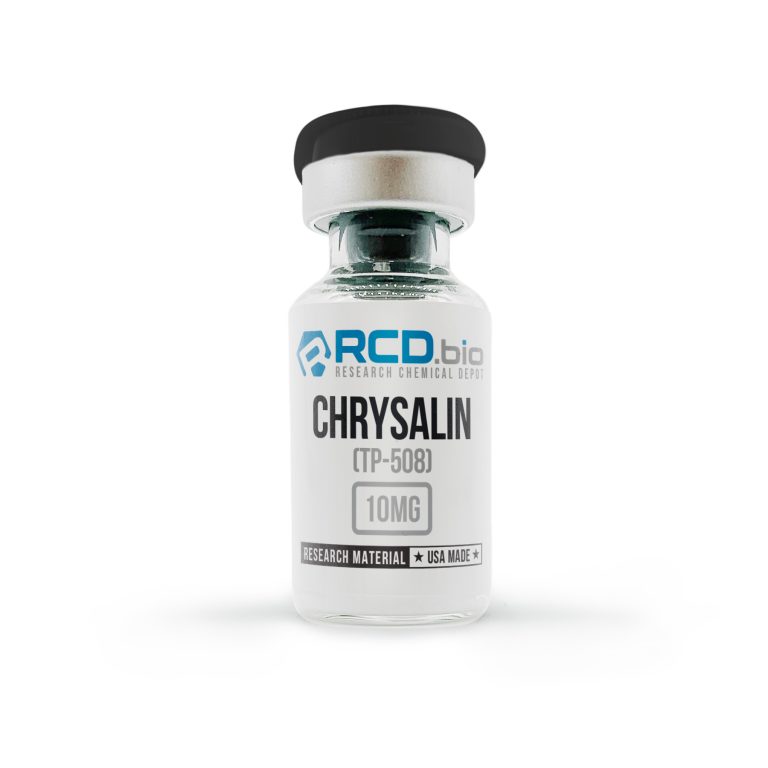
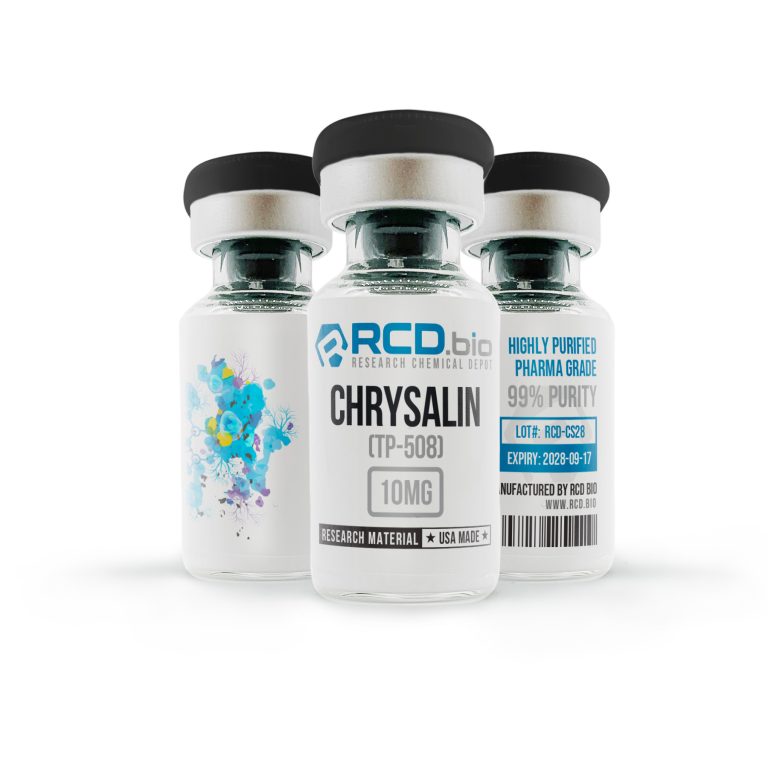
Vial Format Note: RCDbio supplies Chrysalin (TP-508) exclusively as a lyophilized powder in a sterile, sealed glass vial fitted with a black flip-top aluminum crimp cap. This is a powder-only vial — not pre-reconstituted, not a nasal spray, and not a sublingual preparation. The lyophilized format preserves peptide stability under −20°C cold storage conditions. The acetate salt form is standard for research-grade lyophilized peptide applications.
How Does Chrysalin (TP-508) Work?
Nonproteolytic Thrombin Receptor Binding
TP-508 has been investigated in preclinical cell systems as a nonproteolytic agonist at a distinct thrombin receptor subset expressed on fibroblasts and vascular endothelial cells. Unlike proteolytically active thrombin, TP-508 does not cleave PAR-1 or initiate the coagulation cascade. This functional separation makes it a useful probe for isolating receptor-mediated signal transduction events in experimental models without confounding coagulation-related variables.
eNOS Activation and Nitric Oxide Signaling
In isolated endothelial cell systems, TP-508 has been observed to stimulate endothelial nitric oxide synthase (eNOS) activation and rapid nitric oxide (NO) production. Preclinical data suggest this eNOS interaction occurs through a thrombin receptor pathway that is structurally distinct from the protease-activated receptor (PAR) signaling axis used by thrombin itself. In laboratory models, this has made TP-508 a reference compound in eNOS pathway dissection studies.
Angiogenic Signaling and Endothelial Cell Motility
In preclinical wound healing models and chick chorioallantoic membrane assays, TP-508 has been observed to stimulate endothelial cell chemokinesis and chemotaxis in a dose-dependent manner. Preclinical data from these systems indicate increased markers of vascular ingrowth at sites of application in TP-508-treated groups compared to vehicle controls. These findings have positioned TP-508 as a reference angiogenesis compound in in vivo wound model assays.
Fibroblast Gene Expression Modulation
In isolated fibroblast cell systems, TP-508 has been investigated for its potential to modulate differential gene expression through a nonproteolytic receptor activation pathway. Preclinical data suggest this involves upstream signaling events distinct from those initiated by proteolytically active thrombin, including altered expression patterns in genes associated with extracellular matrix organization and cell cycle regulation.
Stem Cell Proliferation Signaling
In in vitro model systems using adipose tissue-derived stem cells, TP-508 has been investigated for its potential to affect proliferation signaling. Preclinical data from these culture systems suggest TP-508 may interact with the PI3K/Akt pathway, a downstream signaling node associated with cellular survival and proliferation responses in multiple preclinical contexts.
αvβ3 Integrin-Mediated Signal Transduction
Separate lines of preclinical investigation have explored TP-508’s potential interactions with αvβ3 integrin-mediated signaling complexes in endothelial and fibroblast cell types. This research vector focuses on whether nonproteolytic thrombin receptor binding intersects with integrin co-receptor pathways to produce observed angiogenic and motility responses.
Potential Research Applications
In controlled laboratory environments, Chrysalin (TP-508) lyophilized vials have been investigated for the following applications:
- Nonproteolytic thrombin receptor binding kinetics and structure-activity relationship (SAR) studies
- eNOS activation and nitric oxide signaling pathway dissection
- Angiogenesis assay reference compound in preclinical wound healing and CAM models
- αvβ3 integrin-mediated signal transduction research
- Fibroblast gene expression pathway investigation
- Stem cell proliferation signaling studies using adipose-derived cell cultures
- Comparative thrombin fragment pharmacology and receptor selectivity profiling
- Coagulation-independent thrombin receptor signaling model development
Potential Side Effects (Preclinical Observations)
The following observations have been noted in preclinical and in vitro research settings. These are not human safety data.
- No human safety profile exists for this research-grade formulation
- Long-term or chronic toxicity data are not established for this research preparation
- Dose-dependent endothelial cell motility responses have been observed in preclinical wound healing models
- PI3K/Akt pathway interactions have been observed in adipose-derived stem cell culture experiments
- Evidence across experimental conditions remains variable and not fully consistent across all model systems
Risk & Handling
Chrysalin (TP-508) is a synthetic, nonproteolytic thrombin peptide under active investigation in preclinical research settings.
Risk Tier: MODERATE
This rating reflects TP-508’s bioactive receptor signaling activity at thrombin receptor subsets, the nanomolar-to-micromolar concentrations used in preclinical work, and the need for proper containment protocols to prevent accidental exposure during reconstitution of the lyophilized powder.
Handling Precautions: Chrysalin (TP-508) lyophilized vials must be handled exclusively in a controlled laboratory environment by trained personnel. Appropriate PPE must be worn at all times. Avoid direct skin and eye contact during vial opening and reconstitution procedures. Avoid inhalation of lyophilized powder. All work with reconstituted peptide solutions should be conducted under appropriate biosafety conditions.
Exposure Risks: No human safety data has been established for the research-grade formulation supplied by RCDbio. Long-term and chronic toxicity data do not exist for this preparation. Biological activity observed in preclinical models should be treated as preliminary and not extrapolated to human or veterinary safety.
Storage: Store lyophilized TP-508 vials at −20°C in a dry, dark environment. Protect from light, heat, and moisture. Avoid repeated freeze-thaw cycles. The vial crimp seal must remain intact until the point of reconstitution. Once reconstituted, use promptly and re-store aliquots under appropriate cold conditions.
FAQs
What distinguishes the lyophilized vial format from the nasal spray format?
The RCDbio lyophilized vial contains Chrysalin (TP-508) as a dry, freeze-dried powder in a sterile sealed glass vial. It requires reconstitution by the researcher using sterile water or 0.1% acetic acid prior to use in experimental systems. This is the standard format for research-grade peptide vials and is not pre-formulated for any specific delivery route. The lyophilized format provides maximum stability for cold storage applications and is appropriate for in vitro cell assay work, biochemical binding studies, and preclinical model dosing by trained laboratory personnel.
What makes TP-508 nonproteolytic in research contexts?
TP-508 corresponds to the receptor-binding domain of prothrombin rather than to the serine protease active site. It occupies a distinct receptor subset on target cells without cleaving the PAR-1 receptor or activating the downstream coagulation cleavage cascade. In experimental models, this allows investigators to study receptor-mediated thrombin signaling in isolation from thrombin’s coagulation and fibrinogen-processing functions — a meaningful experimental advantage in studies aimed at dissecting the two.
What solvent is used to reconstitute Chrysalin (TP-508) powder?
In published preclinical work, TP-508 has been reconstituted in sterile water or 0.1% acetic acid solution. Solvent selection may affect peptide solubility and stability. Researchers should determine the appropriate reconstitution vehicle for their specific experimental application based on published protocols or in-house optimization.
Is Chrysalin (TP-508) safe for human use?
No, Chrysalin (TP-508) supplied by RCDbio is not approved by the FDA for human or veterinary use. It is sold exclusively for laboratory research purposes. Please review the Terms and Conditions before ordering.
What is the purity specification for this vial?
RCDbio supplies Chrysalin (TP-508) as a research-grade lyophilized peptide. Purity data are available via a Certificate of Analysis (CoA). Please refer to the Certificate of Analysis page on the RCDbio website for batch-specific documentation.
References
- Olszewska-Pazdrak, B., Hart-Vantassell, A., & Carney, D. H. (2010). Thrombin peptide TP508 stimulates rapid nitric oxide production in human endothelial cells. Journal of Vascular Research, 47(3), 203–213. https://pubmed.ncbi.nlm.nih.gov/19893317/
- Hembrough, T. A., Swartz, G. M., Papathanassiu, A., et al. (2001). Thrombin peptide, TP508, stimulates angiogenic responses in animal models of dermal wound healing, in chick chorioallantoic membranes, and in cultured human aortic and microvascular endothelial cells. Journal of Vascular Research. https://pubmed.ncbi.nlm.nih.gov/11888680/
- Sower, L. E., Payne, D. A., Meyers, R., & Carney, D. H. (1999). Thrombin peptide, TP508, induces differential gene expression in fibroblasts through a nonproteolytic activation pathway. Experimental Cell Research, 247(2), 422–431. https://pubmed.ncbi.nlm.nih.gov/10066370/
- Freyberg, S., Song, Y. H., Muehlberg, F., & Alt, E. (2009). Thrombin peptide (TP508) promotes adipose tissue-derived stem cell proliferation via PI3 kinase/Akt pathway. Journal of Vascular Research, 46(2), 98–102. https://pubmed.ncbi.nlm.nih.gov/18607113/
Disclaimer
Chrysalin (TP-508) is exclusively for laboratory research purposes. RCDbio products are not intended to diagnose, prevent, treat, or cure any disease or medical condition.
The Food and Drug Administration has not evaluated the statements on our website. This product is not approved for human or veterinary use. Researchers must comply with all applicable local, state, and federal laws and regulations governing the purchase and use of research compounds. By purchasing, you agree to our Terms and Conditions. RCDbio reserves the right to refuse sales to unauthorized individuals.
ATTENTION: All RCDbio products are strictly for LABORATORY AND RESEARCH PURPOSES ONLY. They are not intended for human consumption, veterinary use, or any other non-research application. For queries, complaints, or support, contact support@legacy.rcdbio.co
Reviews
There are no reviews yet