

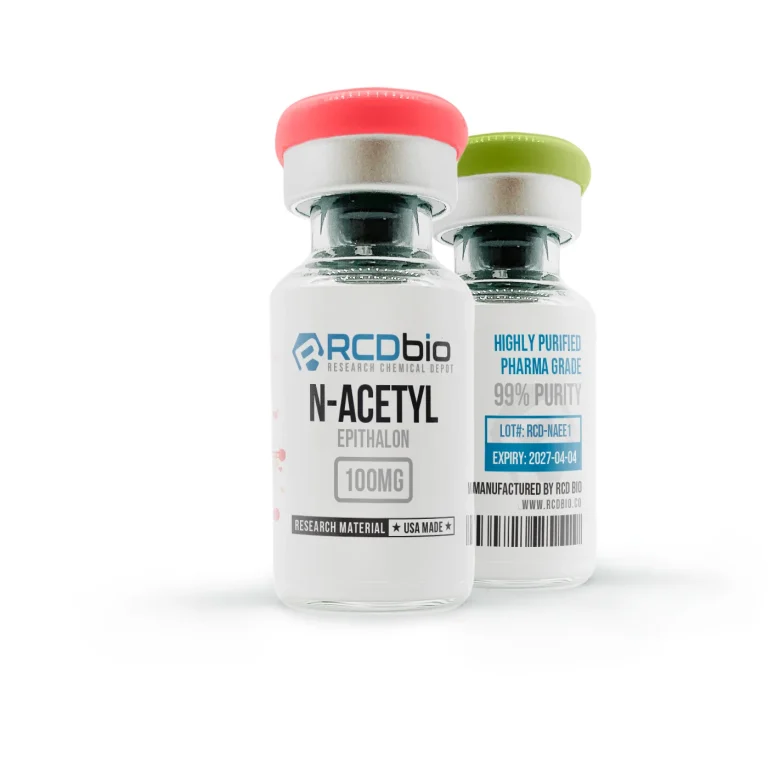
Description
What is N-Acetyl Epithalon?
N-Acetyl Epithalon is a synthetic tetrapeptide consisting of the Epithalon (AEDG) sequence — alanine, glutamic acid, aspartic acid, and glycine — with an N-terminal acetyl group added to the alanine residue. This single structural modification distinguishes N-Acetyl Epithalon from the parent compound Epithalon (H-Ala-Glu-Asp-Gly-OH; CAS 307297-39-8) and from N-Acetyl Epithalon Amidate (Ac-Ala-Glu-Asp-Gly-NH2), which carries both N-terminal acetylation and C-terminal amidation. The acetyl group at the N-terminus removes the free amino group’s positive charge and eliminates the primary recognition site for leucine aminopeptidase — the exopeptidase responsible for N-terminal hydrolysis of short peptides in plasma and tissue matrices — extending the compound’s resistance to exopeptidase-mediated degradation relative to unmodified Epithalon in biological experimental systems.
N-Acetyl Epithalon retains a free carboxyl terminus at glycine (Gly-OH), which distinguishes it from the amidate form. This means that while N-terminal aminopeptidase protection is achieved, the C-terminus remains susceptible to carboxypeptidase activity in biological matrices — making it an intermediate stability form between the unprotected parent Epithalon and the fully-protected N-Acetyl Epithalon Amidate. Researchers should verify from the product’s analytical documentation which terminal configuration is supplied, as “N-Acetyl Epithalon” and “N-Acetyl Epithalon Amidate” are occasionally used interchangeably in commercial research peptide supply.
Published research specific to N-Acetyl Epithalon is extremely limited. The compound’s expected pharmacological activity is inferred from the extensive Epithalon literature — primarily from the Khavinson group at the Saint Petersburg Institute of Bioregulation and Gerontology — combined with the known pharmacokinetic effects of N-terminal acetylation on short peptides. The majority of Epithalon research uses the unmodified AEDG tetrapeptide; researchers should account for this when designing studies using the N-acetylated form. N-Acetyl Epithalon is not approved by the Food and Drug Administration for human or veterinary use. It is not a dietary supplement and is not intended for human consumption or therapeutic self-administration. All RCDbio research compounds are supplied strictly for laboratory and research purposes only.
Chemical Properties
| Property | Detail |
| Product Type | Synthetic N-Terminally Acetylated Tetrapeptide (Pineal Gland-Derived Peptide Bioregulator Analogue) |
| Product Name | N-Acetyl Epithalon |
| Application | Scientific / Research Use Only |
| CAS Number | No widely published dedicated CAS for N-Acetyl Epithalon (free acid form) — parent Epithalon CAS: 307297-39-8; N-Acetyl Epithalon Amidate has separate registry entries; verify form from COA |
| Molar Mass | ~432.39 g/mol (Ac-AEDG-OH, N-Acetyl Epithalon free acid; calculated from C16H24N4O10) |
| Chemical Formula | C16H24N4O10 (free acid, N-terminal acetylation only) |
| PubChem CID | 171390141 (indexed as N-Acetyl Epitalon, Ac-AEDG-OH) |
| Parent Compound | Epithalon (H-Ala-Glu-Asp-Gly-OH; CAS 307297-39-8; MW 390.349 g/mol; C14H22N4O9; PubChem CID 219042) |
| Related Compound | N-Acetyl Epithalon Amidate (Ac-Ala-Glu-Asp-Gly-NH2; doubly-modified with N-terminal acetyl and C-terminal amide; MW ~431.41 g/mol; C16H25N5O9) |
| Structural Distinction | N-Acetyl Epithalon: N-terminal acetylation only (aminopeptidase-resistant; carboxypeptidase-susceptible). N-Acetyl Epithalon Amidate: both termini modified (dual exopeptidase protection). |
| Sequence | Ac-Ala-Glu-Asp-Gly-OH (Ac-AEDG-OH); 4 amino acids; N-terminal acetylation; free C-terminus |
| Synonyms | N-Ac-Epithalon; Acetyl-Epitalon; N-Acetyl-AEDG; Ac-AEDG |
| Physical Form | Lyophilized white to off-white powder |
| Solubility | Freely soluble in water; soluble in PBS and standard aqueous buffers |
| Storage (Lyophilized) | −20°C; sealed container; protected from light and moisture |
| Storage (Reconstituted) | 4°C; use within 48–72 hours; avoid repeated freeze-thaw cycles |
| Purity | ≥98% (HPLC verified, independent third-party laboratory analysis) |
| WADA Status | N-Acetyl Epithalon is not explicitly named on the 2026 WADA Prohibited List. As a non-approved synthetic peptide with reported neuroendocrine and telomerase pathway activity, S0 (Non-Approved Substances) provisions may apply in sport-adjacent research contexts. Verify at GlobalDRO.com before use. |
How Does N-Acetyl Epithalon Work?
Published mechanistic data specific to N-Acetyl Epithalon are not available in the peer-reviewed literature. The mechanisms below are derived from the Epithalon research literature and the known pharmacokinetic effects of N-terminal acetylation on short peptides. All mechanism attributions to parent Epithalon are stated as inferences for N-Acetyl Epithalon.
N-Terminal Acetylation — Aminopeptidase Resistance Pathway
The acetyl group at the alanine N-terminus of N-Acetyl Epithalon removes the free amino group and blocks leucine aminopeptidase recognition, the primary exopeptidase responsible for N-terminal degradation of short peptides in plasma and tissue matrices. For a compact tetrapeptide such as AEDG — which lacks internal protease-resistant structural features found in larger peptides — this N-terminal modification is the primary pharmacokinetic enhancement over the parent compound. The C-terminal glycine’s free carboxyl group, however, remains a substrate for carboxypeptidase activity; complete exopeptidase protection requires the additional C-terminal amidation present in N-Acetyl Epithalon Amidate.
Telomerase Activation and hTERT Pathway — Inferred from Epithalon Literature
The foundational Epithalon mechanism — induction of telomerase catalytic subunit (hTERT) expression and telomerase enzymatic activity in human somatic cell preparations — is expected to be retained by N-Acetyl Epithalon through the preserved AEDG core sequence. In the 2003 Khavinson study (PMID 12937682), unmodified Epithalon (H-AEDG-OH) produced measurable telomere elongation and hTERT upregulation in human fetal fibroblast preparations. Whether N-terminal acetylation alters the binding geometry at the proposed DNA/chromatin interaction site for the AEDG sequence — and therefore modifies the telomerase pathway activity — has not been characterised in published studies for N-Acetyl Epithalon specifically.
DNA-Binding and Epigenetic Regulatory Pathway — Inferred from Epithalon Literature
In silico docking and in vitro binding studies of the AEDG sequence have proposed direct interaction with telomeric TTAGGG repeat sequences and chromatin structure through electrostatic and hydrogen bonding. N-terminal acetylation eliminates the positive charge at the alanine alpha-amino terminus, which may alter the AEDG tetrapeptide’s electrostatic interaction profile with negatively charged DNA phosphate groups. This charge modification is a relevant variable for any DNA-binding mechanism — whether it reduces, enhances, or preserves the interaction profile has not been published for N-Acetyl Epithalon in peer-reviewed studies.
Pineal Gland and Neuroendocrine Pathway — Inferred from Epithalon Literature
Unmodified Epithalon has been investigated in aged rodent in vivo models for interactions with pineal gland neuroendocrine function, melatonin secretion pattern restoration, and circadian-neuroendocrine axis modulation. These systemic neuroendocrine effects are attributed to the AEDG sequence rather than the terminal chemistry; N-Acetyl Epithalon is expected to retain pathway activity while demonstrating altered biodistribution and half-life profiles in biological systems relative to the unmodified parent.
Key Research Findings
In preclinical and in vitro research contexts, Epithalon (the parent compound) has been associated with the following observations. No peer-reviewed data have been published specifically for N-Acetyl Epithalon; all findings are from unmodified Epithalon research and represent inferences for the acetylated form.
- Telomerase induction: Increased hTERT expression, upregulated telomerase activity, and measurable telomere elongation observed in human fetal fibroblast preparations exposed to unmodified Epithalon [Khavinson et al., 2003]; direct data for N-Acetyl Epithalon not available.
- Stability advantage (N-terminal acetylation general principle): N-terminal acetylation eliminates leucine aminopeptidase recognition and extends N-terminal stability in plasma and tissue matrix preparations relative to the unprotected form — a well-characterised peptide chemistry principle applicable to the AEDG sequence.
- Neurogenesis gene expression: Unmodified Epithalon associated with stimulated gene expression and protein synthesis markers during neural differentiation in cell model preparations; epigenetic regulatory mechanism proposed [Khavinson et al., 2020].
- Rodent lifespan extension: Unmodified Epithalon administration associated with extended lifespan in Drosophila and rodent models in Khavinson group studies — data attributed to parent compound; no equivalent data for N-Acetyl Epithalon.
- 2025 cell-line telomere study: Al-dulaimi et al. characterised dose-dependent hTERT upregulation and ALT activity in normal and cancer cell lines using unmodified Epithalon [Al-dulaimi et al., 2025] — inferred applicable to N-Acetyl Epithalon via preserved core sequence.
All findings listed above are derived from preclinical or in vitro data on the parent Epithalon compound. No peer-reviewed data have been published specifically for N-Acetyl Epithalon. The majority of Epithalon research originates from a single research group; independent multi-centre replication is limited. These observations do not constitute evidence of efficacy or safety for N-Acetyl Epithalon in any human condition or organism.
What are the Potential Research Applications of N-Acetyl Epithalon?
In controlled laboratory environments, N-Acetyl Epithalon has been investigated for the following research applications. These are observed in preclinical and in vitro contexts and do not constitute claims of efficacy or safety in any organism.
N-Terminal Modification and Tetrapeptide Stability Studies N-Acetyl Epithalon is employed in comparative in vitro plasma and tissue stability assays examining how N-terminal acetylation alters the degradation kinetics of the AEDG tetrapeptide. Research compares stability profiles of Epithalon, N-Acetyl Epithalon (N-terminal acetyl only), and N-Acetyl Epithalon Amidate (both termini protected) to characterise the relative contributions of each terminal modification to overall metabolic stability.
Telomerase Biology and DNA-Binding Studies Based on the preserved AEDG core sequence, N-Acetyl Epithalon is investigated in TRAP assays, hTERT expression studies, and FISH telomere measurement protocols to characterise whether N-terminal acetylation maintains, reduces, or enhances the telomerase pathway interactions reported for unmodified Epithalon. In silico docking studies examine how the loss of the N-terminal positive charge through acetylation affects AEDG interaction geometry with TTAGGG telomeric repeats and chromatin structures.
Comparative Peptide Analogue SAR Studies N-Acetyl Epithalon occupies a defined intermediate position in the Epithalon modification series — Epithalon (unprotected) → N-Acetyl Epithalon (N-terminal only) → N-Acetyl Epithalon Amidate (dual protection) — making it a key reference compound for SAR investigations examining how progressive terminal modifications alter stability, charge profile, DNA-binding affinity, and downstream telomerase pathway activity across the series.
Cellular Ageing and Senescence Research. In primary human cell cultures and aged tissue preparations, N-Acetyl Epithalon is investigated for effects on cellular senescence markers, p21/p53 pathway expression, and ROS accumulation, building on the Epithalon literature base. Research examines whether N-terminal protection produces measurably different senescence marker profiles compared to unmodified Epithalon at equivalent molar concentrations in cell culture systems.
Pineal Gland and Circadian Neuroendocrine Research Based on the preserved AEDG sequence, N-Acetyl Epithalon is investigated in aged rodent in vivo models for effects on melatonin secretion patterns and circadian-neuroendocrine axis modulation, with research examining whether the N-terminal acetylation modification alters the compound’s tissue distribution, CNS access, or neuroendocrine activity profile relative to the parent compound.
What are the Potential Side Effects of N-Acetyl Epithalon?
No direct side effect or toxicity data for N-Acetyl Epithalon is available in the peer-reviewed literature. The following observations are inferred from parent Epithalon preclinical research.
- Generally low acute toxicity profile reported for unmodified Epithalon in published rodent preclinical studies at research-relevant doses; N-Acetyl Epithalon is expected to share this profile through the preserved AEDG core sequence
- The theoretical consideration applicable to Epithalon — that telomerase reactivation in somatic cells could have implications for cancer biology research systems — applies equally to N-Acetyl Epithalon through the preserved AEDG sequence; researchers in oncology model systems should account for this
- N-terminal acetylation eliminates the free amino group; this eliminates one reactive site and may reduce non-specific adsorption in protein-binding assay systems — a relevant experimental design consideration
- No human safety or tolerability data have been established for N-Acetyl Epithalon. These observations are inferred from parent Epithalon preclinical data and should not be extrapolated to N-Acetyl Epithalon or to human or animal outcomes.
Risk & Handling
Handling Precautions
N-Acetyl Epithalon should only be handled by trained laboratory personnel. Appropriate PPE is required: nitrile gloves, a laboratory coat, and eye protection at a minimum. When working with lyophilized powder, use within a laminar flow cabinet or a clean area. Avoid aerosol generation during reconstitution.
Exposure Risks
Risk Tier: LOW
N-Acetyl Epithalon is expected to share the low acute toxicity profile of parent Epithalon based on structural similarity and the preserved core sequence. No significant adverse effects have been reported in published preclinical studies for the parent compound at research-relevant doses. The compound’s proposed telomerase-activating activity in somatic cell preparations is a relevant pharmacological consideration for cell biology experimental risk assessment. No human safety or tolerability data have been established for N-Acetyl Epithalon.
Storage
- Lyophilized form: Store at −20°C in original sealed, light-protected container with desiccant
- Reconstituted form: Store at 4°C; use within 48–72 hours of reconstitution
- Do not subject to repeated freeze-thaw cycles; tetrapeptide integrity may be compromised
- Protect from prolonged light exposure and moisture
- The N-terminal acetylation provides enhanced aminopeptidase resistance relative to parent Epithalon; standard peptide storage precautions apply
Frequently Asked Questions
Q: What is N-Acetyl Epithalon, and how does it differ from Epithalon? A: N-Acetyl Epithalon adds an acetyl group to the N-terminus of the Epithalon (AEDG) tetrapeptide (Ac-AEDG-OH versus H-AEDG-OH for parent Epithalon). This modification eliminates the leucine aminopeptidase recognition site, extending N-terminal stability in biological matrices relative to unmodified Epithalon. The AEDG core sequence is preserved. It is not approved by the FDA for human use and is intended strictly for laboratory and research purposes.
Q: What is the difference between N-Acetyl Epithalon and N-Acetyl Epithalon Amidate? A: N-Acetyl Epithalon (Ac-AEDG-OH) carries only N-terminal acetylation — the C-terminus (glycine) remains as a free carboxyl group susceptible to carboxypeptidase degradation. N-Acetyl Epithalon Amidate (Ac-AEDG-NH2) carries both N-terminal acetylation and C-terminal amidation, providing dual-terminus exopeptidase protection. N-Acetyl Epithalon Amidate is the most fully protected form of the Epithalon series and is the form most commonly sold under the “N-Acetyl Epithalon Amidate” designation in commercial research peptide supply. Researchers should verify from the product COA which form is supplied.
Q: Is there published research specifically on N-Acetyl Epithalon? A: Published peer-reviewed research specifically characterising N-Acetyl Epithalon in controlled biological assays is not available as of the time of this writing. The compound’s expected properties are inferred from the Epithalon research literature combined with established peptide N-terminal acetylation pharmacokinetics. All available mechanistic and activity data pertain to unmodified Epithalon, primarily from the Khavinson group at the Saint Petersburg Institute of Bioregulation and Gerontology.
Q: How does N-terminal acetylation affect the AEDG tetrapeptide’s proposed DNA-binding mechanism? A: Epithalon’s proposed DNA-binding mechanism involves electrostatic interactions between the AEDG sequence and TTAGGG telomeric DNA sequences. The free amino group at the N-terminus (positively charged at physiological pH) is one contributor to electrostatic interaction with negatively charged DNA phosphate groups. N-terminal acetylation eliminates this positive charge, which could theoretically reduce, alter, or — depending on the specific binding geometry — have minimal effect on AEDG’s DNA interaction profile. This has not been characterised experimentally for N-Acetyl Epithalon in published studies.
Q: What is the plasma half-life of N-Acetyl Epithalon? A: Specific standardised pharmacokinetic data for N-Acetyl Epithalon are not available in published peer-reviewed literature. N-terminal acetylation eliminates the aminopeptidase cleavage site, extending N-terminal stability relative to unmodified Epithalon. The free C-terminal carboxyl remains susceptible to carboxypeptidase; complete dual-terminus protection requires the N-Acetyl Epithalon Amidate form. Epithalon’s compact AEDG structure provides some inherent metabolic stability; the N-acetyl modification adds to this through one degradation pathway only.
Q: How should N-Acetyl Epithalon be stored? A: Lyophilized N-Acetyl Epithalon should be stored at −20°C in a sealed, light-protected container with desiccant. Once reconstituted, store at 4°C and use within 48–72 hours. Repeated freeze-thaw cycles are not recommended. The N-terminal acetylation provides enhanced aminopeptidase resistance; standard lyophilized tetrapeptide storage precautions apply.
Related Research Compounds
Researchers investigating N-Acetyl Epithalon may also be interested in the following compounds currently available for laboratory research at RCDbio:
- Epithalon (Epitalon) — The parent unmodified tetrapeptide (H-AEDG-OH); the primary reference compound for which all published telomerase, neuroendocrine, and cellular ageing research data exists; the foundational compound for N-Acetyl Epithalon comparative stability studies.
- N-Acetyl Epithalon Amidate — The doubly-modified form with both N-terminal acetylation and C-terminal amidation (Ac-AEDG-NH2); the fully exopeptidase-protected Epithalon analogue and the terminal position in the Epithalon modification series.
- Humanin — A mitochondria-derived 24-amino acid peptide investigated for anti-apoptotic signalling and neuroprotective pathway research; shares the cellular ageing, longevity, and mitochondrial biology research context with the Epithalon analogue series.
All products listed are for laboratory and research purposes only.
References
- Khavinson, V. K., Bondarev, I. E., & Butyugov, A. A. (2003). Epithalon peptide induces telomerase activity and telomere elongation in human somatic cells. Bulletin of Experimental Biology and Medicine, 135(6), 590–592. https://pubmed.ncbi.nlm.nih.gov/12937682/
- Khavinson, V., Linkova, N., Kvetnoy, I., & Kvetnaia, T. (2020). AEDG Peptide (Epitalon) Stimulates Gene Expression and Protein Synthesis during Neurogenesis: Possible Epigenetic Mechanism. Molecules, 25(3), 609. https://pubmed.ncbi.nlm.nih.gov/32028714/
- Anisimov, V. N., Khavinson, V. Kh., Provinciali, M., Viticchi, C., Franceschi, C., & Mikheev, V. S. (2003). Effect of Epitalon on biomarkers of aging, life span, and spontaneous tumor incidence in female Swiss-derived SHR mice. Biogerontology, 4(4), 193–202. https://pubmed.ncbi.nlm.nih.gov/14501183/
- Al-dulaimi, S., Thomas, R., Matta, S., & Roberts, T. (2025). Epitalon increases telomere length in human cell lines through telomerase upregulation or ALT activity. Biogerontology, 26(5). https://pubmed.ncbi.nlm.nih.gov/40268845/
Disclaimer
N-Acetyl Epithalon is exclusively for laboratory research purposes. RCDbio products are not intended to diagnose, prevent, treat, or cure any disease or medical condition.
The Food and Drug Administration has not evaluated the statements on our website. This product is not approved for human or veterinary use. Researchers must comply with all applicable local, state, and federal laws and regulations governing the purchase and use of research compounds. By purchasing, you agree to our Terms and Conditions. RCDbio reserves the right to refuse sales to unauthorized individuals.
ATTENTION: All RCDbio products are strictly for LABORATORY AND RESEARCH PURPOSES ONLY. They are not intended for human consumption, veterinary use, or any other non-research application. For queries, complaints, or support, contact support@legacy.rcdbio.co
Reviews
There are no reviews yet