

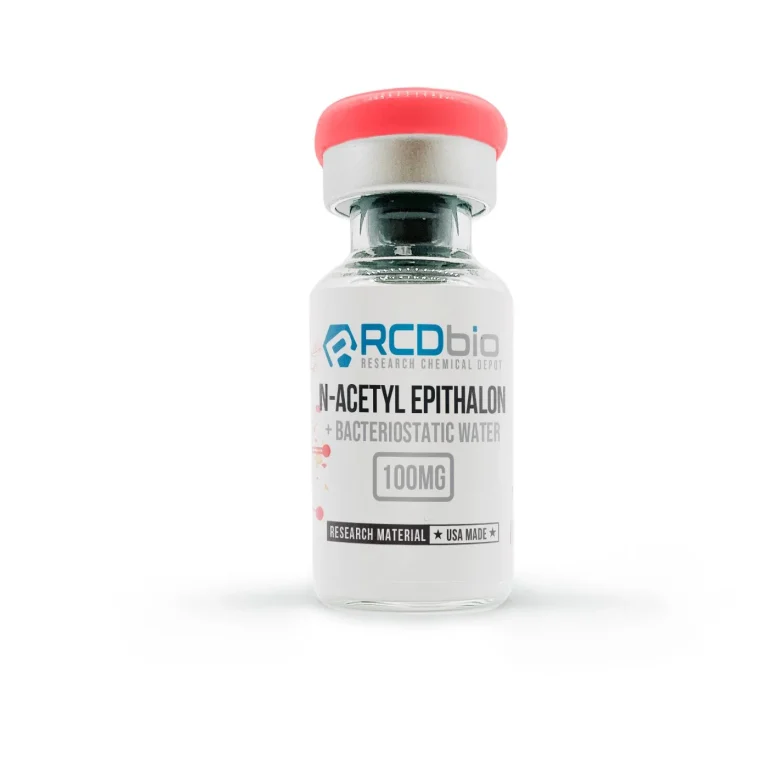
Description
What is N-Acetyl Epithalon Amidate?
N-Acetyl Epithalon Amidate (Ac-AEDG-NH2) is a synthetic tetrapeptide representing the fully terminal-protected form of the Epithalon (AEDG) series. It is the endpoint compound in the Epithalon modification series: the parent Epithalon (H-Ala-Glu-Asp-Gly-OH; unprotected) → N-Acetyl Epithalon (Ac-Ala-Glu-Asp-Gly-OH; N-terminal acetyl only) → N-Acetyl Epithalon Amidate (Ac-Ala-Glu-Asp-Gly-NH2; both termini modified). N-Acetyl Epithalon Amidate carries two structural modifications simultaneously: an N-terminal acetyl group on alanine — eliminating the leucine aminopeptidase recognition site and conferring resistance to N-terminal exopeptidase degradation — and a C-terminal amide group on glycine — replacing the free carboxyl with an amide, eliminating the carboxypeptidase recognition site and conferring resistance to C-terminal exopeptidase degradation. Together, these modifications provide dual-terminus exopeptidase protection, making N-Acetyl Epithalon Amidate the most metabolically stable form of the Epithalon tetrapeptide series in biological matrices.
The AEDG core sequence is derived from the amino acid composition of Epithalamin, a polypeptide complex extracted from bovine pineal gland tissue, developed by Professor Vladimir Khavinson and colleagues at the Saint Petersburg Institute of Bioregulation and Gerontology. N-Acetyl Epithalon Amidate retains the AEDG core sequence and is expected to share Epithalon’s proposed pharmacological activities — telomerase pathway modulation, pineal neuroendocrine interactions, and cellular ageing pathway research — with potentially extended effective half-life in preclinical biological systems due to dual-terminus protection. Published research specific to N-Acetyl Epithalon Amidate as a distinct compound is extremely limited; the majority of available mechanistic data pertains to unmodified Epithalon.
An important data quality note: several commercial suppliers list N-Acetyl Epithalon Amidate using the CAS number (307297-39-8), PubChem CID (219042), and chemical formula (C14H22N4O9) that belong to the parent Epithalon compound. These values are chemically incorrect for the doubly-modified N-Acetyl Epithalon Amidate form. The correct chemical data for the amidate form is provided in the Chemical Properties table below, calculated from first principles and verified against the structural modifications.
RCDbio supplies N-Acetyl Epithalon Amidate with bacteriostatic water for reconstitution — a 0.9% benzyl alcohol in sterile water solution that inhibits microbial growth in reconstituted peptide solutions, extending in-use shelf life relative to sterile water alone. Bacteriostatic water is a standard pharmaceutical-grade reconstitution vehicle; it is supplied separately and is not part of the peptide formulation. N-Acetyl Epithalon Amidate is not approved by the Food and Drug Administration for human or veterinary use. It is not a dietary supplement and is not intended for human consumption or therapeutic self-administration. All RCDbio research compounds are supplied strictly for laboratory and research purposes only.
Chemical Properties
| Property | Detail |
| Product Type | Synthetic Doubly Terminal-Protected Tetrapeptide (N-Acetyl, C-Amidated Epithalon Analogue) |
| Product Name | N-Acetyl Epithalon Amidate |
| Application | Scientific / Research Use Only |
| CAS Number | No dedicated widely-published CAS for Ac-AEDG-NH2 (free base). Parent Epithalon CAS 307297-39-8. Commercial suppliers incorrectly assign Epithalon’s CAS to this compound — verify from product COA. |
| Molar Mass | ~431.40 g/mol (Ac-AEDG-NH2; calculated from C16H25N5O9 free base). Note: some suppliers list 446.45 g/mol — this figure does not correspond to the calculated MW for either the free base or the acetate salt form and likely reflects a data quality error in commercial supply chains. |
| Chemical Formula | C16H25N5O9 (free base; N-terminal acetyl + C-terminal amide; calculated) |
| PubChem CID | No dedicated PubChem CID confirmed for the fully doubly-modified Ac-AEDG-NH2 compound. PubChem CID 219042 (Epithalon) and CID 171390141 (N-Acetyl Epithalon, free acid) are related but distinct compounds. Verify from product COA. |
| IUPAC Name | Chemically: N-acetyl-L-alanyl-L-alpha-glutamyl-L-aspartylglycinamide (C-terminal amide form of N-Acetyl Epithalon) |
| Amino Acid Sequence | Ac-Ala-Glu-Asp-Gly-NH2 (Ac-AEDG-NH2); 4 amino acids; N-terminal acetylation; C-terminal amidation |
| Structural Modifications | N-terminal acetyl: aminopeptidase resistance; C-terminal amide: carboxypeptidase resistance; both modifications together provide dual-terminus exopeptidase protection |
| Epithalon Analogue Series | Epithalon (H-AEDG-OH) → N-Acetyl Epithalon (Ac-AEDG-OH; CID 171390141) → N-Acetyl Epithalon Amidate (Ac-AEDG-NH2; most stable form) |
| Synonyms | Acetyl-Epithalon-Amidate; Ac-AEDG-NH2; Epithalon Acetyl Amidate; Ac-Epitalon-NH2 |
| Physical Form | Lyophilized white to off-white powder |
| Solubility | Freely soluble in water; soluble in bacteriostatic water; soluble in PBS |
| Storage (Lyophilized) | −20°C; sealed; protected from light and moisture |
| Storage (Reconstituted with Bacteriostatic Water) | 2–8°C; use within 28 days of reconstitution; do not freeze reconstituted solution |
| Supplied With | Bacteriostatic water (sterile water with 0.9% benzyl alcohol) for reconstitution — standard pharmaceutical-grade reconstitution vehicle |
| Purity | ≥98% (HPLC verified, independent third-party laboratory analysis) |
| WADA Status | N-Acetyl Epithalon Amidate is not explicitly named on the 2026 WADA Prohibited List. As a non-approved synthetic tetrapeptide with neuroendocrine and cellular ageing pathway activity, S0 (Non-Approved Substances) provisions may apply in sport-adjacent research contexts. Verify at GlobalDRO.com before use. |
Bacteriostatic Water — Reconstitution Vehicle
Bacteriostatic water (BW) is sterile water for injection containing 0.9% benzyl alcohol (BA) as a bacteriostatic preservative. Unlike sterile water for injection — which is single-use and must be discarded after opening — bacteriostatic water remains antimicrobially protected for multiple uses due to the benzyl alcohol content, extending the in-use shelf life of reconstituted peptide research solutions.
In laboratory research contexts, bacteriostatic water enables reconstituted peptide solutions to be stored at 2–8°C and used over an extended period (typically 28 days from reconstitution) rather than requiring immediate use or single-use aliquoting. This is particularly advantageous for research protocols requiring repeated dosing of the same vial over days to weeks.
Important considerations for bacteriostatic water in cell-based research: Benzyl alcohol at 0.9% is cytotoxic in cell culture systems at concentrations significantly below the standard formulation concentration. Researchers using N-Acetyl Epithalon Amidate in cell-based assay systems should account for the benzyl alcohol content from bacteriostatic water in working dilutions and validate excipient cytotoxicity in their specific cell system before use. For sensitive cell preparations, reconstitution in sterile water for injection may be preferable to avoid benzyl alcohol interference.
How Does N-Acetyl Epithalon Amidate Work?
Published mechanistic data specific to N-Acetyl Epithalon Amidate is not available in the peer-reviewed literature. All mechanisms below are inferred from the Epithalon research literature, combined with the known pharmacokinetic effects of terminal peptide modifications. All attributions to parent Epithalon are stated as inferences for the amidate form.
Dual-Terminus Exopeptidase Protection
N-terminal acetylation blocks leucine aminopeptidase recognition, preventing N-terminal hydrolysis in plasma and tissue matrices. C-terminal amidation replaces the free carboxyl group with an amide, eliminating carboxypeptidase B substrate recognition. Together, these modifications provide complete exopeptidase protection at both termini — the primary pharmacokinetic advantage over parent Epithalon and over singly-modified N-Acetyl Epithalon (free acid). For a compact tetrapeptide such as AEDG, which has no internal protease-resistant structural features, dual-terminus protection is the most comprehensive available metabolic stabilisation strategy.
Telomerase Activation and hTERT Pathway — Inferred from Epithalon Literature
The core AEDG sequence in N-Acetyl Epithalon Amidate is preserved. In the foundational 2003 Khavinson study (PMID 12937682), unmodified Epithalon (H-AEDG-OH) produced hTERT upregulation and telomere elongation in human fetal fibroblast preparations. N-Acetyl Epithalon Amidate is expected to retain these pathway interactions through the preserved AEDG core, with potentially prolonged or enhanced activity relative to the unprotected parent due to extended biological half-life. Whether N-terminal acetylation and C-terminal amidation alter the AEDG tetrapeptide’s proposed DNA or chromatin binding geometry — and therefore modify telomerase pathway activity — has not been published for this compound.
Charge Profile Alteration
The parent Epithalon carries a free amino group (positive at physiological pH) at the N-terminus and a free carboxyl (negative) at the C-terminus, providing a net zwitterionic character at physiological pH. N-terminal acetylation removes the positive N-terminal charge; C-terminal amidation removes the negative C-terminal charge. The resulting N-Acetyl Epithalon Amidate has reduced net charge at physiological pH compared to parent Epithalon — a physicochemical change that may alter DNA electrostatic interactions (if the proposed TTAGGG-binding mechanism depends on N-terminal positive charge), membrane permeability, and biodistribution in preclinical experimental systems. These charge-related effects have not been characterised experimentally for N-Acetyl Epithalon Amidate.
Pineal Gland and Neuroendocrine Pathway — Inferred from Epithalon Literature
Unmodified Epithalon has been investigated in aged rodent in vivo models for melatonin secretion pattern restoration, circadian-neuroendocrine axis modulation, and thyroid and gonadotrophic hormone secretion pattern normalisation. N-Acetyl Epithalon Amidate is expected to retain these neuroendocrine pathway interactions via the preserved AEDG sequence, with potentially altered biodistribution due to modified charge profile and extended half-life.
Key Research Findings
In preclinical and in vitro research contexts, Epithalon (parent compound) has been associated with the following observations. No peer-reviewed data have been published specifically for N-Acetyl Epithalon Amidate.
- Telomerase induction (parent Epithalon): Increased hTERT expression, upregulated telomerase activity, and measurable telomere elongation observed in human fetal fibroblast preparations [Khavinson et al., 2003]; inferred applicable to N-Acetyl Epithalon Amidate via preserved AEDG core.
- Neurogenesis gene expression (parent Epithalon): AEDG peptide associated with stimulated gene expression markers during neural differentiation in cell model preparations; epigenetic mechanism proposed [Khavinson et al., 2020].
- Lifespan extension in animal models (parent Epithalon): Epithalon administration associated with extended lifespan markers in Drosophila and rodent model preparations in Khavinson group studies.
- 2025 cell-line telomere study (parent Epithalon): Dose-dependent hTERT upregulation and ALT pathway engagement characterised in normal and cancer cell lines [Al-dulaimi et al., 2025].
- Dual-terminus stability (general peptide chemistry): N-terminal acetylation + C-terminal amidation together provide complete exopeptidase protection — a well-characterised pharmacokinetic strategy for short peptides applicable to the AEDG tetrapeptide sequence.
All findings listed above are derived from preclinical or in vitro data on parent Epithalon. No peer-reviewed data has been published specifically for N-Acetyl Epithalon Amidate. The majority of Epithalon research originates from a single research group; independent multi-centre replication is limited. These observations do not constitute evidence of efficacy or safety in any human condition or organism.
What are the Potential Research Applications?
In controlled laboratory environments, N-Acetyl Epithalon Amidate has been investigated for the following research applications.
Dual-Terminus Protection Stability Studies N-Acetyl Epithalon Amidate is employed as the fully-protected endpoint compound in comparative plasma and tissue stability assays examining the AEDG tetrapeptide modification series. Research characterises how dual-terminus protection extends half-life relative to N-Acetyl Epithalon (N-terminal only) and parent Epithalon (unprotected), isolating the contribution of each modification.
Telomerase Biology and Cellular Ageing Research Based on the preserved AEDG core, N-Acetyl Epithalon Amidate is investigated in TRAP assays, hTERT expression studies, and FISH telomere measurement protocols, examining whether dual-terminus protection maintains, enhances, or alters the telomerase pathway interactions reported for parent Epithalon.
Charge Profile and DNA-Binding SAR Studies. The reduced net charge of N-Acetyl Epithalon Amidate compared to parent Epithalon makes it a useful tool in studies examining how AEDG tetrapeptide charge profile affects proposed DNA/telomeric sequence binding affinity and geometry in silico and in vitro.
Comparative Epithalon Series Research N-Acetyl Epithalon Amidate serves as the most metabolically stable Epithalon series compound in head-to-head SAR studies comparing activity, stability, and charge profiles across Epithalon, N-Acetyl Epithalon, and N-Acetyl Epithalon Amidate in matched experimental systems.
Bacteriostatic Water Reconstitution Research Protocols. The supplied bacteriostatic water enables multi-day in vivo preclinical dosing protocols without single-use vial constraints — relevant to chronic administration rodent model studies examining telomere and neuroendocrine pathway changes over extended time periods.
What are the Potential Side Effects?
No direct toxicity data for N-Acetyl Epithalon Amidate are available in the peer-reviewed literature. Observations are inferred from parent Epithalon preclinical data.
- Generally low acute toxicity profile reported for unmodified Epithalon in published rodent preclinical studies; N-Acetyl Epithalon Amidate is expected to share this profile via the preserved AEDG core
- Benzyl alcohol in the supplied bacteriostatic water is cytotoxic in cell culture systems at 0.9% concentration — researchers must account for the dilution of benzyl alcohol in working concentrations for in vitro assays
- The theoretical consideration applicable to Epithalon — that telomerase reactivation in somatic cells may have implications for cancer biology research systems — applies equally to N-Acetyl Epithalon Amidate via the preserved AEDG sequence
- No human safety or tolerability data have been established for N-Acetyl Epithalon Amidate. These observations are inferred from parent compound data and should not be extrapolated to human or animal outcomes.
Risk & Handling
Handling Precautions
N-Acetyl Epithalon Amidate should only be handled by trained laboratory personnel. Appropriate PPE is required: nitrile gloves, a laboratory coat, and eye protection at a minimum. When working with lyophilized powder, use within a laminar flow cabinet. Avoid aerosol generation during reconstitution. When using bacteriostatic water for reconstitution, note that benzyl alcohol vapour may be produced during manipulation at elevated temperatures — ensure adequate ventilation.
Exposure Risks
Risk Tier: LOW
N-Acetyl Epithalon Amidate is expected to share the low acute toxicity profile of parent Epithalon. The supplied bacteriostatic water introduces benzyl alcohol as an additional laboratory chemical exposure consideration; avoid inhalation and skin contact with concentrated bacteriostatic water solutions. No human safety or tolerability data has been established for N-Acetyl Epithalon Amidate.
Storage
- Lyophilized peptide: Store at −20°C in original sealed, light-protected container with desiccant
- Bacteriostatic water (sealed): Store at room temperature or 2–8°C; protect from light; check product expiry date
- Reconstituted solution (peptide + bacteriostatic water): Store at 2–8°C; use within 28 days; do not freeze the reconstituted solution — freezing may compromise benzyl alcohol distribution and solution stability
- Both components must be protected from light; avoid elevated temperatures
Frequently Asked Questions
Q: What is N-Acetyl Epithalon Amidate, and how does it differ from Epithalon? A: N-Acetyl Epithalon Amidate (Ac-AEDG-NH2) is the fully terminal-protected form of the Epithalon tetrapeptide. Parent Epithalon (H-AEDG-OH) has no terminal modifications. N-Acetyl Epithalon Amidate adds N-terminal acetylation (aminopeptidase resistance) and C-terminal amidation (carboxypeptidase resistance), providing dual-terminus exopeptidase protection — the most stable form in the Epithalon series. All pharmacological activity data pertain to unmodified Epithalon; N-Acetyl Epithalon Amidate-specific published research is not available. It is not approved by the FDA and is intended strictly for laboratory research purposes.
Q: Why do some suppliers list incorrect chemical data for N-Acetyl Epithalon Amidate? A: Multiple commercial suppliers list N-Acetyl Epithalon Amidate with the CAS number (307297-39-8), PubChem CID (219042), formula (C14H22N4O9), and sometimes MW (390.349 g/mol) that belong to the parent unmodified Epithalon compound. This is a data quality error in the commercial supply chain — those values describe Epithalon, not the doubly-modified amidate form. The correctly calculated MW for Ac-AEDG-NH2 is approximately 431.40 g/mol (C16H25N5O8 free base). Researchers should verify compound identity from the product’s HPLC and mass spectrometry Certificate of Analysis rather than relying on supplier-listed CAS or formula data.
Q: What is bacteriostatic water, and why is it supplied with this product? A: Bacteriostatic water is sterile water containing 0.9% benzyl alcohol as an antimicrobial preservative. Unlike sterile water for injection (single-use), bacteriostatic water allows multiple draws from the same vial without microbial contamination risk, enabling reconstituted peptide solutions to be stored at 2–8°C for up to 28 days. This is beneficial for research protocols requiring repeat administration from the same vial. Benzyl alcohol is cytotoxic in cell culture systems at the supplied 0.9% concentration — calculate the final benzyl alcohol concentration in working solutions and validate compatibility in your specific assay system.
Q: Can the bacteriostatic water be used for cell culture work? A: Benzyl alcohol at 0.9% is cytotoxic to most cell lines. Researchers using this product in cell-based assay systems should ensure that the working concentration of benzyl alcohol from bacteriostatic water dilution is well below cytotoxic levels for their specific cell type, and ideally validate benzyl alcohol cytotoxicity with a concentration-response experiment before committing experimental material. For highly sensitive cell preparations, reconstitution in preservative-free sterile water for injection may be preferable.
Q: What is the shelf life of reconstituted N-Acetyl Epithalon Amidate with bacteriostatic water? A: When reconstituted with bacteriostatic water and stored at 2–8°C in the sealed vial, the reconstituted solution is typically stable for up to 28 days. Do not freeze the reconstituted solution — freezing may compromise benzyl alcohol distribution and solution homogeneity. The lyophilized peptide, stored at −20°C unopened, is stable for up to 24 months from the manufacturing date under recommended conditions.
Q: How should the reconstitution be performed? A: Using a clean 1 mL syringe with a 23–25 gauge needle, inject the appropriate volume of bacteriostatic water (typically 1–2 mL per vial, depending on desired working concentration) into the sealed peptide vial by directing the liquid stream along the vial wall rather than directly onto the lyophilized cake. Allow to dissolve by gentle rolling or inversion — do not shake vigorously as this may cause foaming and peptide denaturation. Reconstitution should be performed under aseptic conditions by trained laboratory personnel.
Related Research Compounds
Researchers investigating N-Acetyl Epithalon Amidate may also be interested in the following compounds currently available for laboratory research at RCDbio:
- Epithalon (Epitalon) — The parent unprotected AEDG tetrapeptide; the compound for which all published telomerase, neuroendocrine, and cellular ageing research data exists; the primary reference for N-Acetyl Epithalon Amidate comparative stability and activity studies.
- N-Acetyl Epithalon — The singly-modified intermediate (Ac-AEDG-OH; N-terminal acetyl only; free C-terminus); occupies the position between parent Epithalon and the fully-protected amidate form in the SAR series.
- Humanin — A mitochondria-derived peptide investigated for anti-apoptotic signalling and cellular longevity pathway research; shares the cellular ageing and mitochondrial biology research context with the Epithalon series.
All products listed are for laboratory and research purposes only.
References
- Khavinson, V. K., Bondarev, I. E., & Butyugov, A. A. (2003). Epithalon peptide induces telomerase activity and telomere elongation in human somatic cells. Bulletin of Experimental Biology and Medicine, 135(6), 590–592. https://pubmed.ncbi.nlm.nih.gov/12937682/
- Khavinson, V., Linkova, N., Kvetnoy, I., & Kvetnaia, T. (2020). AEDG Peptide (Epitalon) Stimulates Gene Expression and Protein Synthesis during Neurogenesis: Possible Epigenetic Mechanism. Molecules, 25(3), 609. https://pubmed.ncbi.nlm.nih.gov/32028714/
- Anisimov, V. N., Khavinson, V. Kh., Provinciali, M., Viticchi, C., Franceschi, C., & Mikheev, V. S. (2003). Effect of Epitalon on biomarkers of aging, life span and spontaneous tumor incidence in female Swiss-derived SHR mice. Biogerontology, 4(4), 193–202. https://pubmed.ncbi.nlm.nih.gov/14501183/
- Al-dulaimi, S., Thomas, R., Matta, S., & Roberts, T. (2025). Epitalon increases telomere length in human cell lines through telomerase upregulation or ALT activity. Biogerontology, 26(5). https://pubmed.ncbi.nlm.nih.gov/40268845/
Disclaimer
N-Acetyl Epithalon Amidate is exclusively for laboratory research purposes. RCDbio products are not intended to diagnose, prevent, treat, or cure any disease or medical condition.
The Food and Drug Administration has not evaluated the statements on our website. This product is not approved for human or veterinary use. Researchers must comply with all applicable local, state, and federal laws and regulations governing the purchase and use of research compounds. By purchasing, you agree to our Terms and Conditions. RCDbio reserves the right to refuse sales to unauthorized individuals.
ATTENTION: All RCDbio products are strictly for LABORATORY AND RESEARCH PURPOSES ONLY. They are not intended for human consumption, veterinary use, or any other non-research application. For queries, complaints, or support, contact support@legacy.rcdbio.co
Reviews
There are no reviews yet