

Description
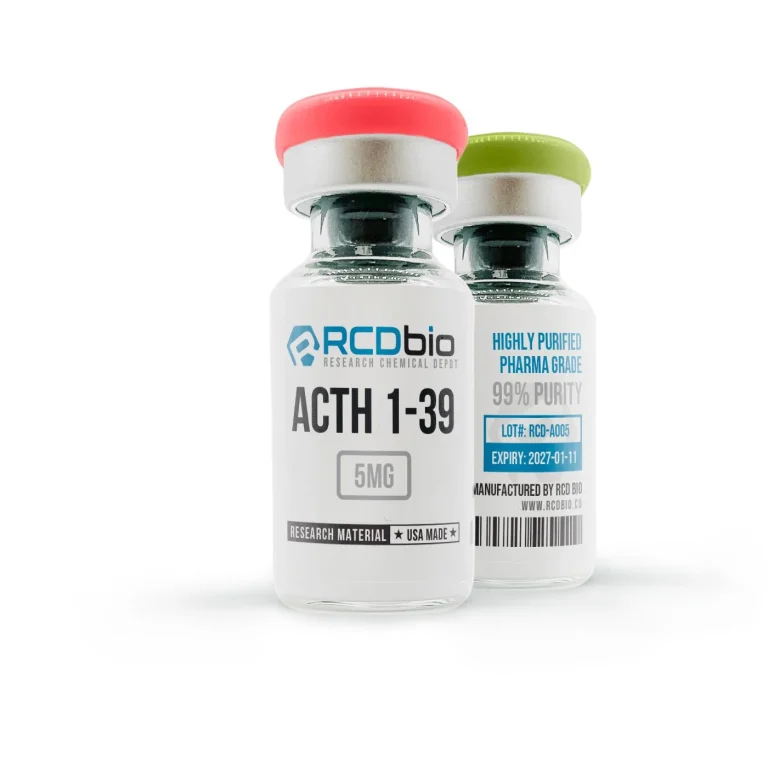
What is ACTH 1-39?
ACTH 1-39 is a synthetic 39-amino acid peptide corresponding to the full biologically active form of adrenocorticotropic hormone (ACTH), derived from proteolytic processing of the precursor molecule pro-opiomelanocortin (POMC). The compound belongs to the melanocortin peptide family and is characterised by a conserved “HFRW” core sequence (residues 6–9) that confers high-affinity binding to melanocortin receptors, particularly the melanocortin-2 receptor (MC2R, also referred to as the ACTH receptor), which is expressed predominantly in adrenocortical cells of the zona fasciculata.
In research settings, synthetic ACTH 1-39 has been employed as a reference ligand and pharmacological tool for investigating MC2R activation kinetics, intracellular cAMP signalling cascades, and hypothalamic-pituitary-adrenal (HPA) axis regulation in preclinical and in vitro model systems. It has been investigated in isolated adrenocortical cell preparations, rodent in vivo models, and cell-free receptor binding assays for its role in steroidogenic enzyme activation, melanocortin receptor pharmacology, and neuroendocrine feedback circuitry.
Synthetic ACTH 1-39 supplied by RCDbio is intended strictly for laboratory and research purposes. It is not approved by the Food and Drug Administration for use in this research-grade, non-pharmaceutical form. It is not a dietary supplement and is not intended for human consumption or therapeutic self-administration.
Chemical Properties
| Property | Detail |
| Product Type | Synthetic Linear Peptide (39-residue melanocortin) |
| Product Name | ACTH 1-39 (Adrenocorticotropic Hormone 1-39) |
| Application | Scientific / Research Use Only |
| CAS Number | 12279-41-3 |
| Molar Mass | 4,541.1 g/mol |
| Chemical Formula | C₂₀₇H₃₀₈N₅₆O₅₈S |
| Sequence | Ser-Tyr-Ser-Met-Glu-His-Phe-Arg-Trp-Gly-Lys-Pro-Val-Gly-Lys-Lys-Arg-Arg-Pro-Val-Lys-Val-Tyr-Pro-Asn-Gly-Ala-Glu-Asp-Glu-Ser-Ala-Glu-Ala-Phe-Pro-Leu-Glu-Phe (residues 1–39) |
| IUPAC Name | L-seryl-L-tyrosyl-L-seryl-L-methionyl-L-α-glutamyl-L-histidyl-L-phenylalanyl-L-arginyl-L-tryptophyl-glycyl-L-lysyl-L-prolyl-L-valyl-glycyl-L-lysyl-L-lysyl-L-arginyl-L-arginyl-L-prolyl-L-valyl-L-lysyl-L-valyl-L-tyrosyl-L-prolyl-L-asparagyl-glycyl-L-alanyl-L-α-glutamyl-L-α-aspartyl-L-α-glutamyl-L-seryl-L-alanyl-L-α-glutamyl-L-alanyl-L-phenylalanyl-L-prolyl-L-leucyl-L-α-glutamyl-L-phenylalanine |
| Synonyms | Corticotropin; ACTH; Adrenocorticotropin (natural pharmaceutical form trade names: Acthar Gel — pharmaceutical form only) |
| Physical Form | Lyophilized white to off-white powder |
| Solubility | Soluble in sterile water for injection or 0.1% acetic acid (aqueous); soluble in dilute PBS at physiological pH; avoid strongly alkaline conditions which promote methionine oxidation at residue 4 |
| Storage (Lyophilized) | Store at −20°C in a sealed, light-protected container with desiccant; protect from moisture and repeated temperature cycling |
| Storage (Reconstituted) | Store at 4°C; use within 24–48 hours of reconstitution; avoid repeated freeze-thaw cycles; discard any solution exhibiting turbidity, discolouration, or particulate matter |
| PubChem CID | 16132436 |
| Purity | ≥98% (HPLC verified, independent third-party laboratory analysis; COA available per batch) |
| WADA Status | ACTH 1-39 (corticotropin) is explicitly listed on the current WADA Prohibited List under S2 — Peptide Hormones, Growth Factors, Related Substances and Mimetics, prohibited in-competition and out-of-competition in sport. Researchers engaged in sport-adjacent studies should verify the current status at GlobalDRO.com before use. |
How Does ACTH 1-39 Work?
ACTH 1-39 exerts its primary pharmacological activity through high-affinity binding to the melanocortin-2 receptor (MC2R), a class A G protein-coupled receptor expressed at high density in the adrenal cortex. Unlike other melanocortin receptor subtypes (MC1R, MC3R–MC5R), MC2R exhibits strict ligand selectivity for ACTH and does not bind α-MSH or other melanocortin peptides. The structural determinants of this selectivity reside in the N-terminal residues 1–24 of the ACTH sequence, with the HFRW motif at positions 6–9 serving as the primary pharmacophore.
MC2R-Mediated cAMP/PKA Signalling in Adrenocortical Cells
In isolated adrenocortical cell preparations, MC2R activation by ACTH 1-39 initiates Gαs-mediated adenylyl cyclase stimulation, resulting in intracellular cyclic AMP (cAMP) accumulation. Elevated cAMP activates protein kinase A (PKA), which phosphorylates steroidogenic acute regulatory (StAR) protein and promotes cholesterol transport from the outer to the inner mitochondrial membrane — the rate-limiting step in glucocorticoid biosynthesis. This signaling sequence has been characterized in primary bovine and human adrenocortical cell preparations as the primary mechanistic basis for cortisol and corticosterone production in response to ACTH receptor stimulation.
StAR Protein Activation and Steroidogenesis
In preclinical adrenocortical cell models, ACTH 1-39-mediated PKA activation induces rapid phosphorylation and upregulation of StAR protein expression, facilitating mitochondrial cholesterol delivery to CYP11A1 (cytochrome P450scc). CYP11A1-catalysed side-chain cleavage converts cholesterol to pregnenolone, which subsequently undergoes enzymatic conversion through CYP17A1, HSD3B, and CYP21A2 in zona fasciculata preparations to yield cortisol (in human-derived cell models) or corticosterone (in rodent-derived models).
HPA Axis Neuroendocrine Feedback Circuitry
In rodent in vivo models, exogenous ACTH 1-39 administration at supraphysiological doses has been characterized as bypassing hypothalamic corticotropin-releasing hormone (CRH) signaling and directly stimulating adrenocortical steroidogenesis. ACTH-induced cortisol or corticosterone elevation subsequently activates glucocorticoid receptor (GR)-mediated negative feedback at the pituitary and hypothalamus, suppressing CRH and endogenous ACTH secretion — a dynamic that has been employed in preclinical HPA axis pharmacology models and ACTH stimulation assay contexts.
Melanocortin Receptor Selectivity and Binding Pharmacology
In radioligand competition binding assays and cell-free receptor systems, ACTH 1-39 demonstrates high-affinity, selective binding at MC2R (Ki in the low nanomolar range in isolated adrenocortical membrane preparations) with no substantial activity at MC1R, MC3R, MC4R, or MC5R at equivalent concentrations. This receptor selectivity profile has made ACTH 1-39 a standard reference compound in melanocortin receptor pharmacology studies, particularly for distinguishing MC2R-mediated from MSH-receptor-mediated downstream signaling.
Key Research Findings
- MC2R-cAMP coupling: Gαs-mediated adenylyl cyclase activation and StAR phosphorylation are characterized in primary human adrenocortical cell preparations following MC2R occupation by ACTH 1-39 at nanomolar concentrations. [Dores et al., 2014]
- Steroidogenic enzyme induction: Dose-dependent upregulation of CYP11A1, CYP17A1, and HSD3B2 mRNA expression observed in bovine adrenocortical cell systems following sustained ACTH 1-39 stimulation, consistent with trophic receptor activation. [Mountjoy, 2010]
- HPA axis suppression modeling: Exogenous ACTH 1-39 administration in rodent in vivo models produced rapid corticosterone elevation with concurrent suppression of endogenous CRH and ACTH secretion, characterizing glucocorticoid negative feedback at the hypothalamic-pituitary level. [Lightman & Conway-Campbell, 2010]
- MRAP1 co-expression requirement: MC2R functional coupling to Gαs and downstream steroidogenesis has been shown to require co-expression of melanocortin-2 receptor accessory protein 1 (MRAP1) in heterologous expression systems; ACTH 1-39 stimulation of MC2R in the absence of MRAP1 fails to produce measurable cAMP accumulation in HEK293 cell models. [Metherell et al., 2005]
- Adrenal trophic effects: Prolonged ACTH 1-39 exposure in adrenocortical cell preparations has been associated with increased cell proliferation and hypertrophy markers in rodent in vivo models, an observation distinct from the acute steroidogenic response and investigated in the context of adrenal growth regulation. [Dores et al., 2014]
All findings listed above are derived from preclinical or in vitro data. No conclusions regarding human therapeutic efficacy can be drawn from these observations. These findings do not constitute evidence of safety or efficacy in any human condition or organism.
What are the Potential Research Applications of ACTH 1-39?
MC2R Pharmacology and Melanocortin Receptor Binding Studies
Synthetic ACTH 1-39 serves as the primary endogenous reference ligand for MC2R characterization in receptor binding assays, including radioligand displacement experiments, BRET/FRET-based coupling studies, and Gαs bias investigations. In in vitro systems, it has been employed to define MC2R activation thresholds, receptor desensitization and internalization kinetics, and the functional contribution of MRAP1 co-factor expression to receptor-effector coupling.
HPA Axis Regulation and Glucocorticoid Feedback Research
ACTH 1-39 has been investigated in preclinical rodent and primate models as a pharmacological tool for characterizing the dynamics of HPA axis activation, glucocorticoid negative feedback, and hypothalamic-pituitary setpoint modulation. It has been employed in stimulation and suppression protocols in preclinical settings to probe adrenocortical reserve and feedback sensitivity in animal models of stress, metabolic dysregulation, and neuroendocrine perturbation.
Adrenocortical Steroidogenesis Pathway Research
In isolated adrenocortical cell preparations and ex vivo tissue slice models, ACTH 1-39 is employed to characterize the enzymatic cascade from cholesterol mobilization to final glucocorticoid product. It has been used to investigate CYP11A1, CYP17A1, CYP21A2, and CYP11B1 activity, StAR protein dynamics, and the dose-response relationship between MC2R occupancy and steroidogenic output.
Melanocortin Peptide Structure-Activity Relationship Studies
The ACTH sequence encompasses multiple melanocortin receptor pharmacophores and truncation variants (including ACTH 1-24 and ACTH 4-10), making ACTH 1-39 a starting-point reference compound in structure-activity relationship (SAR) investigations directed at understanding the contribution of specific residues to MC2R selectivity, potency, and receptor residence time. Such studies are conducted in cell-free and cellular expression systems.
These are observed in preclinical and in vitro contexts only and do not constitute claims of efficacy or safety in any organism.
What are the Potential Side Effects of ACTH 1-39?
- Sustained adrenocortical steroidogenesis was observed in rodent in vivo models following repeated ACTH 1-39 administration; dose-dependent elevation of corticosterone or cortisol was characterized as an expected pharmacological consequence of MC2R activation.
- Adrenal hypertrophy and increased adrenocortical cell mass were observed in rodent models following prolonged exogenous ACTH 1-39 exposure, consistent with the trophic activity of the compound at MC2R; this effect was reversible upon discontinuation in reported animal studies.
- Suppression of endogenous ACTH and CRH secretion via glucocorticoid negative feedback was characterised in rodent HPA axis models following exogenous ACTH 1-39-induced corticosteroid elevation: findings reflect expected HPA axis dynamics rather than off-target toxicity.
- Electrolyte perturbations, including sodium retention and potassium excretion, were noted at high-dose exposure in some rodent in vivo models, attributed to mineralocorticoid precursor production in the adrenal zona glomerulosa; effects were dose-dependent and not uniform across all model systems.
- Oxidative degradation of the methionine residue at position 4 was documented under aerobic storage and reconstitution conditions, yielding methionine sulfoxide variants with reduced biological activity in in vitro binding assays; this is a chemical stability observation, not a biological toxicity finding.
No human safety or tolerability data pertaining to research-grade ACTH 1-39 has been established. These observations are derived from experimental systems and should not be extrapolated to human or animal outcomes.
Risk & Handling
Risk Tier: MODERATE
Handling Precautions
ACTH 1-39 is a potent melanocortin receptor ligand and should be handled exclusively by trained laboratory personnel familiar with the pharmacology of neuroendocrine peptides. Standard PPE is required at all times: nitrile gloves, a laboratory coat, and eye protection at minimum. During reconstitution, aerosol generation must be avoided; perform reconstitution in a laminar flow hood where possible. The methionine residue at position 4 of the sequence is susceptible to oxidative degradation — avoid exposing solutions to ambient air, oxidizing buffers, or high-temperature conditions. Do not combine with strongly oxidizing laboratory reagents.
Exposure Risks
ACTH 1-39 is pharmacologically active at MC2R at nanomolar concentrations in adrenocortical cell systems. It is not acutely lethal in preclinical rodent models at research-relevant concentrations; however, supraphysiological systemic exposure in rodent in vivo models has produced adrenal hypertrophy, sustained glucocorticoid elevation, and secondary HPA axis suppression consistent with the compound’s mechanism of action. These effects are dose-dependent and reversible in animal model contexts. No acute organ toxicity or narrow therapeutic index has been documented preclinically at research concentrations.
The plasma half-life of native ACTH in intravenous rodent models is approximately 3–8 minutes, reflecting rapid proteolytic clearance by plasma neutral endopeptidases. These figures are derived from laboratory and preclinical models and do not represent human pharmacokinetic data for research-grade material.
No human safety data has been established for research-grade ACTH 1-39. Researchers should exercise caution appropriate to handling a potent biologically active peptide with defined neuroendocrine receptor activity.
Storage
- Lyophilized form: Store at −20°C; sealed, light-protected container with desiccant
- Reconstituted form: Store at 4°C; use within 24–48 hours of reconstitution
- Do not subject to repeated freeze-thaw cycles; peptide integrity degrades progressively with each thermal cycling event
- Protect from oxidising conditions during storage and handling; methionine oxidation at residue 4 reduces MC2R binding affinity in in vitro assay systems
- Discard any reconstituted solution that appears turbid, discoloured, or shows particulate matter
FAQs
Q: What is ACTH 1-39 and what is it investigated for in research? A: ACTH 1-39 is a synthetic 39-amino acid peptide corresponding to the full biologically active form of adrenocorticotropic hormone, derived from the POMC precursor. In laboratory settings, it is investigated as a reference ligand for the melanocortin-2 receptor (MC2R) and as a tool for characterising adrenocortical steroidogenesis, HPA axis regulation, and melanocortin receptor pharmacology in preclinical and in vitro model systems. It is not intended for human or veterinary use and is not approved by the FDA for any clinical application in this research-grade form.
Q: What is the half-life of ACTH 1-39 in preclinical models? A: The plasma half-life of native ACTH in intravenous rodent models is approximately 3–8 minutes, reflecting rapid clearance by plasma neutral endopeptidases and angiotensin-converting enzyme-related peptidases. In vitro stability in aqueous solution at 4°C is considerably longer when stored under reducing agent-free, low-oxygen conditions. These figures are derived from laboratory and preclinical models and do not represent human pharmacokinetic data for research-grade material.
Q: How should ACTH 1-39 be stored to maintain stability? A: Lyophilized material should be stored at −20°C in a sealed, light-protected container with desiccant. Once reconstituted, solutions should be stored at 4°C and used within 24–48 hours. Repeated freeze-thaw cycling should be avoided. The methionine residue at position 4 is the primary lability site — oxidative conditions, reducing agents incompatible with this peptide, and prolonged exposure to ambient air accelerate degradation and reduce MC2R binding activity in assay systems.
Q: What toxicity observations have been reported in preclinical studies? A: In rodent in vivo models at supraphysiological doses, sustained ACTH 1-39 exposure produced dose-dependent corticosteroid elevation, adrenal hypertrophy, and suppression of endogenous HPA axis signalling consistent with expected MC2R pharmacology. No acute lethality or organ-specific toxicity was identified at research-relevant concentrations in published preclinical data. Electrolyte effects including sodium retention were noted at high doses in some rodent models. No human safety data has been established for research-grade ACTH 1-39.
Q: What is ACTH 1-39 typically reconstituted with in laboratory research? A: In laboratory settings, ACTH 1-39 lyophilized powder is typically reconstituted in sterile water for injection or 0.1% acetic acid (aqueous solution) to prepare stock concentrations for subsequent dilution in PBS or assay-compatible buffers at physiological pH. Strongly alkaline reconstitution conditions should be avoided as they promote methionine oxidation and peptide backbone degradation. Working concentrations for in vitro receptor assays are generally prepared in the nanomolar range.
Q: Why does MC2R require MRAP1 co-expression for functional coupling? A: In heterologous expression systems such as HEK293 cells, MC2R fails to traffic efficiently to the plasma membrane and does not produce measurable cAMP accumulation in response to ACTH 1-39 stimulation in the absence of melanocortin-2 receptor accessory protein 1 (MRAP1). MRAP1 is a single-pass transmembrane protein that facilitates MC2R folding, membrane insertion, and Gαs coupling. This co-factor requirement is unique among melanocortin receptors and is a critical experimental design consideration in any in vitro MC2R pharmacology study using ACTH 1-39 as the test ligand. This was established in isolated HEK293 and COS-7 cell expression model systems.
Q: How does research-grade ACTH 1-39 differ from the pharmaceutical form? A: Pharmaceutical corticotropin products (e.g., Acthar Gel) are formulated, purified, and approved for specific clinical applications under FDA regulatory oversight, with defined potency units, pharmaceutical excipients, and manufacturing standards applicable to human administration. Research-grade ACTH 1-39 supplied by RCDbio is a lyophilized synthetic peptide produced for laboratory use exclusively — it is not formulated for injection, does not carry pharmaceutical approval, and has no established clinical safety or tolerability profile. These products are not interchangeable for any purpose.
Related Research Compounds
Semax Nasal Spray — An ACTH(4-10) analogue investigated in preclinical CNS models for neuroprotective and melanocortin receptor-related signalling pathways; employed alongside ACTH 1-39 in melanocortin pharmacology research to delineate MC2R-selective from pan-melanocortin receptor activity.
Kisspeptin-10 — A GPR54-targeting neuropeptide investigated in preclinical neuroendocrine models for its role in hypothalamic-pituitary signalling axis regulation; relevant to comparative HPA and HPG axis pathway research.
Gonadorelin — A synthetic GnRH decapeptide investigated in preclinical models for hypothalamic-pituitary-gonadal axis modulation; employed in comparative neuroendocrine receptor pharmacology research alongside ACTH-related HPA axis tools.
All products listed are for laboratory and research purposes only.
References
Dores, R. M., & Baron, A. J. (2011). Evolution of POMC: origin, phylogeny, posttranslational processing, and the melanocortins. Annals of the New York Academy of Sciences, 1220, 34–48. https://pubmed.ncbi.nlm.nih.gov/21388402/
Metherell, L. A., Chapple, J. P., Cooray, S., David, A., Becker, C., Rüschendorf, F., … & Clark, A. J. L. (2005). Mutations in MRAP, encoding a new interacting partner of the ACTH receptor, cause familial glucocorticoid deficiency type 2. Nature Genetics, 37(2), 166–170. https://pubmed.ncbi.nlm.nih.gov/15654338/
Lightman, S. L., & Conway-Campbell, B. L. (2010). The crucial role of pulsatile activity of the HPA axis for continuous dynamic equilibration. Nature Reviews Neuroscience, 11(10), 710–718. https://pubmed.ncbi.nlm.nih.gov/20842176/
Mountjoy, K. G. (2010). Functions for pro-opiomelanocortin-derived peptides in obesity and diabetes. Biochemical Journal, 428(3), 305–324. https://pubmed.ncbi.nlm.nih.gov/20504281/
Dores, R. M., Liang, L., Davis, P., Thomas, A. L., & Petko, B. (2014). 60 YEARS OF POMC: Melanocortin receptors: evolution of ligand selectivity for melanocortin peptides. Journal of Molecular Endocrinology, 52(3), T119–T133. https://pubmed.ncbi.nlm.nih.gov/26792827/
Disclaimer
ACTH 1-39 is exclusively for laboratory research purposes. RCDbio products are not intended to diagnose, prevent, treat, or cure any disease or medical condition.
The Food and Drug Administration has not evaluated the statements on our website. This product is not approved for human or veterinary use. Researchers must comply with all applicable local, state, and federal laws and regulations governing the purchase and use of research compounds. By purchasing, you agree to our Terms and Conditions. RCDbio reserves the right to refuse sales to unauthorized individuals.
ATTENTION: All RCDbio products are strictly for LABORATORY AND RESEARCH PURPOSES ONLY. They are not intended for human consumption, veterinary use, or any other non-research application. For queries, complaints, or support, contact support@legacy.rcdbio.co
Reviews
There are no reviews yet