

Description
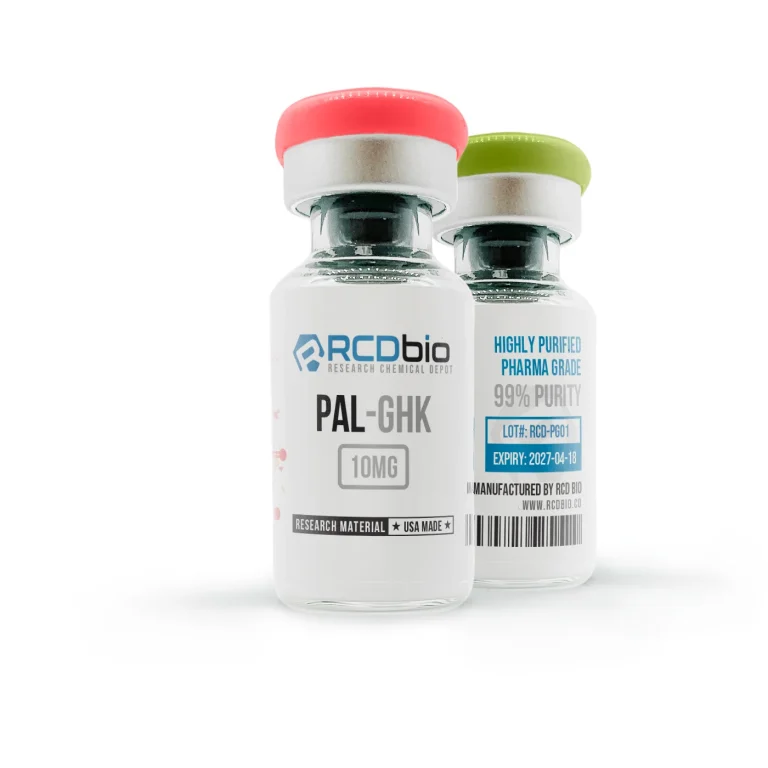
What is PAL-GHK?
PAL-GHK (Palmitoyl Tripeptide-1, also designated Palmitoyl Oligopeptide, C16-GHK, and by its INCI name Palmitoyl Tripeptide-1) is a synthetic lipopeptide consisting of the GHK tripeptide (glycine-histidine-lysine) covalently conjugated at the N-terminus of glycine to palmitic acid — a saturated C16 fatty acid — via an amide bond. The GHK sequence is a naturally occurring collagen-derived matrikine: it corresponds to a fragment of the alpha-2(I) chain of type I collagen and is proposed to be released by proteases at sites of tissue injury or extracellular matrix degradation, where it acts as a signalling molecule attracting fibroblasts and upregulating ECM repair processes. The parent GHK tripeptide has been extensively characterised in cell-free and cell-based research systems for its interactions with collagen synthesis, MMP regulation, and growth factor signalling pathways.
The palmitoyl modification — covalent attachment of the C16 fatty acid chain to the peptide’s N-terminus — fundamentally alters the compound’s physicochemical profile. The resulting amphiphilic lipopeptide has dramatically increased lipophilicity (estimated logP 4.81) compared to the parent GHK tripeptide, enabling penetration through the hydrophobic lipid bilayer barrier of cell membranes in experimental systems. In research contexts, this lipophilic modification converts the relatively cell-impermeable GHK tripeptide into a membrane-penetrant form investigated for enhanced delivery to dermal fibroblast cell systems in topical and in vitro research models.
PAL-GHK is a component of Matrixyl 3000, a commercial cosmetic ingredient preparation combining Palmitoyl Tripeptide-1 and Palmitoyl Tetrapeptide-7 (Pal-GQPR) in an aqueous glycerin carrier. In research settings, PAL-GHK is employed as a cell-penetrant matrikine signal peptide reference compound for studying collagen synthesis pathway modulation and ECM remodelling biology in isolated fibroblast and lipid membrane model systems. PAL-GHK is not approved by the Food and Drug Administration for human or veterinary therapeutic use. It is not a dietary supplement and is not intended for human consumption or therapeutic self-administration. All RCDbio research compounds are supplied strictly for laboratory and research purposes only.
Chemical Properties
| Property | Detail |
| Product Type | Synthetic Lipopeptide / Palmitoylated GHK Tripeptide (Matrikine Signal Peptide Analogue) |
| Product Name | PAL-GHK (Palmitoyl Tripeptide-1) |
| Application | Scientific / Research Use Only |
| CAS Number | 147732-56-7 |
| Molar Mass | 578.8 g/mol |
| Chemical Formula | C30H54N6O5 |
| PubChem CID | 10231864 |
| IUPAC Name | (2S)-6-amino-2-[[(2S)-2-[[2-(hexadecanoylamino)acetyl]amino]-3-(1H-imidazol-5-yl)propanoyl]amino]hexanoic acid |
| Peptide Sequence | Palmitoyl-Gly-His-Lys (Palm-GHK); N-terminal palmitoyl amide bond on glycine; free C-terminal carboxyl on lysine |
| INCI Name | Palmitoyl Tripeptide-1 |
| Lipid Component | Palmitic acid (hexadecanoic acid); C16 saturated fatty acid; covalently bound via N-terminal amide bond to glycine |
| Synonyms | Palmitoyl Tripeptide-1; Palmitoyl Oligopeptide; C16-GHK; C16-GK-3; Collaxyl II; Pal-Tripeptide-1; Biopeptide CL; Matrixyl component |
| LogP (Estimated) | 4.81 (significantly more lipophilic than parent GHK tripeptide) |
| Parent Compound | GHK free tripeptide (Gly-His-Lys; CAS 49557-75-7; MW 340.38 g/mol; PubChem CID 342538) |
| λmax | 283 nm (imidazole ring of histidine) |
| Physical Form | White to off-white solid powder |
| Solubility | DMSO: 10 mg/mL; DMF: 30 mg/mL; Ethanol: 30 mg/mL; limited aqueous solubility due to palmitoyl chain |
| Storage (Lyophilized) | −20°C; sealed container; protected from light and moisture |
| Storage (Reconstituted) | 4°C; use within 48–72 hours; protect from light |
| Purity | ≥98% (HPLC verified, independent third-party laboratory analysis) |
| WADA Status | PAL-GHK is not explicitly named on the 2026 WADA Prohibited List. As a non-approved synthetic lipopeptide with ECM signalling activity, S0 (Non-Approved Substances) provisions may apply in sport-adjacent research contexts. Verify at GlobalDRO.com before use. |
How Does PAL-GHK Work?
PAL-GHK’s biological activity in preclinical and in vitro research systems is mediated through the GHK peptide sequence following membrane penetration enabled by the palmitoyl fatty acid conjugate. The palmitoyl moiety functions as a membrane-active delivery vector; the GHK tripeptide is the biologically active element interacting with cell surface receptors and intracellular signalling targets.
Lipid Membrane Penetration — Palmitoyl Delivery Mechanism
The C16 palmitoyl chain inserts into the hydrophobic core of lipid bilayers, enabling PAL-GHK to traverse cell membrane barriers inaccessible to the hydrophilic parent GHK tripeptide. In lipid model membrane studies, Pal-GHK has been shown to modulate the thermotropic phase behaviour and molecular fluidity of hydrogenated phosphatidylcholine (HSPC) membranes, inducing gauche conformation in acyl chains and increasing membrane fluidity in gel-state lipid bilayers. This membrane interaction profile is consistent with palmitoyl peptide amphiphile (PA) insertion into the hydrophobic membrane core. The palmitoyl modification is proposed to enable GHK delivery to the lipid-rich environment of the stratum corneum and subsequent access to dermal fibroblast populations in topical research models.
Collagen I and III Gene Expression — Matrikine Signalling
In human dermal fibroblast cell culture preparations at concentrations of 0.5 μM, PAL-GHK has been associated with increased collagen synthesis — both collagen type I and type III gene expression — at both mRNA and protein levels [Lintner & Peschard, 2000]. The proposed mechanism is matrikine signalling: GHK is released from type I collagen’s alpha-2(I) chain by proteolysis at injury sites, and the intact or palmitoyl-conjugated GHK signal is proposed to be recognised by cell surface receptors or integrin systems on fibroblast membranes, upregulating the collagen biosynthesis programme. Collagen synthesis upregulation has also been associated with downstream effects on fibronectin and hyaluronic acid synthesis in isolated fibroblast preparations [Gorouhi & Maibach, 2009].
MMP Regulatory Pathway — ECM Remodelling
Concurrent with collagen synthesis upregulation, PAL-GHK has been investigated for modulation of matrix metalloproteinase (MMP) activity in dermal fibroblast preparations. Specifically, MMP-1 (collagenase-1) and MMP-2 (gelatinase A) activity have been examined in cell culture systems exposed to PAL-GHK, with observations of reduced collagenolytic activity at concentrations consistent with collagen synthesis stimulation effects. Ex vivo, PAL-GHK at 6 ppm reduced collagen degradation in UV-irradiated patient-derived human skin samples — a finding attributed to MMP inhibition and/or collagen synthesis compensation under oxidative stress conditions [Pickart et al., 2015].
Growth Factor and Signalling Interactions — Inferred from GHK Literature
The parent GHK tripeptide has been characterised in Pickart group research for interactions with TGF-β1 and VEGF signalling in fibroblast and endothelial cell preparations [Pickart & Margolina, 2018]. PAL-GHK is expected to share these pathway interactions through the preserved GHK core, with potentially enhanced penetration to intracellular signalling targets enabled by the palmitoyl modification. Direct characterisation of PAL-GHK at the TGF-β1 and VEGF pathway level is limited relative to the parent GHK-Cu complex literature.
Key Research Findings
In preclinical and in vitro research contexts, PAL-GHK has been associated with the following observations:
- Collagen synthesis at 0.5 μM: Increased collagen synthesis observed in human dermal fibroblast cell culture preparations at 0.5 μM PAL-GHK; effects on collagen, fibronectin, and hyaluronic acid synthesis characterised [Lintner & Peschard, 2000].
- UV-induced collagen degradation reduction: PAL-GHK at 6 ppm reduced collagen degradation in ex vivo UV-irradiated patient-derived human skin samples, attributed to MMP inhibition and/or collagen synthesis stimulation [Gorouhi & Maibach, 2009].
- Membrane self-assembly: PAL-GHK characterised as a peptide amphiphile forming aggregates, ribbons, and nanobelts in mixed surfactant systems — relevant to formulation-based research and nanostructured peptide delivery investigations.
- Lipid bilayer interaction: PAL-GHK modulates phosphatidylcholine membrane phase behaviour, vesicle size, and storage stability in HSPC-based lipid vesicle systems — relevant to lipid membrane biology and peptide amphiphile drug delivery research.
- Analytic reference use: PAL-GHK was employed as an internal standard for LC-MS/MS quantification of palmitoyl peptides in cosmetic formulation analysis research.
All findings listed above are derived from preclinical in vitro and ex vivo data. No regulatory-grade human clinical trial data have been established for PAL-GHK as a standalone research compound. These observations do not constitute evidence of efficacy or safety in any human condition or organism.
What are the Potential Research Applications of PAL-GHK?
In controlled laboratory environments, PAL-GHK has been investigated for the following research applications. These are observed in preclinical and in vitro contexts only and do not constitute claims of efficacy or safety in any organism.
Fibroblast Collagen Synthesis and ECM Remodelling Studies PAL-GHK is employed as the primary lipopeptide matrikine reference compound in studies characterising collagen type I and III synthesis dynamics, fibronectin and hyaluronic acid expression, and MMP regulatory responses in isolated human dermal fibroblast cell culture systems. Research examines how palmitoylation of the GHK sequence alters the concentration-response profile relative to unmodified GHK or GHK-Cu.
Peptide Amphiphile and Lipid Membrane Research The self-assembly behaviour of PAL-GHK as a peptide amphiphile (PA) is investigated in model membrane systems, mixed lipid-surfactant preparations, and nanostructured lipid vesicle systems. Research characterises aggregate morphology, thermotropic phase behaviour, and the influence of palmitoyl peptide insertion on lipid bilayer physicochemical properties.
Skin Penetration and Topical Delivery Pathway Research PAL-GHK is employed in skin penetration studies examining how the palmitoyl modification enables stratum corneum traversal and access to dermal fibroblast populations in ex vivo human skin tissue preparations. Research compares penetration depth and fibroblast bioavailability of PAL-GHK versus parent GHK tripeptide using HPLC and fluorescence-labelled analogue detection methods.
Comparative Lipopeptide SAR Studies. As a palmitoyl-GHK reference compound, PAL-GHK is employed in comparative SAR investigations examining how C16 fatty acid conjugation alters collagen synthesis potency, receptor interaction profiles, and membrane interaction characteristics relative to the parent GHK, GHK-Cu, and other fatty acid-conjugated GHK analogues (Pal-GHK-Cu, PAL-AHK).
Analytical Method Development PAL-GHK is employed as a certified reference standard and internal standard in LC-MS/MS analytical method development for quantifying palmitoyl peptides in cosmetic and pharmaceutical formulations, supporting regulatory analytical validation work.
What are the Potential Side Effects of PAL-GHK?
Researchers in preclinical and in vitro settings have noted the following observations.
- Generally well-tolerated profile in dermal fibroblast and keratinocyte cell culture systems at research-relevant concentrations; no significant cytotoxicity reported at concentrations used in collagen synthesis studies
- The palmitoyl chain’s lipophilicity increases membrane disruption potential at high concentrations — relevant in cell-based assay systems where high lipopeptide concentrations may produce non-specific membrane effects unrelated to GHK receptor signalling
- Solubility in aqueous buffers is limited due to the palmitoyl chain; aggregation in aqueous media above critical micellar concentration may alter the compound’s interaction profile in cell-based assay systems
- No human safety or tolerability data have been established for PAL-GHK as a research compound. These observations are derived from cell culture and ex vivo experimental systems and should not be extrapolated to human or animal outcomes.
Risk & Handling
Handling Precautions
PAL-GHK should only be handled by trained laboratory personnel. Appropriate PPE is required: nitrile gloves, a laboratory coat, and eye protection at a minimum. When working with lyophilized powder, use within a laminar flow cabinet. Avoid aerosol generation during reconstitution. Due to its lipophilic character, dissolve initially in DMSO or ethanol before aqueous dilution. Do not add directly to aqueous buffers without prior co-solvent dissolution — the palmitoyl chain will cause aggregation.
Exposure Risks
Risk Tier: LOW
PAL-GHK has demonstrated a generally well-tolerated profile in published cell culture and ex vivo research systems. Its palmitoyl modification increases lipophilicity and membrane interaction potential relative to the parent GHK tripeptide; accidental dermal or mucosal exposure may result in local membrane interaction effects. No human safety or tolerability data have been established for research-grade PAL-GHK.
Storage
- Lyophilized form: Store at −20°C in original sealed, light-protected container with desiccant
- Reconstituted form: Dissolve in DMSO, DMF, or ethanol first; further dilute in aqueous buffer; store at 4°C and use within 48–72 hours
- Protect from prolonged light exposure — the histidine imidazole ring is photosensitive
- Avoid aqueous-only dissolution of concentrated stock solutions due to palmitoyl chain aggregation at the critical micellar concentration
Frequently Asked Questions
Q: What is PAL-GHK, and what is it investigated for in research? A: PAL-GHK (Palmitoyl Tripeptide-1; CAS 147732-56-7) is a synthetic lipopeptide consisting of the GHK matrikine tripeptide (Gly-His-Lys) covalently conjugated to palmitic acid via the glycine N-terminus. It is investigated in preclinical research contexts for collagen type I and III synthesis pathway modulation in fibroblast cell culture systems, MMP regulatory signalling, lipid membrane penetration biology, and peptide amphiphile self-assembly research. It is not approved by the FDA and is intended strictly for laboratory research purposes.
Q: How does PAL-GHK differ from the parent GHK tripeptide and GHK-Cu? A: GHK is the parent tripeptide (Gly-His-Lys; MW 340.38 g/mol) — hydrophilic, limited cell membrane penetration. GHK-Cu is the copper-chelated complex with copper(II) coordination at the histidine imidazole and glycine alpha-amine (MW 401.91 g/mol) — investigated as a copper chaperone with ECM remodelling activity. PAL-GHK adds a C16 palmitoyl fatty acid chain to GHK’s N-terminus (MW 578.8 g/mol) — dramatically increasing lipophilicity and enabling membrane penetration without copper coordination. The three forms occupy distinct research niches: copper chaperone activity (GHK-Cu), membrane-penetrant ECM signalling (PAL-GHK), and aqueous-soluble receptor pharmacology (GHK free tripeptide).
Q: What collagen synthesis effect has been observed with PAL-GHK in vitro? A: At a concentration of 0.5 μM in human dermal fibroblast cell culture preparations, PAL-GHK has been associated with increased collagen synthesis, with effects on collagen type I, type III, fibronectin, and hyaluronic acid expression characterised in the published research literature [Lintner & Peschard, 2000]. Ex vivo, PAL-GHK at 6 ppm reduced collagen degradation in UV-irradiated patient-derived human skin samples. These findings are from in vitro and ex vivo experimental systems and should not be extrapolated to human outcomes.
Q: How should PAL-GHK be dissolved for use in cell-based assay systems? A: Due to the palmitoyl chain’s hydrophobicity, PAL-GHK should first be dissolved in a water-miscible co-solvent (DMSO, DMF, or ethanol; up to 10–30 mg/mL depending on solvent). This stock solution is then diluted into aqueous buffer (PBS, cell culture media) to the desired working concentration. Direct addition to aqueous buffers without prior co-solvent dissolution will result in aggregation and altered bioavailability. Ensure the final co-solvent concentration in assay systems does not exceed 0.1% DMSO to avoid solvent-mediated cytotoxicity.
Q: What is PAL-GHK’s relationship to Matrixyl 3000? A: Matrixyl 3000 is a commercial cosmetic ingredient preparation combining two palmitoyl peptides: PAL-GHK (Palmitoyl Tripeptide-1; GHK sequence) and Pal-GQPR (Palmitoyl Tetrapeptide-7; GQPR sequence from IgG immunoglobulin) in an aqueous glycerin carrier. Research-grade PAL-GHK from RCDbio is the isolated, standalone Palmitoyl Tripeptide-1 component for use in controlled laboratory experimental systems, not the commercial Matrixyl 3000 cosmetic preparation.
Q: How should PAL-GHK be stored? A: Lyophilized PAL-GHK should be stored at −20°C in a sealed, light-protected container with desiccant. Reconstituted solutions should be stored at 4°C and used within 48–72 hours. Protect from light — the histidine imidazole ring has a λmax at 283 nm and is sensitive to prolonged UV exposure.
Related Research Compounds
Researchers investigating PAL-GHK may also be interested in the following compounds currently available for laboratory research at RCDbio:
- Copper Peptide GHK-Cu 1:1 — The parent GHK tripeptide chelated to copper(II); the primary copper-coordinated ECM remodelling reference compound for comparative studies against PAL-GHK’s palmitoyl-modified, copper-free lipopeptide profile.
- GHK-Cu 2:1 — The 2:1 molar ratio GHK-Cu preparation for comparative copper stoichiometry and ECM signalling research; relevant to distinguishing copper-dependent versus copper-independent GHK pathway effects relative to PAL-GHK.
All products listed are for laboratory and research purposes only.
References
- Lintner, K., & Peschard, O. (2000). Biologically active peptides: From a laboratory bench curiosity to a functional skin care product. International Journal of Cosmetic Science, 22(3), 207–218. https://pubmed.ncbi.nlm.nih.gov/18503476/
- Gorouhi, F., & Maibach, H. I. (2009). Role of topical peptides in preventing or treating aged skin. International Journal of Cosmetic Science, 31(5), 327–345. https://pubmed.ncbi.nlm.nih.gov/19570099/
- Pickart, L., & Margolina, A. (2018). Regenerative and Protective Actions of the GHK-Cu Peptide in the Light of the New Gene Data. International Journal of Molecular Sciences, 19(7), 1987. https://pubmed.ncbi.nlm.nih.gov/29970841/
- Pickart, L., Vasquez-Soltero, J. M., & Margolina, A. (2015). GHK Peptide as a Natural Modulator of Multiple Cellular Pathways in Skin Regeneration. BioMed Research International, 2015, 648108. https://pubmed.ncbi.nlm.nih.gov/26236730/
Disclaimer
PAL-GHK (Palmitoyl Tripeptide-1) is exclusively for laboratory research purposes. RCDbio products are not intended to diagnose, prevent, treat, or cure any disease or medical condition.
The Food and Drug Administration has not evaluated the statements on our website. This product is not approved for human or veterinary use. Researchers must comply with all applicable local, state, and federal laws and regulations governing the purchase and use of research compounds. By purchasing, you agree to our Terms and Conditions. RCDbio reserves the right to refuse sales to unauthorized individuals.
ATTENTION: All RCDbio products are strictly for LABORATORY AND RESEARCH PURPOSES ONLY. They are not intended for human consumption, veterinary use, or any other non-research application. For queries, complaints, or support, contact support@legacy.rcdbio.co
Reviews
There are no reviews yet