

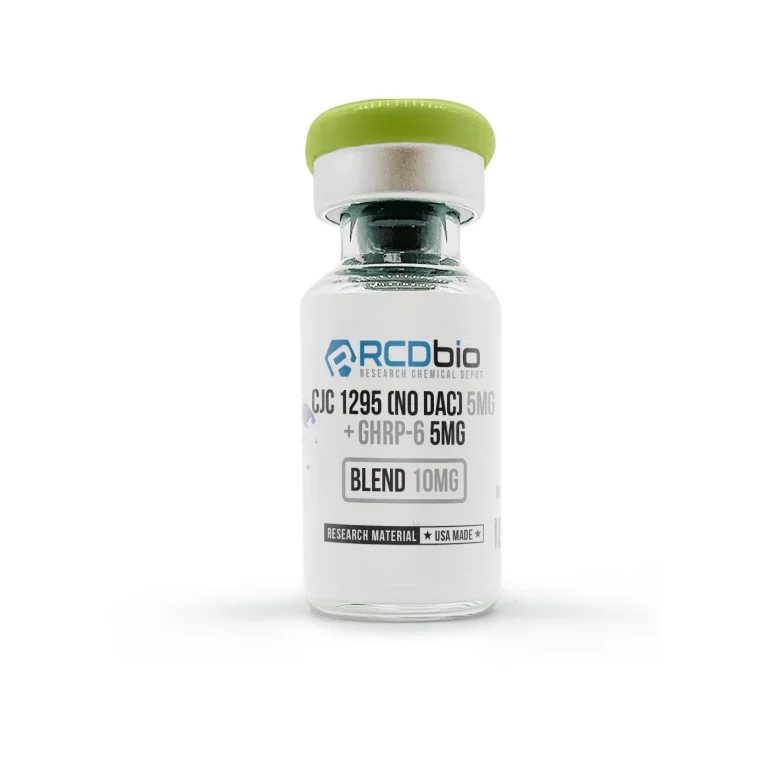
Description
What is the Mod GRF 1-29 + GHRP-6 Blend?
The Mod GRF 1-29 + GHRP-6 Blend is a dual-peptide research preparation combining Modified GRF (1-29) — CJC-1295 without DAC — and GHRP-6, co-formulated for simultaneous investigation of complementary GH-releasing pathways through GHRH receptor (GHRHR) and growth hormone secretagogue receptor 1a (GHS-R1a) co-activation. The blend targets the same fundamental dual-pathway GH axis stimulation principle as the CJC-1295 No DAC + Ipamorelin combination — both preparations pair a short-acting GHRH analogue with a GHS-R1a agonist — but employs GHRP-6 rather than Ipamorelin as the secretagogue component. This distinction is pharmacologically meaningful: GHRP-6 produces the strongest orexigenic (appetite-stimulating) effect of any GHRP through GHS-R1a/NPY pathway activation and additionally produces modest cortisol and prolactin elevations at research-relevant doses, creating a broader hormonal footprint than the highly selective Ipamorelin. Researchers selecting this blend over the Ipamorelin variant are typically investigating appetite circuit biology, the relationship between GHS-R1a activation and neuroendocrine confounder pathways, or require GHRP-6’s full pharmacological profile alongside GHRHR stimulation.
Modified GRF (1-29), also designated CJC-1295 without DAC, Mod GRF 1-29, and tetrasubstituted GRF(1-29), is a synthetic 29-amino acid analogue of human GHRH (1-29) with four amino acid substitutions — D-Ala2, Ala8, Ala15, Leu27 — engineering DPP-4 and general protease resistance into the native sequence. Without the maleimidopropionic acid Drug Affinity Complex (DAC) moiety present in CJC-1295 with DAC, this form has a plasma half-life of approximately 30 minutes, producing discrete GH pulses aligned with physiological pulsatility rather than the sustained GH elevation produced by the albumin-conjugated DAC form.
GHRP-6 (His-D-Trp-Ala-Trp-D-Phe-Lys-NH2) is the founding member of the GHRP class, developed by Bowers et al. in 1984. It is a potent GHS-R1a agonist signalling through Gαq/IP3/calcium, complementing GHRHR’s Gαs/cAMP/PKA pathway. In addition to GH release, GHRP-6 activates hypothalamic NPY/AgRP circuits, producing the strongest orexigenic response among all GHRPs. Neither Mod GRF 1-29 nor GHRP-6 is approved by the Food and Drug Administration for human or veterinary use. Neither Mod GRF 1-29 nor GHRP-6 is a dietary supplement, and neither is intended for human consumption or self-administration. All RCDbio research compounds are supplied strictly for laboratory and research purposes only.
Chemical Properties
| Property | Detail |
| Mod GRF 1-29 Component | |
| CAS Number | 863288-34-0 |
| Molar Mass | 3367.954 g/mol |
| Chemical Formula | C152H252N44O42 |
| PubChem CID | 56841945 (shared with CJC-1295 with DAC in many databases; verify from COA) |
| Amino Acid Count | 29 AA; D-Ala2, Ala8, Ala15, Leu27 substitutions; C-terminal amide; no DAC maleimide |
| Half-Life | ~30 minutes; no albumin binding |
| Synonyms | Modified GRF 1-29; Mod GRF 1-29; CJC-1295 without DAC; Tetrasubstituted GRF(1-29); Neorelin |
| GHRP-6 Component | |
| CAS Number | 87616-84-0 (free base); 145177-42-0 (acetate salt) |
| Molar Mass | 873.032 g/mol |
| Chemical Formula | C46H56N12O6 |
| PubChem CID | 5486806 |
| IUPAC Name | L-histidyl-D-tryptophyl-L-alanyl-L-tryptophyl-D-phenylalanyl-L-lysinamide |
| Amino Acid Sequence | His-D-Trp-Ala-Trp-D-Phe-Lys-NH2; 6 AA; D-Trp2; D-Phe5; C-terminal amide |
| Half-Life | ~2.5 hours |
| Receptor | GHS-R1a (ghrelin receptor); Gαq/IP3/Ca²⁺ signalling |
| Synonyms | GHRP-6; Growth Hormone-Releasing Hexapeptide; SK&F 110679 |
| Blend Properties | |
| Product Type | Dual-Peptide Research Blend (GHRH Analogue + Broad-Spectrum GHS-R1a Agonist) |
| Physical Form | Lyophilized white to off-white powder |
| Solubility | Both components soluble in sterile water and PBS |
| Storage (Lyophilized) | −20°C; sealed container; protected from light and moisture |
| Storage (Reconstituted) | 4°C; use within 48–72 hours; avoid repeated freeze-thaw cycles |
| Purity | ≥98% each component (HPLC verified, independent third-party laboratory analysis) |
| WADA Status | Both components are prohibited at all times under S2.2.4 of the 2026 WADA Prohibited List. Mod GRF 1-29 is prohibited as a GHRH analogue (CJC-1295 listed by name in the same subcategory); GHRP-6 is explicitly named as a prohibited GH-releasing peptide (GHRP). Verify at GlobalDRO.com before use. |
How Does the Mod GRF 1-29 + GHRP-6 Blend Work?
Mod GRF 1-29 — GHRHR Gαs/cAMP/PKA Pathway
Modified GRF 1-29 binds the GHRH receptor (GHRHR) on anterior pituitary somatotroph cells, initiating Gαs-coupled adenylyl cyclase stimulation, elevated intracellular cAMP, and downstream PKA activation [Jetté et al., 2005]. This cascade promotes GH1 gene transcription and pulsatile somatotroph GH granule exocytosis. The four DPP-4-resistant substitutions extend the active half-life to ~30 minutes, producing discrete GH pulses. Without the DAC albumin-binding moiety, receptor stimulation is time-limited and physiologically pulsatile — making this form preferred when pulsatile GH dynamics rather than sustained plateau elevation are the research objective.
GHRP-6 — GHS-R1a Gαq/IP3/Calcium Pathway and Somatostatin Suppression
GHRP-6 binds GHS-R1a, activating Gαq-coupled phospholipase C, IP3-mediated intracellular calcium release, potassium channel inhibition, and calcium channel activation — driving GH granule exocytosis through a pathway parallel to and independent of the GHRHR cAMP cascade [Bowers et al., 1984]. Additionally, GHRP-6 suppresses hypothalamic somatostatin release, removing the principal GH inhibitory signal and amplifying GHRHR-mediated GH release. This dual mechanism — direct GH release plus somatostatin disinhibition — underlies the supraphysiological GH responses observed with GHRH + GHRP combinations.
GHRP-6’s Orexigenic and Neuroendocrine Footprint — Key Distinction from Ipamorelin Blend
Unlike the CJC-1295 No DAC + Ipamorelin blend, this preparation’s GHRP-6 component produces significant additional pharmacological effects beyond GH release: pronounced appetite stimulation through hypothalamic GHS-R1a/NPY/AgRP pathway activation [Wren et al., 2000], and modest cortisol and prolactin elevations at research-relevant doses. These effects are mechanistic features, not liabilities — they are the primary research rationale for selecting GHRP-6 over Ipamorelin when investigating hypothalamic appetite circuits, ghrelin pathway biology, or the full neuroendocrine GHS-R1a pharmacological footprint alongside GH axis effects.
Synergistic GH Release
As with all GHRH analogue + GHS-R1a agonist combinations, the Mod GRF 1-29 + GHRP-6 blend produces supraphysiological GH pulse amplitudes exceeding either compound alone in preclinical preparations. The summation of GHRHR-cAMP and GHS-R1a-calcium cascades, combined with somatostatin disinhibition from GHRP-6, produces the characteristic supraphysiological GH response.
Key Research Findings
In preclinical and clinical research contexts, the individual blend components have been associated with the following observations. No peer-reviewed published study has directly characterised this specific blend combination in a controlled head-to-head comparison.
- Mod GRF 1-29 GHRHR activity: Tetrasubstituted GRF(1-29) demonstrated GHRHR receptor activation and GH release in anterior pituitary rat preparations; identified as the core GHRH analogue in the CJC-1295 programme [Jetté et al., 2005].
- GHRP-6 GH release — founding study: Dose-dependent GH release from pituitary somatotrophs in vitro and in vivo across multiple species; first characterisation of the GHS-R1a pharmacological target [Bowers et al., 1984].
- GHRP-6 GHS-R1a receptor cloning: GHRP-6 was the primary tool compound enabling GHS-R1a receptor cloning; the receptor was subsequently identified as the endogenous ghrelin receptor [Howard et al., 1996].
- GHRP-6 orexigenic activity: Intracerebroventricular GHRP-6 produced rapid, dose-dependent food intake increases in rodent models; mechanistic overlap with ghrelin/NPY pathway confirmed [Wren et al., 2000].
- GHRH + GHS synergy: Combined GHRH analogue + GHS-R1a agonist administration consistently produces supraphysiological GH pulse amplitudes in preclinical and human pharmacology preparations.
All findings listed above are derived from preclinical in vitro and in vivo data and early-phase human pharmacology studies. No peer-reviewed data directly characterises this specific blend. These observations do not constitute evidence of efficacy or safety for research-grade material in any human condition or organism.
What are the Potential Research Applications?
Dual-Pathway GH Axis Stimulation Research The blend is employed in studies characterising the additive or synergistic relationship between GHRHR (cAMP/PKA) and GHS-R1a (Gαq/calcium) GH release pathways, with GHRP-6 providing both GHS-R1a signalling and somatostatin suppression alongside GHRHR stimulation from Mod GRF 1-29.
Appetite and Orexigenic Circuit Research GHRP-6’s pronounced NPY/AgRP-mediated orexigenic activity makes this blend specifically valuable for research examining appetite circuit biology alongside GH axis engagement — an experimental question that the Ipamorelin blend cannot adequately address due to Ipamorelin’s lack of significant appetite pathway activity.
GHS-R1a Full Pharmacological Footprint Studies Research examining the complete pharmacological profile of GHS-R1a agonism — GH release, appetite stimulation, cortisol, prolactin, dopamine interactions — requires a broad-spectrum GHS-R1a agonist like GHRP-6 rather than the selective Ipamorelin. This blend is the preferred preparation for characterising the full neuroendocrine consequences of GHS-R1a activation alongside GHRHR stimulation.
Comparative GH Secretagogue Blend Pharmacology The Mod GRF 1-29 + GHRP-6 blend is employed alongside the Mod GRF 1-29 + Ipamorelin blend in comparative studies examining how GHS-R1a agonist selectivity (GHRP-6 vs Ipamorelin) alters overall GH axis and neuroendocrine outcomes in matched experimental systems.
Historical Reference Blend Research: As the combination of the foundational GHRP (GHRP-6, discovered 1984) with the tetrasubstituted GHRH analogue, this blend represents the historically precedent-setting GHRH + GHRP research preparation — employed in studies examining the mechanistic foundations of GH secretagogue co-activation established in the original pre-Ipamorelin era research programmes.
What are the Potential Side Effects?
- Pronounced orexigenic effect from the GHRP-6 component — the strongest appetite stimulation of any GHRP; observed in preclinical and clinical pharmacology preparations
- Modest ACTH/cortisol and prolactin elevations from GHRP-6 at research-relevant doses — distinguishes this blend from the CJC-1295 No DAC + Ipamorelin combination
- GH axis activation effects (water retention, transient insulin sensitivity changes) are consistent with GH class pharmacology
- No human safety data has been established for research-grade preparations of either component outside pharmacological study protocols
Risk & Handling
Handling Precautions
Both components require standard laboratory peptide PPE: nitrile gloves, lab coat, eye protection. Use in a laminar flow cabinet. Avoid aerosol generation. GHRP-6 contains two tryptophan residues — protected from light throughout.
Exposure Risks
Risk Tier: MODERATE
Both components are pharmacologically active at their respective pituitary receptor targets. GHRP-6’s broader GHS-R1a footprint (GH release + appetite + cortisol) means accidental exposure may produce more diverse pharmacological effects than the Ipamorelin blend. No human safety data has been established.
Storage
- Lyophilized: −20°C; sealed; light-protected; desiccated
- Reconstituted: 4°C; 48–72 hours; avoid freeze-thaw; protect from light
Frequently Asked Questions
Q: What is the key difference between the Mod GRF 1-29 + GHRP-6 blend and the Mod GRF 1-29 + Ipamorelin blend? A: The GHRH analogue component (Mod GRF 1-29) is identical in both blends. The distinction is entirely in the GHS-R1a agonist: GHRP-6 produces robust GH release alongside significant appetite stimulation (NPY/AgRP pathway), modest cortisol/prolactin elevation, and broad GHS-R1a pharmacology. Ipamorelin selectively produces GH release without appetite, cortisol, or prolactin effects. Researchers requiring GH axis + appetite circuit co-investigation should use the GHRP-6 blend; researchers requiring isolated GH axis stimulation without confounders should use the Ipamorelin blend.
Q: Why does GHRP-6 stimulate appetite more than other GHRPs? A: GHRP-6’s specific GHS-R1a pharmacological profile in hypothalamic arcuate nucleus neurons produces the most pronounced NPY/AgRP circuit activation and downstream orexigenic response of any GHRP in preclinical models. This reflects both GHRP-6’s receptor binding geometry and its activity in hypothalamic regions where ghrelin/GHS-R1a/NPY interactions are most active. Later GHRPs (GHRP-2, hexarelin, Ipamorelin) retain GH-releasing potency but progressively reduce appetite activation through structural refinements.
Q: Is there published research on this specific combination? A: No peer-reviewed study has directly characterised the Mod GRF 1-29 + GHRP-6 blend in a controlled head-to-head comparison against individual components in matched preclinical models. The research rationale is inferred from the well-characterised individual mechanisms of each component and the established GHRH + GHS-R1a synergy principle.
Q: What is the WADA status of this blend? A: Both components are explicitly prohibited at all times under S2.2.4 of the 2026 WADA Prohibited List — Mod GRF 1-29 as a GHRH analogue and GHRP-6 by name as a GH-releasing peptide.
Q: How should the blend be stored? A: Store lyophilized blend at −20°C in a sealed, light-protected container with desiccant. Reconstituted: 4°C, use within 48–72 hours. GHRP-6’s tryptophan residues are photosensitive — protect from light throughout.
Related Research Compounds
- CJC-1295 No DAC + Ipamorelin Blend — The selective GHS-R1a agonist blend variant; used when isolated GH axis stimulation without orexigenic or cortisol confounders is required.
- GHRP-6 — The standalone founding GHRP; the primary reference compound for GHS-R1a pharmacology and appetite circuit research.
All products listed are for laboratory and research purposes only.
References
- Bowers, C. Y., Momany, F. A., Reynolds, G. A., & Hong, A. (1984). On the in vitro and in vivo activity of a new synthetic hexapeptide that acts on the pituitary to specifically release growth hormone. Endocrinology, 114(5), 1537–1545. https://pubmed.ncbi.nlm.nih.gov/1592884/
- Howard, A. D., Feighner, S. D., Cully, D. F., Arena, J. P., Liberator, P. A., Rosenblum, C. I., et al. (1996). A receptor in the pituitary and hypothalamus that functions in growth hormone release. Science, 273(5277), 974–977. https://pubmed.ncbi.nlm.nih.gov/8688080/
- Wren, A. M., Small, C. J., Ward, H. L., Murphy, K. G., Dakin, C. L., Taheri, S., et al. (2000). The novel hypothalamic peptide ghrelin stimulates food intake and growth hormone secretion. Endocrinology, 141(11), 4325–4328. https://pubmed.ncbi.nlm.nih.gov/11089563/
- Jetté, L., Léger, R., Thibaudeau, K., Benquet, C., Robitaille, M., Pellerin, I., et al. (2005). Human Growth Hormone-Releasing Factor (hGRF)1-29-Albumin Bioconjugates Activate the GRF Receptor on the Anterior Pituitary in Rats. Endocrinology, 146(7), 3052–3058. https://pubmed.ncbi.nlm.nih.gov/15817669/
Disclaimer
Mod GRF 1-29 + GHRP-6 Blend is exclusively for laboratory research purposes. RCDbio products are not intended to diagnose, prevent, treat, or cure any disease or medical condition.
The Food and Drug Administration has not approved Mod GRF 1-29 or GHRP-6 for any indication. This product is not approved for human or veterinary use. Researchers must comply with all applicable local, state, and federal laws and regulations governing the purchase and use of research compounds. By purchasing, you agree to our Terms and Conditions. RCDbio reserves the right to refuse sales to unauthorized individuals.
ATTENTION: All RCDbio products are strictly for LABORATORY AND RESEARCH PURPOSES ONLY. They are not intended for human consumption, veterinary use, or any other non-research application. For queries, complaints, or support, contact support@legacy.rcdbio.co
Reviews
There are no reviews yet