

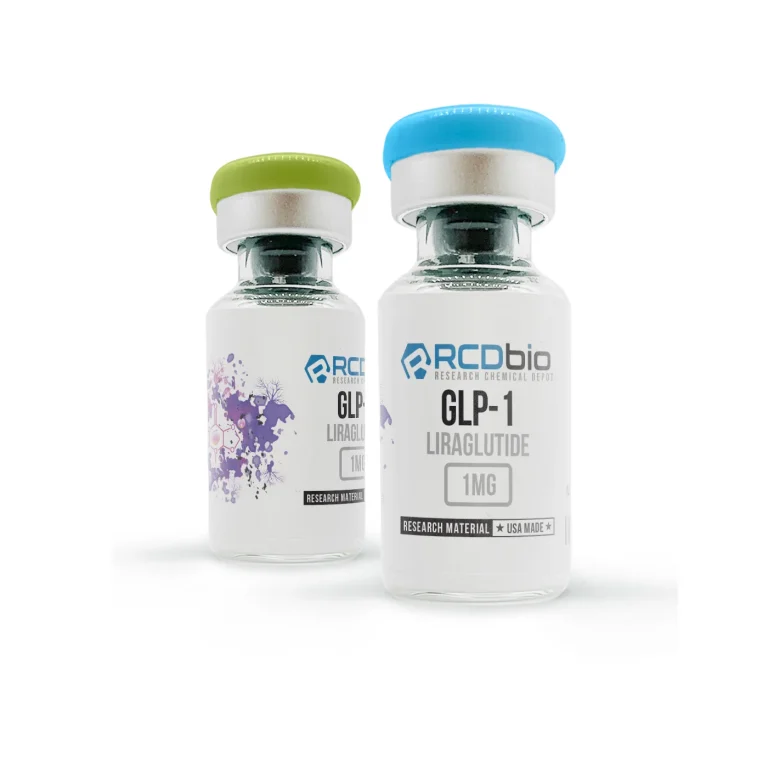
Description
What is Liraglutide?
Liraglutide (NN2211) is a synthetic once-daily GLP-1 receptor agonist with 97% amino acid sequence homology to endogenous human GLP-1(7-37), developed by Novo Nordisk as the second-generation GLP-1R agonist following exenatide (Byetta, 2005). Its sequence is based on human GLP-1(7-37) with two structural modifications: substitution of arginine for lysine at position 34 (K34R) to prevent enzymatic degradation at this site and to provide an unobstructed acylation site at Lys26; and attachment of a C16 palmitic acid (palmitoyl) fatty acid chain to the epsilon-amino group of Lys26 via a glutamic acid spacer. The palmitoyl-Glu spacer conjugate non-covalently but avidly binds human serum albumin, extending liraglutide’s half-life to approximately 10–15 hours — enabling once-daily dosing.
Liraglutide received multiple FDA approvals: Victoza (liraglutide 1.2 or 1.8 mg SC) was FDA-approved on January 25, 2010, for type 2 diabetes management; Saxenda (liraglutide 3 mg SC) was FDA-approved on December 23, 2014, for chronic weight management in obese adults and adolescents; a generic liraglutide injection received FDA approval on December 23, 2024, for type 2 diabetes only. Liraglutide represents the first GLP-1R agonist to demonstrate cardiovascular outcome benefit in a prospective dedicated CVOT trial (LEADER, 2016), reducing MACE by 13% (HR 0.87) in adults with type 2 diabetes and established cardiovascular disease.
As the first long-acting, once-daily GLP-1R agonist to achieve widespread clinical use — preceding semaglutide by seven years — liraglutide serves as the primary historical reference compound for GLP-1R agonist pharmacology, against which all subsequent GLP-1R agonists (semaglutide, tirzepatide, retatrutide, survodutide) have been compared. Research-grade Liraglutide from RCDbio is not Victoza, Saxenda, or any approved formulation. It is not a dietary supplement and is not intended for human consumption or self-administration. All RCDbio research compounds are supplied strictly for laboratory and research purposes only.
Chemical Properties
| Property | Detail |
| Product Type | Synthetic Long-Acting GLP-1 Receptor Agonist (Palmitoyl Fatty Acid Acylated GLP-1 Analogue) |
| Product Name | Liraglutide (GLP-1) |
| Application | Scientific / Research Use Only |
| CAS Number | 204656-20-2 |
| Molar Mass | 3751.262 g/mol |
| Chemical Formula | C172H265N43O51 |
| PubChem CID | 16134956 |
| IUPAC Name | Full canonical IUPAC at PubChem CID 16134956; 31-residue GLP-1(7-37) backbone with K34R substitution and palmitoyl-Glu spacer at Lys26 |
| Structural Basis | GLP-1(7-37) with 97% homology to human GLP-1; K34R substitution; C16 palmitic acid via glutamic acid spacer at Lys26 epsilon-amine |
| Albumin Binding | Non-covalent but avid albumin binding via palmitoyl chain enables half-life extension; binds multiple sites on albumin |
| Receptor Target | GLP-1R (glucagon-like peptide-1 receptor; class B GPCR; Gαs-coupled); potent selective full agonist (EC50 61 pM) |
| Elimination Half-Life | 10–15 hours (clinical pharmacokinetics); enables once-daily dosing |
| FDA Approval Status | Multiple FDA approvals: Victoza (Jan 25, 2010; T2D); Saxenda (Dec 23, 2014; obesity); Generic liraglutide injection (Dec 23, 2024; T2D only). Research-grade Liraglutide from RCDbio is NOT any of these products and is not approved for human use. |
| Key Trials | LEADER (2016) — 13% MACE reduction vs placebo in T2D + CVD; SCALE (2015) — obesity weight management |
| Synonyms | NN2211; Victoza (pharmaceutical); Saxenda (pharmaceutical); GLP-1 agonist liraglutide |
| Physical Form | Lyophilized white to off-white powder |
| Solubility | Soluble in water; soluble in 0.9% NaCl saline and PBS |
| Storage (Lyophilized) | −20°C; sealed container; protected from light and moisture |
| Storage (Reconstituted) | 4°C; use within 48–72 hours; protect from light; avoid repeated freeze-thaw cycles |
| Purity | ≥98% (HPLC verified, independent third-party laboratory analysis) |
| WADA Status | Liraglutide is on the 2026 WADA Monitoring Program. GLP-1 receptor agonists are not currently on the Prohibited List but are under active surveillance with funded detection method development. Monitoring status may change on future list updates. Verify current status at GlobalDRO.com before any sport-adjacent research use. Pharmaceutical formulations may qualify for TUE under specific conditions; research-grade material is not eligible. Verify at GlobalDRO.com. |
How Does Liraglutide Work?
Liraglutide exerts its effects through selective, high-affinity full agonism at the GLP-1 receptor (GLP-1R), a class B GPCR coupling to multiple G protein and non-G protein pathways with established roles across pancreatic, cardiovascular, neurological, and hepatic tissue systems.
GLP-1R Gαs/cAMP/PKA Pathway — Glucose-Dependent Insulin Secretion
Liraglutide binds GLP-1R with an EC50 of 61 pM — approximately threefold greater binding affinity than endogenous GLP-1. Receptor activation initiates Gαs-coupled adenylyl cyclase stimulation, generating elevated intracellular cAMP and PKA activation in pancreatic beta cells. This cascade stimulates glucose-dependent insulin secretion (requiring co-elevation of blood glucose), simultaneously suppresses glucagon secretion from alpha cells, and slows gastric emptying — the incretin triplex responsible for the GLP-1R agonist class’s type 2 diabetes efficacy [Marso et al., 2016].
Hypothalamic Appetite Regulation
In hypothalamic and brainstem GLP-1R-expressing nuclei — arcuate nucleus, NTS, area postrema — liraglutide activates appetite-suppressive circuits, reducing food intake and increasing satiety. In animal studies, peripheral administration of liraglutide specifically activated GLP-1 receptors in the hypothalamus, increasing satiety signals and decreasing hunger signals, driving body weight reduction. The SCALE Obesity and Prediabetes trial (3,731 participants, liraglutide 3 mg, 56 weeks) demonstrated 8.4% mean body weight reduction versus 2.8% for placebo.
Cardiovascular Pathway Effects — LEADER Trial
In LEADER (9,340 T2D participants; median 3.8 years), liraglutide 1.8 mg daily produced 13% reduction in MACE composite (HR 0.87; 95% CI 0.78–0.97; p=0.01). Cardiovascular effects include direct anti-inflammatory signalling in vascular tissue, endothelial function improvement, blood pressure reduction, and anti-atherosclerotic mechanisms — proposed as GLP-1R-mediated effects on cardiac and vascular tissue beyond glycaemic control [Marso et al., 2016].
Albumin Binding, DPP-4 Resistance, and Pharmacokinetics
Liraglutide’s protracted pharmacokinetic profile arises from three mechanisms: (1) self-association forming heptameric/octameric aggregates at the injection site, slowing absorption; (2) albumin binding via the palmitoyl chain, reducing renal filtration and proteolytic exposure; and (3) DPP-4 resistance at both the N-terminal His-Aib equivalent position and through steric protection from the fatty acid chain — together producing the 10–15 hour half-life enabling once-daily dosing.
Key Research Findings
In preclinical, in vitro, and clinical research contexts, liraglutide has been associated with the following observations:
- LEADER cardiovascular outcomes: 13% MACE reduction (HR 0.87; p=0.01) in 9,340 T2D patients with established CVD over a median of 3.8 years; supported cardiovascular indication expansion [Marso et al., 2016].
- SCALE obesity trial: 8.4% mean body weight reduction at 56 weeks with liraglutide 3 mg versus 2.8% placebo in non-diabetic obesity; 63.2% achieved ≥5% weight loss [Pi-Sunyer et al., 2015].
- Beta cell protection: Liraglutide is associated with reduced beta cell apoptosis, increased beta cell mass, and preserved insulin secretory function in rodent T2D model preparations through GLP-1R-mediated PDX-1 and Nkx6.1 upregulation.
- Neuroprotection: In rodent Alzheimer’s disease model preparations, liraglutide reduced amyloid-beta plaques, decreased neuroinflammation, and improved cognitive performance — generating research interest in GLP-1R agonism for neurodegenerative disease pathway research [McClean et al., 2011].
- NASH/hepatic fat: GLP-1R agonism associated with hepatic fat reduction in NASH model preparations and clinical populations, through direct hepatic GLP-1R effects and indirect weight-loss-mediated mechanisms.
Clinical findings relate to pharmaceutical Victoza/Saxenda formulations at defined doses in approved clinical protocols. Research-grade Liraglutide is not these products. These observations do not constitute evidence of safety or efficacy for research-grade material.
What are the Potential Research Applications?
GLP-1R Pharmacology — Foundational Reference Compound Liraglutide is employed as the established once-daily GLP-1R agonist reference compound in receptor binding assays, cAMP accumulation studies, and biased agonism characterisation at GLP-1R. As the first widely adopted long-acting GLP-1R agonist with extensive published pharmacology, it provides the pharmacological baseline against which semaglutide, tirzepatide, and next-generation multi-receptor agonists are benchmarked.
Incretin Biology and Beta Cell Research. In isolated islet and beta cell preparations, liraglutide is employed to characterise glucose-dependent insulin secretion dynamics, beta cell survival signalling (PDX-1, Nkx6.1, GLP-1R-mediated anti-apoptotic pathways), and the relationship between GLP-1R activation and beta cell mass in preclinical T2D models.
Obesity and Body Weight Regulation Research. In rodent diet-induced obesity models, liraglutide is employed to characterise hypothalamic appetite circuit modulation, food intake reduction mechanisms, and energy balance changes — research examining the relative contributions of direct hypothalamic GLP-1R activation versus peripheral satiety signalling to body weight outcomes.
Neurodegenerative Disease Pathway Research In rodent Alzheimer’s disease models, liraglutide is investigated for amyloid-beta plaque reduction, neuroinflammation modulation, and cognitive function restoration — research examining whether GLP-1R agonism accesses neuroprotective pathways relevant to neurodegeneration.
Comparative GLP-1 Agonist Pharmacology Liraglutide (C16 palmitoyl; once-daily; EC50 61 pM; monoagonist) is employed alongside semaglutide (C18 fatty diacid; once-weekly; EC50 ~3 pM; monoagonist) and tirzepatide (dual GLP-1R/GIPR) in comparative pharmacology studies characterising how fatty acid chain length, albumin binding affinity, and receptor co-agonism alter incretin pharmacokinetics and downstream pathway outcomes.
What are the Potential Side Effects?
Observations from Victoza and Saxenda clinical trial data and post-marketing surveillance.
- Gastrointestinal adverse events (nausea, vomiting, diarrhoea, constipation) — most common class effects; dose-dependent; predominantly mild-to-moderate; more frequent than semaglutide due to once-daily vs once-weekly dosing regimen
- Thyroid C-cell adenomas and carcinomas in rodent 2-year carcinogenicity studies; clinical relevance in humans not established; boxed warning for MTC/MEN2 history in pharmaceutical labelling
- Pancreatitis risk — class association; patients with a pancreatitis history excluded from trials
- Gallbladder disease at higher rates than placebo in obesity clinical trial populations
- Transient injection site reactions
- No human safety data established for research-grade liraglutide outside approved clinical trial contexts
Risk & Handling
Handling Precautions
Research-grade Liraglutide should only be handled by trained laboratory personnel. Appropriate PPE: nitrile gloves, lab coat, eye protection. Use in a laminar flow cabinet. Avoid aerosol generation. The palmitoyl fatty acid contributes an amphiphilic character — avoid surfaces that adsorb lipophilic compounds.
Exposure Risks
Risk Tier: MODERATE
Liraglutide is a potent GLP-1R agonist with 10–15 hour half-life. Accidental systemic exposure could engage GLP-1R in pancreatic, hypothalamic, and gastrointestinal tissues, producing prolonged glucose-dependent insulin secretion effects, nausea, and appetite suppression. The 10–15-hour half-life means effects from accidental exposure would be protracted. No human safety data for research-grade material.
Storage
- Lyophilized: −20°C; sealed; light-protected; desiccated
- Reconstituted: 4°C; 48–72 hours; protect from light; avoid freeze-thaw cycles
- Palmitoyl chain: amphiphilic character; avoid adsorptive surfaces
Frequently Asked Questions
Q: What is Liraglutide, and how does it differ from Semaglutide? A: Liraglutide (NN2211; MW 3751.262 g/mol) is a once-daily GLP-1R monoagonist with C16 palmitoyl-Glu albumin binding and 10–15 hour half-life. Semaglutide is a once-weekly GLP-1R monoagonist with C18 fatty diacid-OEG-OEG-γGlu albumin binding and ~1-week half-life. Semaglutide has approximately threefold lower EC50 (~3 pM vs 61 pM), stronger albumin binding, and greater weight loss in head-to-head comparisons. Both have multiple FDA approvals; research-grade preparations of each from RCDbio are not pharmaceutical products and are not approved for human use.
Q: What are Liraglutide’s FDA-approved formulations and indications? A: Victoza (1.2/1.8 mg SC) — January 25, 2010 (T2D); Saxenda (3 mg SC) — December 23, 2014 (chronic weight management); Generic liraglutide injection — December 23, 2024 (T2D only). Research-grade Liraglutide from RCDbio is not any of these products.
Q: What were the LEADER trial key findings? A: LEADER (Liraglutide Effect and Action in Diabetes: Evaluation of Cardiovascular Outcome Results) enrolled 9,340 adults with T2D and established cardiovascular disease. Over a median 3.8 years, liraglutide 1.8 mg daily reduced the MACE composite (CV death, non-fatal MI, non-fatal stroke) by 13% versus placebo (HR 0.87; 95% CI 0.78–0.97; p=0.01). These data related to the pharmaceutical Victoza formulation [Marso et al., 2016].
Q: How does liraglutide compare to other GLP-1R agonists for research use? A: Liraglutide offers the largest published research and clinical trial literature base (>10 years of post-approval data), once-daily dosing in clinical studies, and established safety/efficacy across T2D and obesity populations. Semaglutide has stronger GLP-1R affinity, once-weekly dosing, and more recent head-to-head superiority data. For comparative incretin pharmacology research, liraglutide serves as the foundational reference compound; semaglutide as the current clinical standard.
Q: How should research-grade Liraglutide be stored? A: Lyophilized Liraglutide should be stored at −20°C in a sealed, light-protected container with desiccant. Once reconstituted, store at 4°C and use within 48–72 hours. Protect from light and avoid repeated freeze-thaw cycles. The palmitoyl fatty chain may adsorb to glass surfaces at low concentrations — consider using polypropylene containers for working solutions.
Related Research Compounds
- Semaglutide — The current clinical standard, once-weekly GLP-1R monoagonist; primary comparative reference for evaluating how half-life extension and increased affinity alter GLP-1R pharmacology and downstream metabolic outcomes relative to liraglutide.
- Tirzepatide — Dual GLP-1R/GIPR agonist (twincretin); employed alongside liraglutide and semaglutide to characterise how GIPR co-agonism modifies the GLP-1R pharmacology profile.
- Retatrutide — Triple GLP-1R/GIPR/GCGR agonist; represents the next generation multi-receptor extension of the liraglutide/semaglutide GLP-1R pharmacological lineage.
All products listed are for laboratory and research purposes only.
References
- Marso, S. P., Daniels, G. H., Brown-Frandsen, K., Kristensen, P., Mann, J. F. E., Nauck, M. A., et al. (2016). Liraglutide and Cardiovascular Outcomes in Type 2 Diabetes. New England Journal of Medicine, 375(4), 311–322. https://pubmed.ncbi.nlm.nih.gov/27295427/
- Pi-Sunyer, X., Astrup, A., Fujioka, K., Greenway, F., Halpern, A., Krempf, M., et al. (2015). A Randomised, Controlled Trial of 3.0 mg of Liraglutide in Weight Management. New England Journal of Medicine, 373(1), 11–22. https://pubmed.ncbi.nlm.nih.gov/26132939/
- Marre, M., Shaw, J., Brändle, M., Bebakar, W. M. W., Kamaruddin, N. A., Strand, J., et al. (2009). Liraglutide, a once-daily human GLP-1 analogue, added to a sulphonylurea over 26 weeks, produces greater improvements in glycaemic and weight control compared with adding rosiglitazone or placebo. Diabetic Medicine, 26(3), 268–278. https://pubmed.ncbi.nlm.nih.gov/19317822/
- McClean, P. L., Parthsarathy, V., Faivre, E., & Hölscher, C. (2011). The diabetes drug liraglutide prevents degenerative processes in a mouse model of Alzheimer’s disease. Journal of Neuroscience, 31(17), 6587–6594. https://pubmed.ncbi.nlm.nih.gov/21525301/
Disclaimer
Liraglutide is exclusively for laboratory research purposes. RCDbio products are not intended to diagnose, prevent, treat, or cure any disease or medical condition. Research-grade Liraglutide is not Victoza, Saxenda, or generic liraglutide injection, and is not equivalent to or interchangeable with any approved pharmaceutical formulation.
The Food and Drug Administration has approved liraglutide in multiple formulations. Research-grade Liraglutide from RCDbio is not an approved product. Researchers must comply with all applicable laws and regulations. By purchasing, you agree to our Terms and Conditions. RCDbio reserves the right to refuse sales to unauthorized individuals.
ATTENTION: All RCDbio products are strictly for LABORATORY AND RESEARCH PURPOSES ONLY. They are not intended for human consumption, veterinary use, or any other non-research application. For queries, complaints, or support, contact support@legacy.rcdbio.co
Reviews
There are no reviews yet