

Description
What is Sermorelin?
Sermorelin (INN; brand names Geref, Gerel), also known as GRF(1-29) or GHRH(1-29), is a synthetic 29-amino acid peptide corresponding to the N-terminal 1–29 fragment of endogenous human growth hormone-releasing hormone (GHRH). It is the shortest fully functional fragment of GHRH — retaining the full receptor binding affinity and GH-stimulating capacity of the native 44-amino acid GHRH molecule while containing fewer residues than any known biologically active GHRH fragment. Its sequence (H-Tyr-Ala-Asp-Ala-Ile-Phe-Thr-Asn-Ser-Tyr-Arg-Lys-Val-Leu-Gly-Gln-Leu-Ser-Ala-Arg-Lys-Leu-Leu-Gln-Asp-Ile-Met-Ser-Arg-NH2) is the unmodified native GHRH(1-29) sequence with a C-terminal amide for stability.
Sermorelin acetate was the first GHRH analogue to receive FDA approval, developed for two clinical uses: as a diagnostic agent for assessing pituitary GH secretory capacity in growth hormone deficiency and as a therapeutic agent for treating GH deficiency in children. The pharmaceutical product Geref (Serono Laboratories) was withdrawn from the United States market by the manufacturer in November 2002, not due to safety concerns but due to commercial discontinuation. Sermorelin is listed as a “discontinued drug product” by the FDA. It is not currently marketed as a pharmaceutical product in the United States, though compounded sermorelin continues to be prepared by compounding pharmacies.
Importantly, Sermorelin has no DPP-4-resistant modifications — unlike Modified GRF 1-29 (CJC-1295 No DAC), which incorporates four substitutions for enhanced protease resistance. The native GHRH(1-29) sequence of Sermorelin is therefore susceptible to DPP-4 cleavage at the Tyr1-Ala2 N-terminal bond in plasma, resulting in a very short plasma half-life of approximately 10 minutes. This rapid clearance produces sharp, physiologically timed GH pulses when administered immediately before the natural GH pulse window in preclinical research protocols — a kinetic profile distinct from DPP-4-resistant Mod GRF 1-29’s 30-minute activity duration.
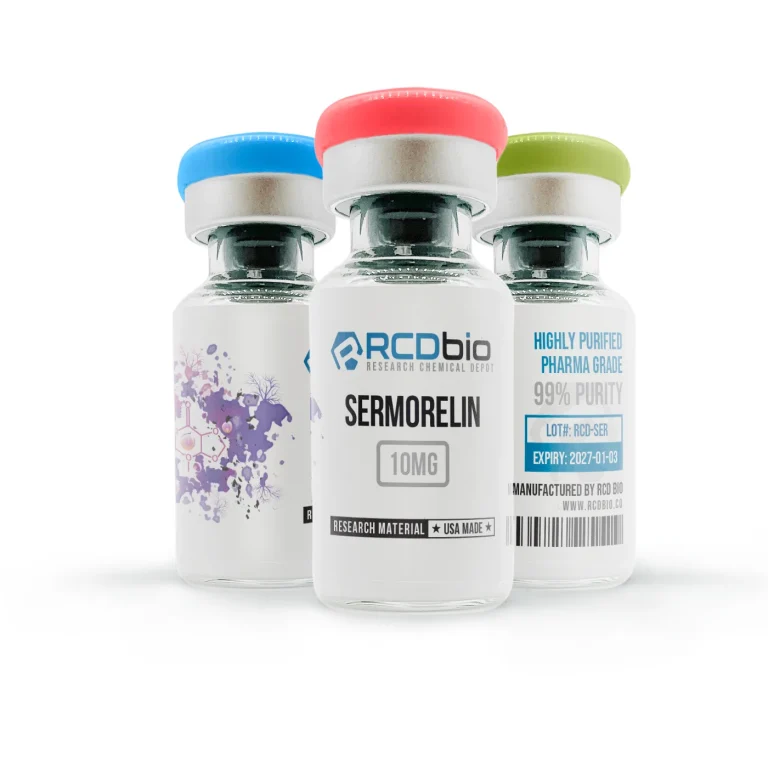
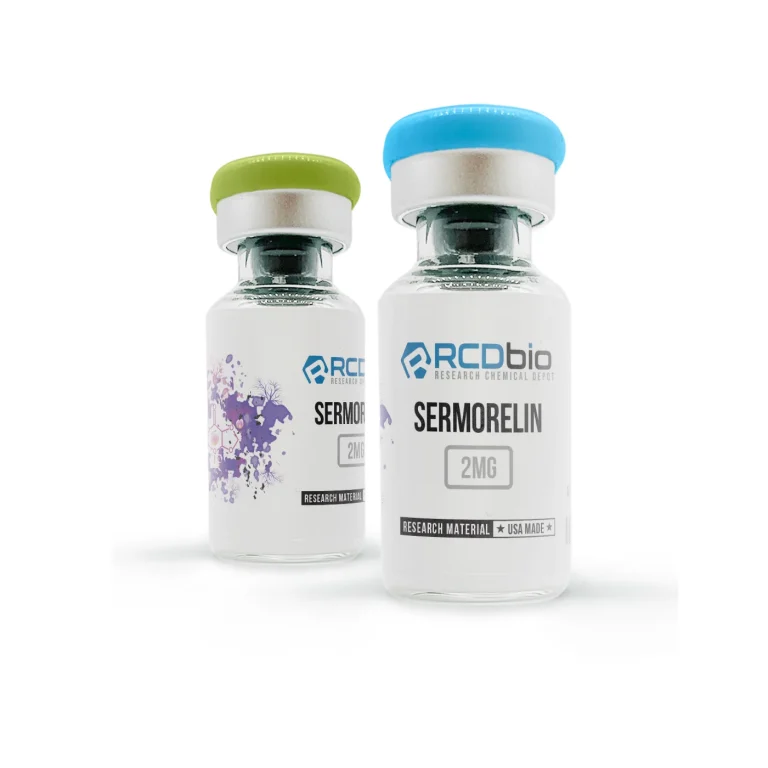
Research-grade Sermorelin from RCDbio is not a pharmaceutical product and is not approved for any use outside laboratory research contexts. It is not a dietary supplement and is not intended for human consumption or self-administration. All RCDbio research compounds are supplied strictly for laboratory and research purposes only.
Chemical Properties
| Property | Detail |
| Product Type | Synthetic 29-Amino Acid GHRH(1-29) Fragment / Shortest Fully Functional GHRH Analogue |
| Product Name | Sermorelin |
| Application | Scientific / Research Use Only |
| CAS Number | 86168-78-7 |
| Molar Mass | 3357.93 g/mol |
| Chemical Formula | C149H246N44O42S |
| PubChem CID | 16132413 |
| IUPAC Name | L-Tyrosyl-L-alanyl-L-α-aspartyl-L-alanyl-L-isoleucyl-L-phenylalanyl-L-threonyl-L-asparaginyl-L-seryl-L-tyrosyl-L-arginyl-L-lysyl-L-valyl-L-leucylglycyl-L-glutaminyl-L-leucyl-L-seryl-L-alanyl-L-arginyl-L-lysyl-L-leucyl-L-leucyl-L-glutaminyl-L-α-aspartyl-L-isoleucyl-L-methionyl-L-seryl-L-argininamide |
| Amino Acid Count | 29 amino acids; C-terminal amide; unmodified native GHRH(1-29) sequence — no DPP-4-resistant substitutions |
| Key Distinction from Mod GRF 1-29 | Sermorelin = unmodified GHRH(1-29) with ~10-min half-life. Mod GRF 1-29 = same backbone with D-Ala2, Ala8, Ala15, Leu27 for DPP-4 resistance and ~30-min half-life. |
| Elimination Half-Life | ~10 minutes (DPP-4 susceptible at Tyr1-Ala2; rapid plasma clearance) |
| FDA Status | Discontinued (Geref, Serono — withdrawn from US market November 2002; commercial discontinuation, not safety recall) |
| Synonyms | GRF(1-29); GHRH(1-29) amide; Geref (discontinued pharmaceutical); hGRF(1-29)-NH2; Somatotropin Releasing Hormone 1-29 amide |
| Physical Form | Lyophilized white to off-white powder |
| Solubility | Soluble in sterile water and PBS; reconstitute in 0.9% NaCl or sterile water |
| Storage (Lyophilized) | −20°C; sealed container; protected from light and moisture |
| Storage (Reconstituted) | 4°C; use within 48–72 hours; avoid repeated freeze-thaw cycles |
| Purity | ≥98% (HPLC verified, independent third-party laboratory analysis) |
| WADA Status | Sermorelin is explicitly prohibited at all times under S2.2.4 (Growth Hormone Releasing Factors – GHRH and its analogues, with sermorelin explicitly named) of the 2026 WADA Prohibited List. Verify at GlobalDRO.com. |
How Does Sermorelin Work?
Sermorelin binds the GHRH receptor (GHRHR) on anterior pituitary somatotroph cells with the same pharmacological mechanism as endogenous GHRH and Tesamorelin, but with a much shorter in vivo activity duration due to rapid DPP-4-mediated N-terminal cleavage.
GHRHR Gαs/cAMP/PKA Pathway
Sermorelin binds GHRHR — a Gαs-coupled class B GPCR — with high affinity, initiating adenylyl cyclase activation, intracellular cAMP elevation, and downstream PKA activation in somatotroph cells. PKA activation promotes GH1 gene transcription and pulsatile GH granule exocytosis. In vitro studies using anterior pituitary cultures demonstrate a dose-dependent increase in intracellular cAMP signalling and GH release following sermorelin exposure — confirming direct GHRHR activation as the primary mechanism.
Pulsatile GH Release and Physiological Feedback Preservation
Sermorelin’s ~10-minute half-life produces sharp, brief GH pulses that preserve the natural hypothalamic-pituitary feedback regulation through IGF-1-mediated negative feedback and somatostatin inhibition. This is mechanistically distinct from CJC-1295 with DAC (5.8–8.1 day sustained GH elevation) and from exogenous GH replacement (which suppresses endogenous pulsatility). In preclinical preparations, sermorelin produces peak GH elevations approximately 15–30 minutes after subcutaneous administration, with return to baseline within 1–2 hours.
GH/IGF-1 Axis Downstream Effects
GH released by sermorelin stimulates hepatic IGF-1 production, with dose-dependent IGF-1 increases observed in preclinical rodent models and clinical GHD populations. In GH-deficient subjects, sermorelin increases peak GH levels by approximately 2–4 fold in preclinical rodent preparations and clinical diagnostic protocols, supporting restoration of neuroendocrine GH axis function. Downstream IGF-1 elevation produces anabolic, metabolic, and trophic effects in muscle, bone, and hepatic tissue preparations consistent with GH axis activation.
DPP-4 Susceptibility — Key Pharmacokinetic Feature
Unlike Modified GRF 1-29, CJC-1295, and Tesamorelin, Sermorelin retains the native Tyr1-Ala2 N-terminal DPP-4 cleavage site. DPP-4 cleaves the Tyr1-Ala2 bond in plasma within minutes of administration, inactivating Sermorelin rapidly. This rapid clearance is the mechanistic basis for Sermorelin’s very short half-life and, in research contexts, makes it useful as the native GHRH(1-29) reference when studying the pharmacokinetic consequences of DPP-4 resistance modifications in the Modified GRF 1-29 / CJC-1295 analogue series.
Key Research Findings
In preclinical and clinical research contexts, Sermorelin has been associated with the following observations:
- GH release in rodent models: Sermorelin (1 μg/kg IV) increased serum GH levels by approximately 17% in rat preparations at 15 minutes versus saline control in preclinical pharmacology studies.
- Diagnostic GH stimulation: Sermorelin IV administration (1–2 μg/kg) has been used as a GHRH stimulation test in clinical settings to assess pituitary GH secretory capacity; peak GH responses 2–4 fold above baseline characterised normal vs deficient responses.
- GH deficiency treatment in children: Pharmaceutical Geref (sermorelin) demonstrated GH axis restoration and linear growth improvement in GH-deficient children in clinical trials supporting original FDA approval; Geref was withdrawn from the market in November 2002 for commercial reasons, not efficacy or safety concerns.
- Comparative half-life studies: Sermorelin (~10 min) vs Modified GRF 1-29 (~30 min) vs CJC-1295 with DAC (5.8–8.1 days) provide the reference series for studying how DPP-4 resistance and albumin binding progressively extend GHRH analogue activity duration.
- VEGF and FAK signalling: Sermorelin at 0.1–1 μM in lung carcinoid cell preparations increased VEGF secretion and FAK phosphorylation — observations relevant to research on GHRHR expression in non-pituitary tissues.
All findings listed above are derived from preclinical in vitro and in vivo data and clinical diagnostic and therapeutic use of the discontinued pharmaceutical formulation. Research-grade Sermorelin is not a pharmaceutical product. These observations do not constitute evidence of safety or efficacy for research-grade material.
What are the Potential Research Applications?
GHRHR Reference Pharmacology Studies Sermorelin is employed as the native unmodified GHRH(1-29) reference agonist in GHRHR binding assays, cAMP accumulation studies, and somatotroph GH secretion protocols. As the unprotected parent compound for the GHRH analogue series, it provides the pharmacokinetic and pharmacodynamic baseline against which modified analogues (Mod GRF 1-29, CJC-1295, Tesamorelin) are compared.
DPP-4 Susceptibility and Protease Resistance SAR Studies Sermorelin’s rapid DPP-4-mediated inactivation makes it the reference compound for studying how N-terminal substitutions (D-Ala2 in Mod GRF 1-29; trans-3-hexenoic acid in Tesamorelin) alter DPP-4 kinetics, in vitro plasma stability, and in vivo activity duration. In vitro plasma stability assays comparing Sermorelin against Modified GRF 1-29 directly quantify the half-life extension from the D-Ala2 substitution alone.
GH Axis Diagnostic Research Tools In preclinical pituitary function assessment models, sermorelin is employed as a pharmacological GHRHR stimulation tool, analogous to its diagnostic use in the now-discontinued pharmaceutical Geref. Research employs sermorelin as a controlled GHRHR stimulus to characterise somatotroph secretory capacity, GHRH-GH-IGF-1 axis feedback loop dynamics, and pituitary somatotroph number and responsiveness in preclinical animal models.
Historical GHRH Analogue Research Context As the first GHRH analogue studied in clinical pharmacology and the compound whose discovery preceded Modified GRF 1-29, CJC-1295, and Tesamorelin, Sermorelin provides the historical pharmacological reference for the entire GHRH analogue research field.
What are the Potential Side Effects?
Observations from clinical use of the discontinued pharmaceutical Geref formulation.
- Injection site reactions (redness, swelling, pain) — most commonly reported adverse events in the Geref clinical programme
- Transient GH-related effects (water retention, arthralgias) at therapeutic doses in clinical populations
- Headache is reported at low frequency in clinical populations
- Flushing is reported at low frequency
- No specific safety concerns that prompted pharmaceutical withdrawal — Geref was withdrawn in November 2002 for commercial reasons
- No human safety data established for research-grade Sermorelin outside approved clinical study contexts
Risk & Handling
Handling Precautions
Sermorelin should only be handled by trained laboratory personnel. Appropriate PPE: nitrile gloves, lab coat, eye protection. Use in a laminar flow cabinet. Avoid aerosol generation. The methionine at position 27 is susceptible to oxidative modification — minimise aerobic exposure.
Exposure Risks
Risk Tier: LOW–MODERATE
Sermorelin is a pharmacologically active GHRHR agonist. The ~10-minute half-life limits the duration of pharmacological effects from accidental exposure. Accidental systemic exposure may produce transient GH axis activation. No human safety data for research-grade material.
Storage
- Lyophilized: −20°C; sealed; light-protected; desiccated
- Reconstituted: 4°C; 48–72 hours; avoid freeze-thaw; Met27 oxidation risk
Frequently Asked Questions
Q: What is Sermorelin, and how does it differ from Modified GRF 1-29? A: Sermorelin (GRF 1-29; CAS 86168-78-7; MW 3357.93 g/mol) is the unmodified native GHRH(1-29) sequence with ~10-minute half-life due to DPP-4 susceptibility at the Tyr1-Ala2 N-terminal bond. Modified GRF 1-29 (CJC-1295 No DAC; CAS 863288-34-0; MW 3367.954 g/mol) has four amino acid substitutions (D-Ala2, Ala8, Ala15, Leu27) providing DPP-4 and protease resistance and extending half-life to ~30 minutes. Sermorelin is the unmodified reference; Mod GRF 1-29 is the protease-resistant analogue. Neither is FDA-approved for current human use.
Q: Why was Sermorelin (Geref) withdrawn from the US market? A: Geref (sermorelin) was withdrawn from the United States market by Serono Laboratories in November 2002 for commercial reasons, not due to safety, efficacy, or regulatory concerns. The FDA lists it as a “discontinued drug product.” Compounded sermorelin continues to be prepared by compounding pharmacies in the US.
Q: What makes Sermorelin the shortest fully functional GHRH fragment? A: The first 29 amino acids of GHRH (residues 1-29) contain the complete receptor binding domain necessary for full GHRHR activation and GH release. GHRH(1-28) and shorter fragments show progressively reduced receptor binding and GH-stimulating capacity. GHRH(1-29) as the minimum fully active sequence was established in receptor pharmacology studies comparing truncated GHRH fragments, making Sermorelin the pharmacological minimum of the GHRH sequence.
Q: What is the WADA status of Sermorelin? A: Sermorelin is explicitly prohibited under S2.2.4 (GHRH and its analogues, with sermorelin named) of the 2026 WADA Prohibited List. Verify at GlobalDRO.com.
Q: How should Sermorelin be stored? A: Lyophilized Sermorelin should be stored at −20°C in a sealed, light-protected container with desiccant. Once reconstituted, store at 4°C and use within 48–72 hours. The methionine residue at position 27 is susceptible to oxidative modification — minimise oxygen exposure and avoid repeated freeze-thaw cycles.
Related Research Compounds
- CJC-1295 No DAC + Ipamorelin Blend — The Modified GRF 1-29 (DPP-4-resistant Sermorelin analogue) + selective GHS-R1a agonist blend; the pharmacokinetically optimised pulsatile GH dual-pathway research preparation.
- Tesamorelin — FDA-approved GHRH analogue with full 44-AA sequence and trans-3-hexenoic acid N-terminal modification; the clinically validated GHRH reference standard against which Sermorelin’s shorter sequence and unprotected profile are compared.
All products listed are for laboratory and research purposes only.
References
- Prakash, A., & Goa, K. L. (1999). Sermorelin: A Review of its Use in the Diagnosis and Treatment of Children with Idiopathic Growth Hormone Deficiency. BioDrugs, 12(2), 139–157. https://pubmed.ncbi.nlm.nih.gov/18031173/
- Thorner, M. O., Reschke, J., Chitwood, J., Rogol, A. D., Furlanetto, R., Rivier, J., Vale, W., & Blizzard, R. M. (1985). Acceleration of growth in two children treated with human growth hormone-releasing factor. New England Journal of Medicine, 312(1), 4–9. https://pubmed.ncbi.nlm.nih.gov/3905327/
- Walker, R. F. (2006). Sermorelin: a better approach to management of adult-onset growth hormone insufficiency? Clinical Interventions in Ageing, 1(4), 307–308. https://pubmed.ncbi.nlm.nih.gov/18046879/
- Izdebski, J., Pinski, J., Horvath, J. E., Halmos, G., Groot, K., & Schally, A. V. (1995). Synthesis and biological evaluation of superactive agonists of growth hormone-releasing hormone. Proceedings of the National Academy of Sciences USA, 92(10), 4872–4876. https://pubmed.ncbi.nlm.nih.gov/7539140/
Disclaimer
Sermorelin is exclusively for laboratory research purposes. RCDbio products are not intended to diagnose, prevent, treat, or cure any disease or medical condition.
The Food and Drug Administration has listed Sermorelin (Geref) as a discontinued drug product. Research-grade Sermorelin from RCDbio is not a pharmaceutical product and is not approved or intended for any human use. Researchers must comply with all applicable laws and regulations. By purchasing, you agree to our Terms and Conditions. RCDbio reserves the right to refuse sales to unauthorized individuals.
ATTENTION: All RCDbio products are strictly for LABORATORY AND RESEARCH PURPOSES ONLY. They are not intended for human consumption, veterinary use, or any other non-research application. For queries, complaints, or support, contact support@legacy.rcdbio.co
Reviews
There are no reviews yet