

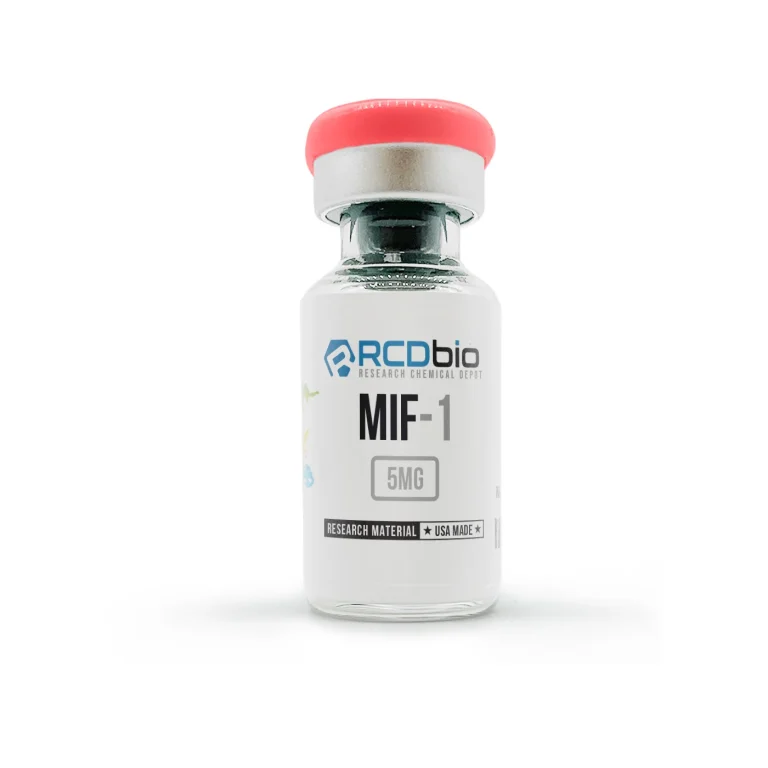
Description
What is MIF-1?
MIF-1, formally designated melanocyte-stimulating hormone release-inhibiting factor 1 (melanostatin), is an endogenous linear tripeptide with the amino acid sequence Pro-Leu-Gly-NH2 (L-prolyl-L-leucylglycinamide). It is derived from proteolytic cleavage of the C-terminal region of oxytocin, a cyclic nonapeptide hormone, by specific brain peptidases — notably a Mn²⁺-stimulated aminopeptidase characterized in bovine cerebral homogenates and mitochondrial fractions of rat brain tissue. Despite sharing three residues with its oxytocin precursor, MIF-1 has a pharmacological profile distinct from oxytocin: it does not bind with significant affinity to the oxytocin receptor (OXTR) and instead acts primarily at dopaminergic and opioid receptor systems in the central nervous system.
In preclinical research settings, MIF-1 has been investigated as a positive allosteric modulator of the dopamine D2 receptor (D2R) and D4 receptor (D4R) subtypes, as an opioid receptor antagonist with documented activity against morphine-induced catalepsy in rodent models, and as a potentiator of melatonin activity in neuroendocrine systems. The compound crosses the blood-brain barrier in rodent models with a degree of resistance to plasma protease degradation attributable to its C-terminal primary amide modification. It has been identified in bovine hypothalamus and human parietal cortex tissue, establishing its status as an endogenous neuropeptide rather than a purely synthetic research tool.
Synthetic MIF-1 supplied by RCDbio is intended strictly for laboratory and research purposes. It is not approved by the Food and Drug Administration for use in this research-grade, non-pharmaceutical form. It is not a dietary supplement and is not intended for human consumption, veterinary use, or therapeutic self-administration.
Chemical Properties
| Property | Detail |
| Product Type | Synthetic Endogenous Tripeptide Neuropeptide |
| Product Name | MIF-1 (Melanostatin; Melanocyte-Stimulating Hormone Release-Inhibiting Factor 1) |
| Application | Scientific / Research Use Only |
| CAS Number | 2002-44-0 (free base); 35240-69-8 (TFA salt) |
| Molar Mass | 284.35 g/mol (free base, C₁₃H₂₄N₄O₃); 398.35 g/mol (TFA salt, C₁₃H₂₄N₄O₃ · C₂HF₃O₂) |
| Chemical Formula | C₁₃H₂₄N₄O₃ (free base); C₁₃H₂₄N₄O₃ · C₂HF₃O₂ (TFA salt) |
| Sequence | H-Pro-Leu-Gly-NH₂ (L-Pro–L-Leu–Gly-NH₂; C-terminal primary amide) |
| IUPAC Name | (2S)-N-[(2S)-1-[(2-amino-2-oxoethyl)amino]-4-methyl-1-oxopentan-2-yl]pyrrolidine-2-carboxamide |
| Synonyms | Melanostatin; MIF-I; Pro-Leu-Gly-NH2; PLG-NH2; MSH-R-IF; Prolyl-leucyl-glycinamide; L-Prolyl-L-leucylglycinamide |
| Physical Form | Lyophilized white to off-white powder |
| Solubility | Soluble in water and aqueous buffer systems (PBS, 0.9% NaCl) at physiological pH; does not contain disulfide bonds; compatible with standard reducing agent-containing buffers |
| Storage (Lyophilized) | Store at -20°C in a sealed, light-protected container with desiccant; protect from moisture and temperature fluctuations |
| Storage (Reconstituted) | Store at 4°C; use within 48–72 hours of reconstitution; avoid repeated freeze-thaw cycles; discard if turbid, discolored, or particulate |
| PubChem CID | 92910 (free base); 137700208 (TFA salt) |
| Purity | ≥98% (HPLC verified, independent third-party laboratory analysis; COA available per batch) |
| WADA Status | MIF-1 does not appear by name on the current WADA Prohibited List. As a peptide with neuromodulatory activity, researchers engaged in sport-adjacent studies should consider its classification under the S0 Non-Approved Substances category, which encompasses any pharmacological substance not approved by a regulatory authority for human use. Researchers should verify the current status at GlobalDRO.com before use. |
How Does MIF-1 Work?
MIF-1 is a multimodal neuropeptide that interacts with at least three distinct receptor systems in the central nervous system: the dopamine D2/D4 receptor family, opioid receptors, and the melatonin system. Its primary pharmacological identity in the current literature is as a positive allosteric modulator of dopamine D2 receptors, though its opioid antagonist properties and melatonin-potentiating effects have each been characterized in separate preclinical systems.
Positive Allosteric Modulation of Dopamine D2 and D4 Receptors
In radioligand binding assays employing rat striatal membrane preparations, MIF-1 has been shown to increase the maximal binding of D2R agonists — including tritiated N-propylapomorphine ([³H]-NPA) and [³H]-spiroperidol — without competing directly at the orthosteric dopamine binding site. This pharmacological profile is consistent with positive allosteric modulation (PAM), in which the modulator binds at a topographically distinct site and induces conformational changes in the receptor that increase agonist affinity or efficacy. Functional cAMP inhibition assays in D2R-expressing cell preparations have corroborated PAM activity, with MIF-1 producing a bell-shaped dose-response curve consistent with allosteric cooperativity at concentrations in the picomolar-to-nanomolar range. PAM activity has also been characterized at the dopamine D4 receptor subtype in in vitro preparations, though mechanistic data at D4R are less extensively characterized than at D2R.
Opioid Receptor Antagonism
MIF-1 has been characterized as a functional antagonist of opioid receptor-mediated responses in rodent in vivo models. In preclinical studies examining morphine-induced catalepsy in rodent subjects, systemic administration of MIF-1 produced dose-dependent attenuation of cataleptic behavior. Opiate receptor binding studies in isolated membrane preparations have shown that MIF-1 reduces opioid agonist binding at mu-opioid receptors, though the precise binding mode — competitive vs. functional antagonism through allosteric mechanisms — has not been fully resolved in the literature. The opioid antagonist activity of MIF-1 is mechanistically distinct from classical opioid receptor antagonists such as naloxone, which act at the orthosteric binding site.
Melatonin Activity Potentiation
In neuroendocrine and in vitro model systems, MIF-1 has been observed to potentiate the activity of melatonin, the principal hormone of the pineal gland involved in circadian rhythm regulation. The mechanism underlying this potentiation has not been fully characterized at the receptor level but is hypothesized to involve modulation of melatonin receptor signaling or downstream intracellular pathways in pinealocyte-relevant cell systems. This interaction has been noted in the context of MIF-1’s broader neuromodulatory profile.
Blood-Brain Barrier Penetration
MIF-1 has been shown to cross the blood-brain barrier (BBB) directly in rodent in vivo models, a property that distinguishes it from larger neuropeptides that require active transport mechanisms. The C-terminal primary amide modification (Gly-NH₂) contributes to plasma stability by reducing susceptibility to carboxypeptidase cleavage, extending the functional half-life beyond that predicted from its tripeptide size alone. CNS access has been demonstrated following peripheral administration in rodent pharmacokinetic studies.
Key Research Findings
- D2R allosteric modulation: MIF-1 produced a significant increase in maximal [³H]-NPA binding at dopamine D2 receptors in rat striatal membrane preparations at concentrations as low as 0.01 nM, consistent with positive allosteric modulator activity. [Sampaio-Dias et al., 2019; PMID 31347842]
- Striatal D2 receptor ontogeny: Co-administration of MIF-1 (1.0 mg/kg/day, IP) in postnatal rat models fully attenuated spiroperidol-induced impairment of striatal D2 receptor development; [³H]-spiroperidol binding at 5 and 8 weeks was normalized to saline control levels. [Saleh & Kostrzewa, 1989; PMID 2568624]
- Opioid receptor antagonism: MIF-1 dose-dependently blocked morphine-induced catalepsy in rodent in vivo models; radioligand displacement studies in membrane preparations demonstrated reduced opioid agonist binding consistent with functional opioid receptor antagonism. [Dickinson & Slater, 1980; PMID 6117839]
- BBB penetration: MIF-1 crosses the blood-brain barrier by direct membrane transit in rodent models; plasma stability is enhanced relative to linear tripeptides without C-terminal amide modification, supporting CNS availability following peripheral dosing. [Bocheva et al., 2004]
- Tyr-MIF-1 precursor relationship: In mitochondrial fractions of rat brain, incubation of labeled Tyr-MIF-1 (Tyr-Pro-Leu-Gly-NH₂) yielded MIF-1 accumulation at more than three times the rate observed in whole brain homogenate, establishing mitochondrial enzymatic cleavage as a documented in situ pathway for MIF-1 generation. [Banks & Kastin, 1995; PMID 7891114]
All findings listed above are derived from preclinical or in vitro data. No conclusions regarding human therapeutic efficacy can be drawn from these observations. These findings do not constitute evidence of safety or efficacy in any human condition or organism.
What are the Potential Research Applications of MIF-1?
Dopamine D2 Receptor Pharmacology and Allosteric Modulation Studies
MIF-1 serves as the prototypical positive allosteric modulator scaffold for the dopamine D2 receptor in academic pharmacology research. It is used in radioligand binding assays — including [³H]-NPA and [³H]-spiroperidol displacement experiments — to characterize allosteric binding sites on D2R and to benchmark novel peptidomimetic analogs for PAM activity. Research groups have employed MIF-1 as a reference standard in functional cAMP assays and receptor cooperativity studies using D2R-transfected cell lines, enabling structure-activity relationship (SAR) analyses of the Pro-Leu-Gly pharmacophore. Its distinct mechanism from orthosteric dopaminergic ligands makes it a relevant tool for investigating D2R conformational states and biased signaling pathways in vitro.
Neuropeptide-Opioid Receptor Interaction Research
MIF-1’s characterized activity as a functional opioid receptor antagonist has been investigated in rodent preclinical models for understanding neuropeptide modulation of opioid signaling. Preclinical studies have examined MIF-1’s capacity to attenuate morphine-induced behavioral endpoints — including catalepsy and analgesia — in rodent in vivo paradigms, providing a pharmacological tool for dissecting endogenous peptidergic regulation of the opioid system. This application is relevant to research programs examining neuropeptide cross-talk with classical neurotransmitter receptor systems.
Melatonin System and Circadian Research
In neuroendocrine research contexts, MIF-1 is investigated as a melatonin activity potentiator in cell-based and in vitro systems. This property positions it as a research tool for studies examining pinealocyte signaling, circadian regulatory mechanisms at the cellular level, and neuropeptide modulation of the melatonin pathway. Data from these investigations remain at the in vitro stage.
Peptidomimetic Drug Discovery Scaffold
MIF-1 is extensively employed as the parent scaffold in medicinal chemistry programs aimed at developing orally active or structurally modified positive allosteric modulators of D2R. Research publications have documented systematic modification of the Pro, Leu, and Gly residues — including proline bioisostere replacement (e.g., 3-furoic acid, picolinoyl groups) and C-terminal amide modifications — to generate novel analogs with altered potency, selectivity, and metabolic stability. MIF-1 itself serves as the benchmark comparator in these analog evaluation programs.
These research applications are observed in preclinical and in vitro contexts only and do not constitute claims of efficacy or safety in any organism.
What are the Potential Side Effects of MIF-1?
- Motor activity alterations — including hyperactivity and changes in locomotor behavior — have been observed in rodent in vivo models at pharmacologically active doses; findings vary by dose, route of administration, and model system
- Dose-dependent changes in monoamine neurotransmitter turnover (norepinephrine, dopamine, and serotonin) have been characterized in rat brain tissue following systemic administration; the direction and magnitude of these effects are not uniform across models
- Suppression of opioid-mediated analgesia has been observed in rodent pain models as a direct pharmacological consequence of MIF-1’s opioid antagonist activity; this represents an on-target preclinical effect rather than a toxicological finding
- Changes in blood pressure have been noted in some rodent model systems at higher dose ranges; the mechanism has not been fully characterized and findings are not consistent across all preclinical models
- Minor gastrointestinal disturbances have been reported in rodent in vivo studies; these findings are sporadic and not systematically characterized in the available literature
No human safety or tolerability data pertaining to research-grade MIF-1 have been established. These observations are derived from experimental systems and should not be extrapolated to human or animal outcomes.
Risk & Handling
Handling Precautions
MIF-1 lyophilized powder should be handled exclusively by trained laboratory personnel familiar with neuropeptide research protocols. Minimum personal protective equipment (PPE) includes nitrile gloves, a laboratory coat, and eye protection. Reconstitution should be performed on a clean laboratory bench or within a biosafety cabinet to minimize contamination and aerosol generation from the lyophilized powder. MIF-1 does not contain a disulfide bond and is not sensitive to reducing agents; standard buffer conditions are compatible with the compound. Researchers should verify solubility at their intended working concentration prior to experimental use.
Exposure Risks
Risk Tier: LOW-MODERATE
MIF-1 is a pharmacologically active endogenous neuropeptide with characterized activity at D2R, D4R, and opioid receptors in preclinical systems. At research-relevant concentrations, acute systemic toxicity has not been consistently reported in rodent in vivo models; however, CNS-active effects — including modulation of dopaminergic tone and attenuation of opioid receptor signaling — are expected pharmacological consequences of D2R PAM activity and opioid antagonism. Plasma half-life in rodent models is approximately 2–5 minutes, limiting the duration of any acute exposure effect. Formal acute toxicity LD₅₀ data for MIF-1 are not available in the public literature. No human safety data have been established for research-grade MIF-1. Researchers should exercise caution appropriate to handling a biologically active CNS-targeting neuropeptide.
Storage
- Lyophilized form: Store at -20°C in a sealed, light-protected container with desiccant
- Reconstituted form: Store at 4°C; use within 48–72 hours of reconstitution
- Do not subject to repeated freeze-thaw cycles; peptide integrity degrades with each cycle
- MIF-1 does not contain disulfide bonds; storage in the presence of reducing agents is acceptable but not required
- Discard any reconstituted solution that appears turbid, discolored, or shows particulate matter
FAQs
Q: What is MIF-1, and what is it investigated for in research?
A: MIF-1 (Pro-Leu-Gly-NH₂, melanostatin) is an endogenous tripeptide neuropeptide derived from enzymatic cleavage of oxytocin. It is investigated in preclinical and in vitro models as a positive allosteric modulator of dopamine D2 and D4 receptors, an opioid receptor antagonist, and a modulator of melatonin activity. It is not approved by the FDA for human use and is intended strictly for laboratory research purposes.
Q: What is the half-life of MIF-1 in preclinical models?
A: In rodent in vivo models, the plasma half-life of MIF-1 is approximately 2–5 minutes, reflecting rapid degradation by plasma protease enzymes. MIF-1 is notably more resistant to enzymatic inactivation relative to many other tripeptides of comparable size, attributed to its C-terminal amide modification. In vitro stability in aqueous buffer at 4°C is considerably longer than plasma half-life. These figures derive from preclinical models and do not represent pharmacokinetic data for research-grade material in any other system.
Q: How should MIF-1 peptide powder be stored to maintain stability?
A: Lyophilized MIF-1 should be stored at −20°C in a sealed, light-protected container with desiccant. Reconstituted solutions should be stored at 4°C and used within 48–72 hours. Repeated freeze-thaw cycles should be avoided. Reconstituted solutions showing turbidity, discoloration, or particulate matter should be discarded.
Q: What solvent is MIF-1 typically reconstituted with in laboratory research?
A: MIF-1 is soluble in water and standard aqueous buffer systems at physiological pH. Sterile water for injection, phosphate-buffered saline (PBS, pH 7.4), and 0.9% sodium chloride solutions have been used in preclinical reconstitution protocols. The compound does not contain disulfide bonds and is not sensitive to reducing agents; standard buffer conditions are appropriate. Researchers should confirm solubility at their working concentration prior to use.
Q: What toxicity observations have been reported for MIF-1 in preclinical studies?
A: Preclinical toxicity data for MIF-1 are limited. At research-relevant doses in rodent models, overt systemic toxicity has not been consistently reported. Dose-dependent changes in motor activity and neurotransmitter turnover have been observed in rodent in vivo models. No formal acute or chronic toxicity datasets are available in the public literature for research-grade MIF-1. No human safety or tolerability data have been established.
Q: How does MIF-1 interact with the dopamine D2 receptor at the molecular level?
A: MIF-1 acts as a positive allosteric modulator (PAM) of the dopamine D2 receptor, binding at an allosteric site distinct from the orthosteric dopamine binding site. In radioligand binding assays using rat striatal membrane preparations, MIF-1 increases the maximal binding of D2R agonists without competing directly at the orthosteric site. Functional cAMP assays have corroborated PAM activity at D2R, with MIF-1 producing a bell-shaped dose-response curve consistent with allosteric cooperativity. These observations derive from in vitro cell-based and membrane preparation assays.
Q: What distinguishes MIF-1 structurally from its precursor oxytocin?
A: MIF-1 (Pro-Leu-Gly-NH₂) is a linear tripeptide comprising only the C-terminal three amino acids of oxytocin’s nonapeptide sequence, with a C-terminal amide modification. Unlike oxytocin, MIF-1 contains no disulfide bond, no cyclic ring structure, and no N-terminal cysteine. Despite sharing three residues with oxytocin, MIF-1 has a distinct pharmacological profile, acting at dopamine and opioid receptors rather than primarily at OXTR. The C-terminal amide is considered critical for receptor binding activity and contributes to MIF-1’s relative resistance to aminopeptidase degradation.
Related Research Compounds
Oxytocin [Peptide] — The nine-residue cyclic nonapeptide from which MIF-1 is proteolytically derived; investigated in preclinical models for OXTR-mediated Gαq signaling, uterine smooth muscle contractility, and neuroendocrine modulation. [https://legacy.rcdbio.co/product/oxytocin/]
DSIP — Delta Sleep-Inducing Peptide [Nasal Spray] — A nonapeptide investigated in preclinical models for modulation of sleep-wake cycling, EEG delta wave activity, and neuroendocrine axis interactions; shares a neuromodulatory research context with MIF-1’s circadian-adjacent melatonin potentiation profile. [https://legacy.rcdbio.co/product/dsip-delta-sleep-inducing-peptide-nasal-spray/]
N-Acetyl Selank [Peptide] — An N-acetylated heptapeptide analog of Tuftsin investigated in preclinical models for anxiolytic-like activity, BDNF modulation, and GABAergic/serotonergic signaling; relevant to research programs examining neuropeptide effects on mood-related neurochemical pathways. [https://legacy.rcdbio.co/product/n-acetyl-selank-peptide/]
References
- Sampaio-Dias IE, Silva-Reis SC, García-Mera X, et al. Synthesis, pharmacological, and biological evaluation of MIF-1 picolinoyl peptidomimetics as positive allosteric modulators of D2R. ACS Chemical Neuroscience. 2019. https://pubmed.ncbi.nlm.nih.gov/31347842/
- Saleh MI, Kostrzewa RM. MIF-1 attenuates spiroperidol alteration of striatal dopamine D2 receptor ontogeny. Peptides. 1989;10(1):35–39. https://pubmed.ncbi.nlm.nih.gov/2568624/
- Dickinson SL, Slater P. Opiate receptor antagonism by L-prolyl-L-leucyl-glycinamide, MIF-I. Peptides. 1980;1(4):293–299. https://pubmed.ncbi.nlm.nih.gov/6117839/
- Kastin AJ, Hahn K, Zadina JE, Banks WA, Hackler L. Melanocyte-stimulating hormone release-inhibiting factor-1 (MIF-1) can be formed from Tyr-MIF-1 in brain mitochondria but not in brain homogenate. J Neurochem. 1995 Apr;64(4):1855–1859. https://pubmed.ncbi.nlm.nih.gov/7891114/
- Silva-Reis SC, Correia XC, Sampaio-Dias IE, et al. Discovery of new potent positive allosteric modulators of dopamine D2 receptors: insights into the bioisosteric replacement of proline to 3-furoic acid in the melanostatin neuropeptide. Journal of Medicinal Chemistry. 2021. https://pubmed.ncbi.nlm.nih.gov/33861612/
Disclaimer
MIF-1 is exclusively for laboratory research purposes. RCDbio products are not intended to diagnose, prevent, treat, or cure any disease or medical condition.
The Food and Drug Administration has not evaluated the statements on our website. This product is not approved for human or veterinary use. Researchers must comply with all applicable local, state, and federal laws and regulations governing the purchase and use of research compounds. By purchasing, you agree to our Terms and Conditions. RCDbio reserves the right to refuse sales to unauthorized individuals.
ATTENTION: All RCDbio products are strictly for LABORATORY AND RESEARCH PURPOSES ONLY. They are not intended for human consumption, veterinary use, or any other non-research application. For queries, complaints, or support, contact support@legacy.rcdbio.co
Reviews
There are no reviews yet